
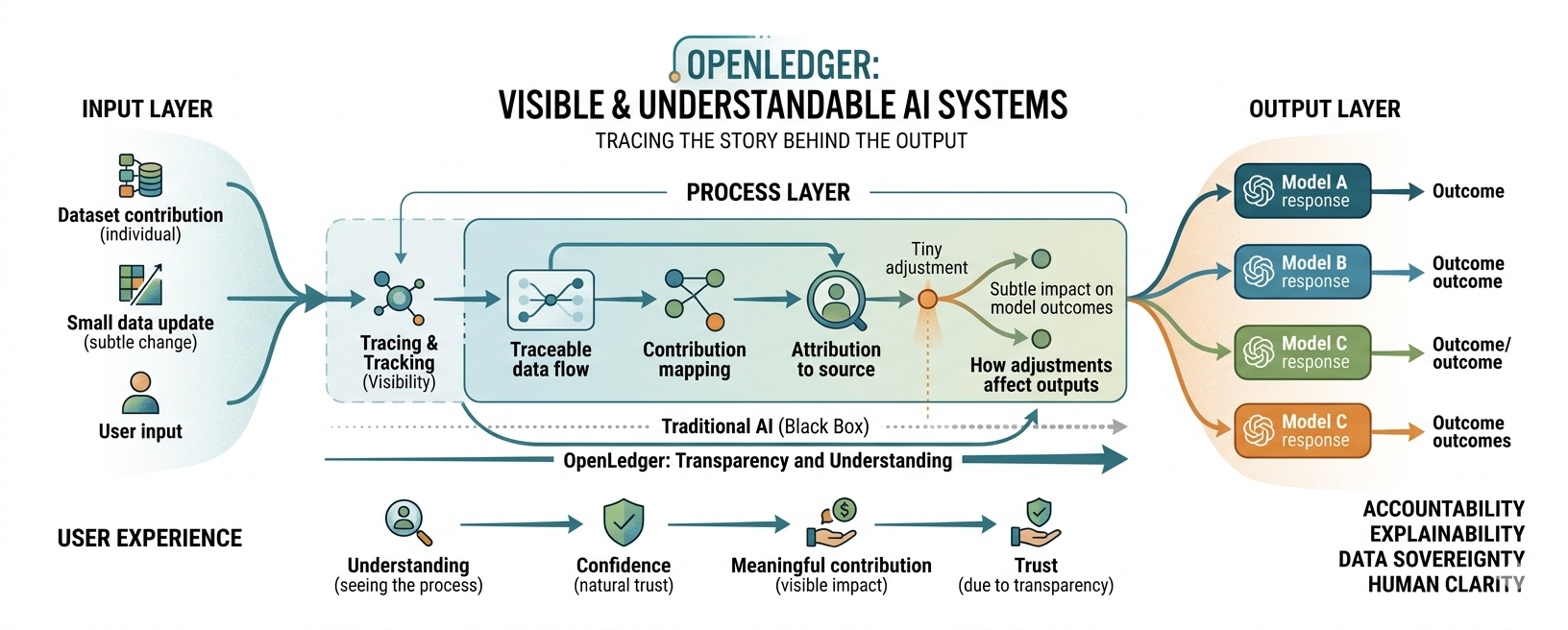

I was spending some time exploring OpenLedger recently when something unexpectedly stayed on my mind long after I logged off. It wasn’t a huge update or some breakthrough headline. Honestly, it was something most people would probably scroll past without noticing.
A tiny change in one dataset ended up slightly affecting responses across multiple AI models. The shift was subtle almost invisible but watching how one small input quietly influenced other outcomes made me stop and think for a while.
What felt different was that I could actually follow the process.
Most AI systems today feel like black boxes. You upload data, receive an answer, and everything happening in between stays hidden somewhere behind layers of code and infrastructure. You’re expected to trust the result without ever really seeing how it came together.
OpenLedger didn’t feel like that.
For the first time in a while, I felt like I wasn’t just looking at AI outputs — I was seeing the story behind them. I could trace where information came from, how contributions connected together, and how even small actions carried weight inside the system.
And honestly, that changed the experience completely.
It made me realize that maybe the future of AI isn’t only about building faster or more powerful models. Maybe it’s also about making systems people can actually understand. Because transparency creates a different kind of confidence. When you can see how decisions are formed, trust stops feeling forced and starts feeling natural.
What I found most interesting was how this also changes the value of contribution. In many platforms, the people behind the data disappear completely. Their effort becomes invisible once it enters the machine. But here, every dataset and every adjustment felt connected to something bigger. Small contributions didn’t feel lost — they felt meaningful.
That kind of visibility matters more than people realize.
Institutions want accountability. Regulators want explainability. Everyday users simply want to know why a system produced a certain result. And while the AI world keeps racing toward bigger benchmarks and louder announcements, OpenLedger quietly seems focused on something more human: clarity.
By the end of it, one thought kept coming back to me.
The real strength of AI might not be how intelligent it becomes, but how understandable it remains. And platforms that choose openness over mystery may end up building the deepest trust of all.