
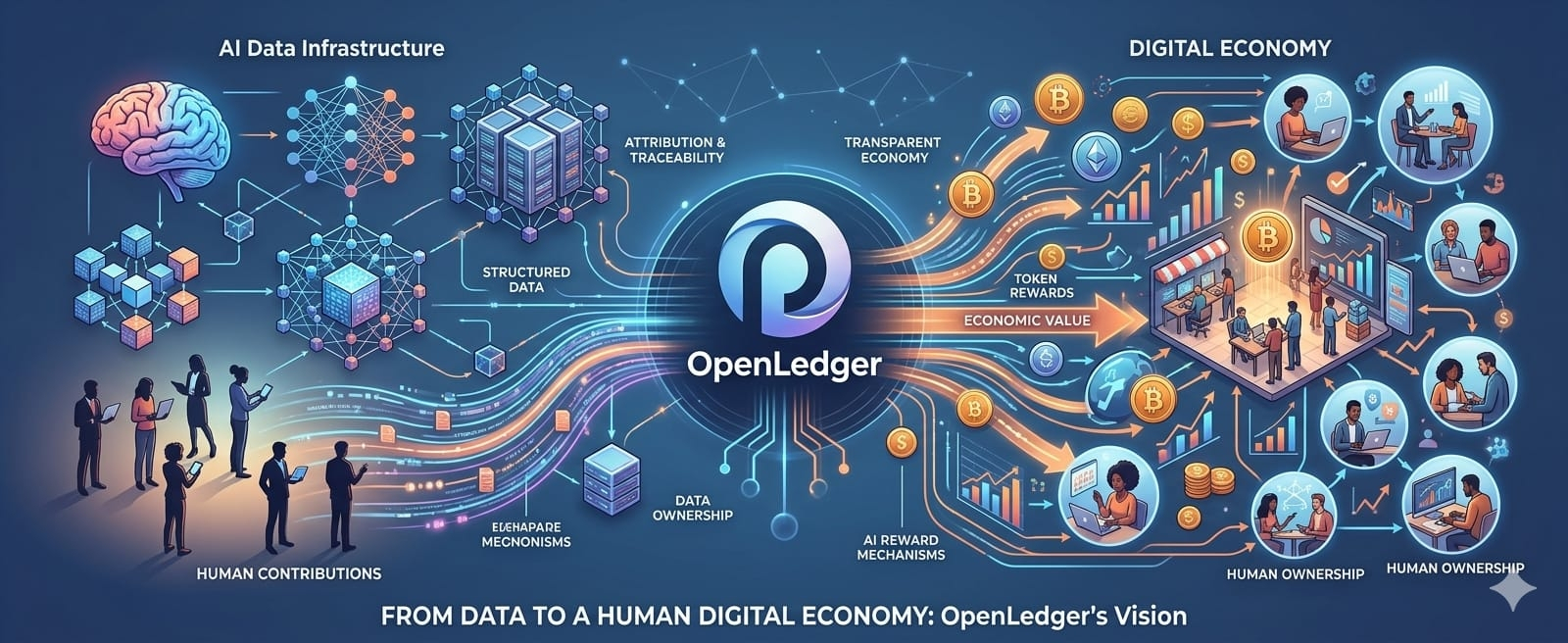
At first, OpenLedger can easily look like another project trying to mix AI and blockchain because that narrative is everywhere right now. Every few days, a new crypto project suddenly starts calling itself AI infrastructure, and honestly, most of them begin to feel the same after a while. Big words, futuristic promises, token utility, and very little depth underneath. I also had that first impression when I started looking at OpenLedger. But the more I looked into it, the more I felt that the real story was not just about AI hype. It was about something much quieter, but possibly far more important: data.
AI does not exist without data. Every model, every agent, every assistant, every automated system depends on information created by people, businesses, communities, and digital behavior. Conversations, images, preferences, feedback, knowledge, niche expertise, market patterns, user activity, and countless other signals are constantly being absorbed by AI systems. But the uncomfortable part is that once this data enters the machine, the original contributors usually disappear from the value chain. The system learns from them, companies monetize the output, and the people or networks that helped create that intelligence rarely get recognized in any meaningful way. Value moves upward, control becomes centralized, and ownership quietly fades into the background.
That structure made sense in the Web2 era because most users were not thinking deeply about data ownership. People traded information for convenience without asking too many questions. But AI changes the weight of that exchange. When data is no longer just used for ads or recommendations, but becomes the foundation of intelligent systems that can generate commercial value, the question becomes much bigger. Who actually owns the value created from human-generated data? Who should be credited when a model improves because of a specific contribution? Who earns when that intelligence becomes useful, profitable, or widely adopted? These questions are no longer abstract. They are becoming part of the serious conversation around AI transparency, attribution, licensing, and digital rights.
This is where OpenLedger starts to feel different from many AI crypto projects. Instead of treating data like a hidden backend resource, it seems to treat data as the foundation of an open digital economy. The idea is not only that data should move through a system, but that useful contribution should be recognized, tracked, and connected to economic value. If someone provides valuable data, improves a model, supports inference activity, or contributes to a specialized AI network, that contribution should not simply disappear into a black box. The system should be able to identify it and create a clearer path between contribution and reward.
That sounds simple when written in one sentence, but in reality it is extremely difficult. AI attribution is one of the hardest problems in the entire space. Models are trained from many sources. Data gets mixed, transformed, reused, and layered into outputs that are not always easy to trace. Thousands of contributors may influence one system in different ways. Some data may be more valuable than others. Some contributions may improve accuracy, while others may create noise. Measuring all of that fairly is not easy. This is exactly where blockchain begins to make more practical sense, not as a marketing label, but as a coordination and traceability layer.
The important point is that OpenLedger is not just saying “AI on-chain” because it sounds exciting. The stronger idea is that AI economies may need transparent rails for contribution, ownership, verification, and incentive distribution. If AI becomes more fragmented across different sectors, then specialized data networks could become extremely valuable. Healthcare does not need the same type of intelligence as gaming. Finance does not need the same data patterns as education. Enterprise automation does not rely on the same signals as consumer assistants. The future may not belong only to giant general-purpose models. It may also belong to specialized AI systems powered by high-quality, domain-specific data.
That is why OpenLedger’s focus on data networks feels interesting. It is not only about building models. It is about building the economic environment around models. Who provides the data? Who validates it? Who uses it? Who benefits when it creates value? That is a deeper infrastructure question, and these are the kinds of questions that usually look boring before they become obvious. Applications get the attention because people can see them immediately. Chatbots, agents, image tools, assistants, and automation products are easy to understand. Infrastructure is quieter. It works beneath the surface. But history shows that the quiet layers often become the most important ones later. Cloud infrastructure was not always exciting. Payment rails were not always exciting. Internet protocols were not always exciting. But eventually, entire economies started depending on them.
I think OpenLedger is trying to position itself in that deeper layer. Not necessarily as the face of AI, but as part of the system that could help AI data become more transparent, measurable, and economically connected. That does not mean success is guaranteed. The risks are real. Building AI infrastructure is extremely difficult. Attribution can be messy. Quality control is hard. Spam, manipulation, fake contributions, and low-value data can damage the system if they are not handled properly. And beyond the technology, adoption is the real test. Developers and enterprises will not use decentralized infrastructure just because it sounds philosophically attractive. They care about speed, reliability, compliance, scalability, integration, and actual business value.
So OpenLedger still has a lot to prove. But the direction itself makes sense to me. The internet already showed us what happens when users create massive value while platforms capture most of the ownership. AI could repeat that same pattern at a much larger scale if nothing changes. OpenLedger seems to be betting that the next stage of AI will need something more open, more traceable, and more participatory. Maybe the project succeeds fully. Maybe it evolves into something different. Maybe the market takes longer to understand the need. But at least it is pointing toward a real structural problem, not just attaching AI to a token and hoping the trend does the rest.
And that is why OpenLedger keeps my attention. It is not only about AI data. It is about whether human contribution can become part of a visible digital economy instead of being swallowed silently by centralized intelligence systems. If AI is going to keep learning from people, then sooner or later the market may demand a better answer to one simple question: who actually gets paid when intelligence is built from everyone’s data?