

Nobody handed data creators a seat at the table. They just kept producing — writing, annotating, building — while the real money flowed somewhere else entirely. That's not a conspiracy. That's just how the system was designed. And for a long time, there wasn't really an alternative worth talking about.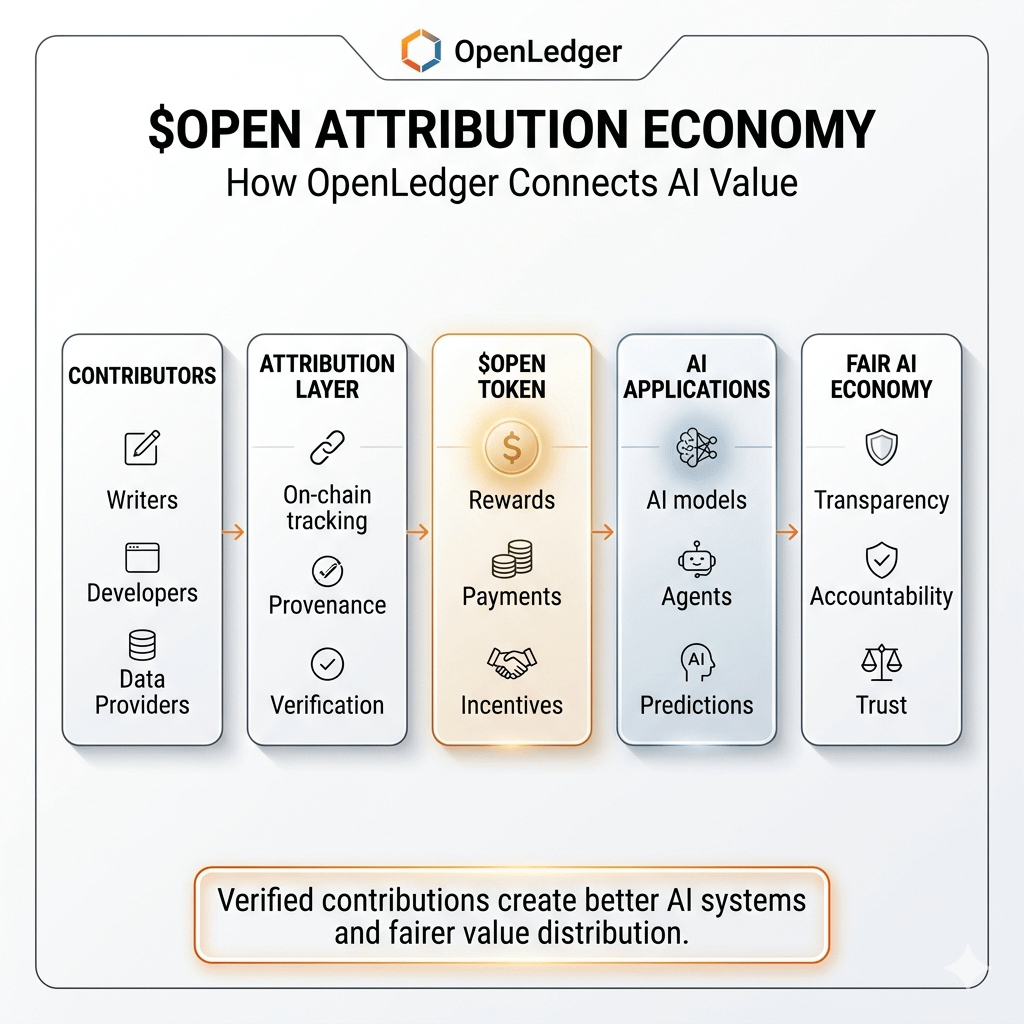
Then OpenLedger came along.
Not with a whitepaper full of promises nobody intends to keep. With actual infrastructure. A working model for how data contributors can participate in the AI economy without getting quietly exploited in the process. The 0token sits at the center of this — not as a speculative vehicle, but as a functional mechanism for value distribution across the Open network.
Here's something I think gets missed in most coverage of OpenLedger. People look at it and immediately think "oh, another data marketplace." And they move on. That framing is wrong and it costs people a genuine understanding of what's being built.
OpenLedger isn't a marketplace in the traditional sense. It's a protocol layer. The difference matters enormously. A marketplace connects buyers and sellers and takes a cut. A protocol layer sets the rules for how value flows across an entire ecosystem — permanently, transparently, without a central authority deciding whmisn't just a payment token inside OpenLedger. It's the economic logic of the network itself.
When a contributor submits data to the Open ecosystem, they're not just listing a product for sale. They're entering an attribution system that tracks, verifies, and compensates that contribution on-chain. The token is how that compensation materializes. That's a fundamentally different relationship between contributor and platform than anything that existed before OpenLedger.
Let me be direct about something. The AI training data industry right now is messy. Really messy. Big labs are getting sued. Regulatory bodies are asking hard questions. Creators are angry. And the old defense — "it was publicly available" — is crumbling in courts and legislatures simultaneously.
OpenLedger doesn't need that chaos to succeed. But that chaos does create a window. A genuine opening for a consent-based, attribution-first alternative to become the standard rather than the exception. The Open network is designed precisely for this moment. Projects that are already operating with proper data provenance when regulators finally land on firm rules will have an enormous advantage over those scrambling to retrofit compliance after the fact.
That's not hype. That's just reading the room correctly.
What I find personally compelling about $OPEN specifically — not just OpenLedger as a concept — is that the token utility isn't manufactured. A lot of projects design a token first and then reverse-engineer reasons for it to exist. With Open, the token utility emerges naturally from the protocol's actual function. Contributors earn it. Developers spend it to access verified datasets. The network uses it to align incentives between both sides. That's a clean economic loop. Simple, but not simplistic.
And simple economic loops, when they actually work, are incredibly durable.
There's also a community angle to OpenLedger that doesn't get enough attention. The Open ecosystem grows in direct proportion to how many contributors trust it enough to participate. That means the project has a genuine incentive to treat its contributors well — not just in marketing language, but in actual protocol design. The $OPEN reward mechanism isn't charity. It's what makes the whole thing function. Contributors who feel fairly compensated bring better data. Better data attracts more developers. More developers create more demand for $OPEN. The loop tightens.
This is what a well-designed token economy looks like when it's oriented around a real problem instead of speculation.
OpenLedger is early. I want to be clear about that — this is not a finished product in a finished market. The data contributor economy is still forming. The norms, the regulations, the dominant platforms — none of it is settled. But that's also exactly the right time to be building foundational infrastructure. The projects that get there first with solid architecture tend to define the spaceand the Open network are positioning for exactly that role. Whether they fully capture it depends on execution. But the blueprint is sound. And in a space full of noise, a sound blueprint is worth a lot.
