
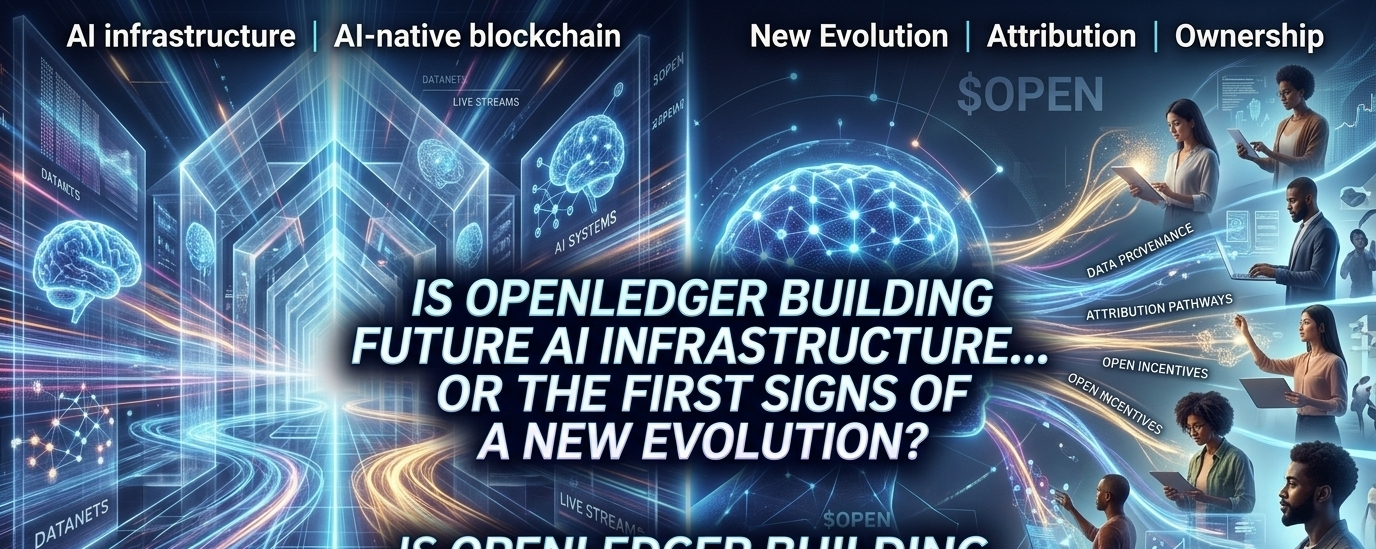
@OpenLedger There are some ideas that seem easy to understand at first, but the more time you spend thinking about them, the more complicated they become. Lately I have had that feeling with the phrase “AI-native blockchain.” It sounds futuristic immediately. It sounds like one of those terms built to grab attention. But after hearing it repeatedly, I kept asking myself a simple question: what does it actually mean? Is this truly a different direction for technology, or are we watching familiar concepts return with a more modern identity? In technology, this happens often. New language appears, excitement builds, and suddenly old systems begin wearing new names. That thought stayed in my mind when I started looking deeper into @OpenLedger, because from a distance it looks like another blockchain network, but the more I explored the idea behind it, the more it felt like something attempting to change the structure itself rather than simply adding another layer on top.
The thing that caught my attention was how AI is positioned inside the system. Usually AI feels like a feature. Something external. Something added later. Input goes in, output comes out, and the process in the middle remains hidden. Here, the explanation feels different. AI is being described as part of the foundation rather than a tool sitting on the side. The Formula 1 comparison initially sounded dramatic to me, almost like one of those exaggerated examples projects use to make themselves sound bigger. But after thinking about it for a while, I started understanding why they use it. During a race, a team is not simply driving around a track. Every second conditions shift. Tire performance changes, weather changes, track grip changes, competitors react, and strategies constantly evolve. Teams survive by processing information continuously and making adjustments without stopping. The race is not static. It is alive. And OpenLedger seems to imagine AI operating through a similar kind of environment.
The more I thought about it, the more interesting the concept became. Their system appears to revolve around live data streams and Datanets functioning almost like continuous awareness. The system never really pauses. It keeps observing, reading signals, processing information and adapting to movement around it. That idea feels powerful, but also a little unsettling. Because if AI begins operating through endless streams of real-time information, another question appears immediately. Does more data naturally create smarter decisions, or does more information also create more confusion? Human beings already struggle with information overload. We know that having access to everything does not automatically create understanding. Sometimes more signals simply create more noise. And that is where the challenge becomes fascinating. Real-time intelligence sounds incredible in theory, but reacting too fast can also create mistakes. A system that adapts every second may become incredibly responsive, but it could also become vulnerable to overreaction. The balance between awareness and stability feels much harder than people admit.
Still, there is something compelling about moving away from static systems. Traditional AI often feels fixed. You ask a question and receive an answer. The interaction ends there. But the idea here appears larger than that. It imagines AI almost like a living process, constantly recalculating and reevaluating itself as new information enters the environment. Instead of a machine that waits to be asked something, it becomes something continuously evolving. Whether that works perfectly is another question entirely, but the shift in thinking itself feels important.
Then there is another layer that probably interests me even more: attribution. This is where @OpenLedger seems to move onto a different path. In most conversations around AI, attention goes toward outputs. Better models. Better responses. Better performance. But very few people stop and ask where the actual value begins. AI learns from data, and data comes from somewhere. It comes from people, actions, behavior, contribution, and participation. OpenLedger appears to suggest that if data creates value, then the path of that value should not disappear. It should be visible. It should be traceable. And contributors should receive recognition through the network economy and $OPEN incentives.
That idea immediately creates bigger questions because it touches one of the most uncomfortable discussions inside AI and Web3. If data becomes fuel, then who owns that fuel? Who deserves credit? And perhaps more importantly, can contribution really be measured perfectly? Because not all influence looks the same. Some impact is visible immediately. Some impact exists quietly beneath the surface. Human contribution is messy. Influence is messy. Even if systems become better at tracking activity, I still wonder whether some forms of value will always remain invisible. Maybe not everything meaningful can fit inside a ledger.
That is why I find it difficult to call OpenLedger a complete answer. But it also feels too simple to dismiss it as another trend. To me, it feels more like a direction. A direction where AI, blockchain and data ownership slowly begin blending into something more dynamic. The technology itself may not be the biggest story. The mindset shift might be bigger. For years AI has existed as a black box. People provide input and receive output while everything in between remains hidden from view. What OpenLedger seems to suggest is something different — an environment where intelligence becomes traceable, connected, adaptive and economically linked to the people feeding it.
And maybe that is the thought that keeps staying with me. Not whether the technology works perfectly today, but whether this way of thinking eventually changes how people understand AI itself. Because if real-time intelligence, attribution and ownership truly begin working together, then AI stops feeling like software and starts feeling more like infrastructure. Maybe that future starts here. Or maybe we are only standing at the beginning of an evolution that still has not fully revealed itself. Either way, it feels too early to ignore and too interesting not to watch closely.