OpenLedger and the Problem of Machine-Native Liquidity Coordination
Most blockchain infrastructure was designed around human financial behavior. Transfers settle ownership. Liquidity pools facilitate exchange. Validators secure balances and transaction ordering. Even when throughput scales aggressively, the system architecture still assumes that economic intent originates from people making discrete decisions.
OpenLedger introduces a different assumption that creates a structural tension beneath the surface of the project. If autonomous systems become persistent economic actors rather than passive software tools, then conventional blockchain liquidity models begin to fail at coordination level rather than capacity level.
The important question is not whether AI agents can transact on-chain. That problem is already solved in fragmented forms across existing ecosystems. The deeper issue is whether a blockchain can sustain continuous machine-originated economic interaction without collapsing into latency bottlenecks, fragmented incentives, validator dependency, or extraction-heavy execution environments.
This is where OpenLedger becomes analytically interesting. The project is not attempting to optimize purely for financial settlement. It appears to optimize for machine-native liquidity coordination, where data exchange, model execution, and agent interaction become primary economic activity rather than secondary applications built on top of a general-purpose chain.
That distinction changes how the infrastructure must behave under pressure.
Traditional liquidity systems rely on predictable human pacing. Trading spikes are episodic. Governance participation is slow. Capital allocation reacts with delay. AI-driven infrastructure does not necessarily inherit those rhythms. Autonomous agents can generate persistent transactional demand at machine frequency, especially if the underlying system allows models, datasets, or inference layers to become monetizable primitives.
Under those conditions, execution architecture matters more than headline throughput metrics.
The structural design challenge for OpenLedger is therefore not simply scaling transaction count. It is coordinating economic state transitions generated by systems that may operate continuously, asynchronously, and without behavioral predictability.
This creates a validator topology problem immediately.
In most blockchain systems, validators primarily secure ordering and consensus finality. In an AI-linked environment, validators may indirectly become infrastructure gatekeepers for computational liquidity itself. If economic activity increasingly depends on rapid interaction between agents, datasets, and execution layers, then validator concentration introduces more than censorship risk. It introduces coordination asymmetry.
A small validator cluster with disproportionate influence over ordering, latency optimization, or execution routing could begin shaping the economic visibility of AI activity itself. That is structurally different from simple transaction prioritization in DeFi systems because the informational layer becomes economically productive.
This is the central structural test repeatedly visible throughout OpenLedger’s design direction: whether the network can preserve coordination neutrality once machine-generated economic density begins concentrating around infrastructure advantages.
Projects operating in the AI-blockchain category often emphasize monetization layers conceptually while underestimating the stress introduced by continuous coordination demand. OpenLedger appears more aware of this pressure than many adjacent systems because the infrastructure narrative consistently points toward liquidity abstraction rather than isolated application logic.
That matters.
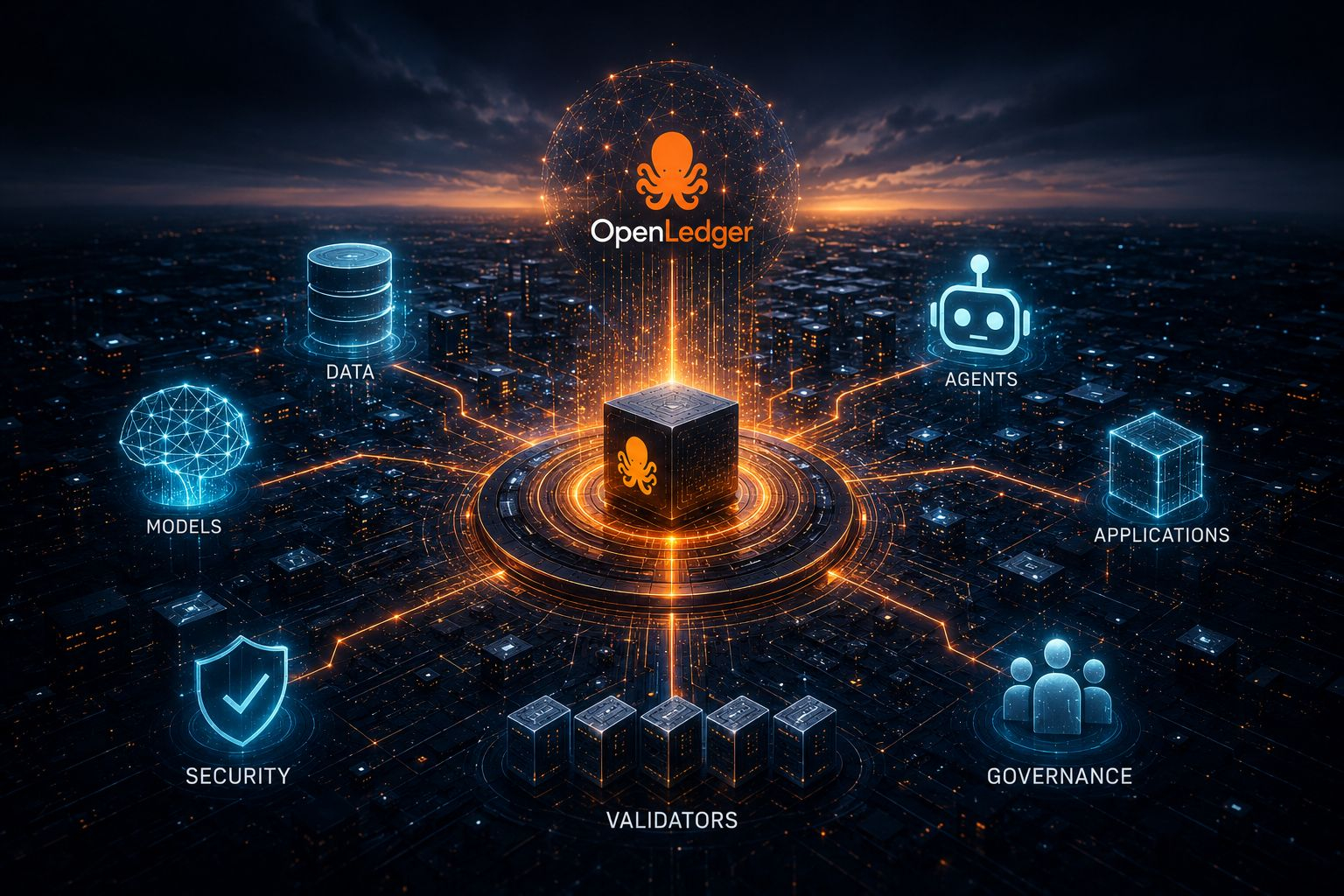
If data, models, and agents become transferable economic objects, then the network must solve for interoperability between heterogeneous execution environments. A model marketplace, for example, behaves differently from a standard token market because execution dependency exists alongside ownership transfer. Liquidity is no longer purely financial. It becomes computational and informational simultaneously.
This introduces unavoidable trade-offs.
A system optimized for high-frequency coordination between AI actors will likely sacrifice certain forms of decentralization efficiency. Faster synchronization often increases dependency on higher-performance validators. Lower execution latency can centralize hardware requirements over time. Networks attempting to support persistent machine-level interaction may gradually drift toward infrastructure specialization whether intentionally or not.
OpenLedger’s long-term resilience will depend on how transparently it manages this trade-off rather than whether it claims to eliminate it.
Another important dimension is execution determinism.
AI-linked systems naturally introduce probabilistic behavior at application layer. Blockchain systems, meanwhile, require deterministic settlement guarantees. The tension between those environments is usually ignored in superficial discussions around AI infrastructure.
OpenLedger implicitly attempts to separate economic coordination from probabilistic computation itself. That architectural separation is rational because deterministic consensus cannot efficiently absorb unrestricted probabilistic execution without introducing verification complexity or unacceptable latency expansion.
The consequence is that parts of the intelligence layer inevitably migrate outside strict consensus boundaries while economic settlement remains on-chain.
Again, this creates another version of the same structural test.
Can the network preserve coordination neutrality when economically meaningful computation increasingly occurs beyond direct validator visibility?
This question becomes more important during infrastructure stress conditions.
Consider a scenario where OpenLedger experiences sustained transactional saturation generated not by retail speculation but by competing autonomous systems attempting to secure execution priority simultaneously. Traditional blockchains often experience mempool congestion during human-driven demand spikes because users react slower than infrastructure recalibration.
Machine-originated congestion behaves differently.
Autonomous agents can dynamically escalate bidding behavior in milliseconds. Liquidity routing becomes reflexive. Economic interaction density compounds faster than governance systems can intervene. Under those conditions, validator advantages become magnified and execution fairness deteriorates quickly unless the architecture was explicitly designed for machine-coordination pressure.
This is where many theoretical AI-blockchain systems would likely fragment operationally.
OpenLedger’s survivability under that environment depends less on peak throughput numbers and more on whether coordination costs remain stable as execution complexity rises. If coordination costs become unstable, agent activity concentrates around dominant liquidity corridors, gradually reducing system neutrality.
The project also faces governance stress asymmetry.
Infrastructure projects tied to AI narratives often attract rapid ecosystem expansion before governance maturity stabilizes. That creates a dangerous imbalance where economic importance grows faster than institutional resilience. If OpenLedger evolves into a meaningful coordination layer for machine-driven interaction, governance disputes would no longer resemble ordinary protocol disagreements. They would directly influence economic routing behavior across dependent systems.
This elevates governance from political process into infrastructure risk surface.

A fragmented governance environment during periods of high machine-level activity could destabilize settlement assumptions across interconnected applications. In practical terms, uncertainty around validator incentives or execution rules may become more damaging than temporary throughput reduction.
This again returns to the same analytical pattern: coordination neutrality under pressure.
The strongest infrastructure systems are rarely the ones optimizing for maximum flexibility. They are usually the systems that remain behaviorally stable when assumptions fail simultaneously.
OpenLedger appears to understand that its future relevance depends less on becoming another generalized blockchain and more on becoming reliable coordination infrastructure for machine-originated economic activity. That is a narrower but more structurally coherent objective.
The limitation is that such systems often become increasingly dependent on invisible operational discipline rather than visible ecosystem growth. Validator composition, execution fairness, latency distribution, and governance restraint matter more than narrative velocity.
Most market participants will focus on AI branding, ecosystem announcements, or transactional metrics because those are easier to observe. The more important variables are buried deeper inside infrastructure behavior during periods of stress.
That is where the real evaluation of OpenLedger eventually occurs.
Not in whether the network attracts temporary attention, but in whether coordination neutrality survives once machine-level economic interaction becomes dense enough to pressure the architecture continuously.
If that threshold is never reached, the system remains conceptually ambitious but operationally unproven.
If it is reached, then the design trade-offs embedded into the network today will become impossible to hide.