
Lately I’ve noticed I trust market reactions less and wallet behavior more. That probably says something about where crypto is heading. Prices still move narratives, but conviction feels different now. Sometimes a quiet liquidity rotation tells you more than ten bullish threads combined. A governance vote with low attention suddenly matters weeks later. A small cluster of wallets starts positioning before the timeline even understands the narrative. The strange part is that most trading systems still process these events like isolated signals instead of connected behavior. That disconnect kept bothering me while I was reading through @OpenLedger because the protocol seems built around solving exactly that problem.
At first I thought #OpenLedger web just another AI agent narrative trying to ride the cycle. Crypto has become saturated with those. Every week there’s a new protocol promising autonomous traders, predictive intelligence, or infinite automation. Most of them feel interchangeable after ten minutes. Same language, same dashboards, same vague promises about “AI-powered alpha.” But OpenLedger felt different the deeper I looked into it. The protocol doesn’t seem obsessed with replacing traders. It seems more interested in tracing how intelligence itself is created, trained, verified, and rewarded on chain. That distinction sounds small initially, but honestly it changes the entire framework.
What caught my attention most was the Datanet structure. Markets generate enormous amounts of fragmented information every second, liquidity flows, governance participation, social sentiment, cross chain activity, developer behavior, derivatives positioning. Most AI systems dump everything into one opaque model and hope correlations appear. OpenLedger approaches it differently. Datanets allow specialized datasets to remain modular and attributable instead of disappearing into a black box. Then OpenLoRA infrastructure lets those models evolve collaboratively without losing ownership trails. The more I thought about it, the more it resembled how actual traders think in practice. Nobody interprets markets through one universal lens anymore.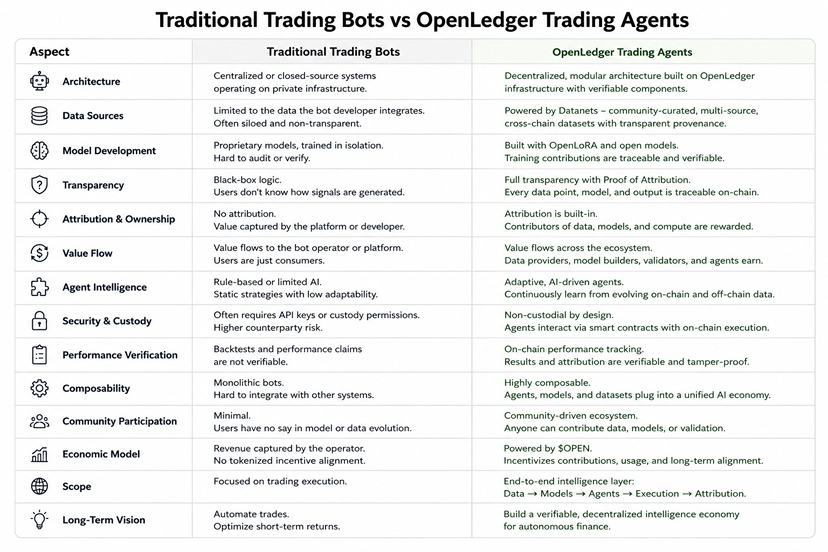
I think that’s why the idea of trading agents suddenly started making more sense to me here. OpenLedger agents aren’t positioned like magical bots predicting candles perfectly. They feel closer to autonomous intelligence layers that continuously absorb, refine, and price information directly on chain. And because of Proof of Attribution, the outputs can theoretically remain economically traceable back to the datasets and contributors that shaped them. That part matters more than people realize. AI without attribution eventually becomes extractive. Models consume data endlessly while contributors disappear economically. OpenLedger is basically trying to solve that imbalance before autonomous systems scale further.
The interesting thing is that the protocol already shows signs of economic activity forming underneath the narrative. Recent OpenLedger metrics showed annualized protocol revenue approaching roughly $580K, while monthly fees remained near the mid five figure range. $OPEN market capitalization has recently fluctuated around $50M, with daily trading volume often moving above $10M during stronger activity periods. Those numbers are still tiny compared to larger infrastructure protocols, but honestly early infrastructure almost always looks underwhelming before applications mature. Most people only notice systems after speculation arrives, not while foundations are quietly forming.
What I keep returning to though is the trust problem around AI generated intelligence. The market already feels flooded with synthetic analysis pretending to be genuine insight. Automated sentiment accounts. Recycled research threads. Engagement farming disguised as market conviction. And it’s only getting harder to tell which information originates organically anymore. That’s why OpenLedger’s focus on attribution feels more important than the agents themselves. The protocol seems to understand that decentralized AI eventually fails if intelligence cannot remain economically and transparently verifiable. In a weird way, it reminds me of why blockchains mattered originally. Transparency became valuable because trust was deteriorating.
At the same time, I still have doubts. Markets are irrational in ways models struggle to understand. Narratives move emotionally before they move fundamentally. Liquidity disappears suddenly. Incentives distort behavior constantly. Even strong agents can become trapped optimizing for conditions that no longer exist. I actually think skepticism matters here because too many AI projects speak with artificial certainty. OpenLedger at least feels architected around adaptation instead of prediction perfection. Continuous Datanet contribution, modular models, attribution incentives, the system seems designed for evolving intelligence rather than static accuracy.
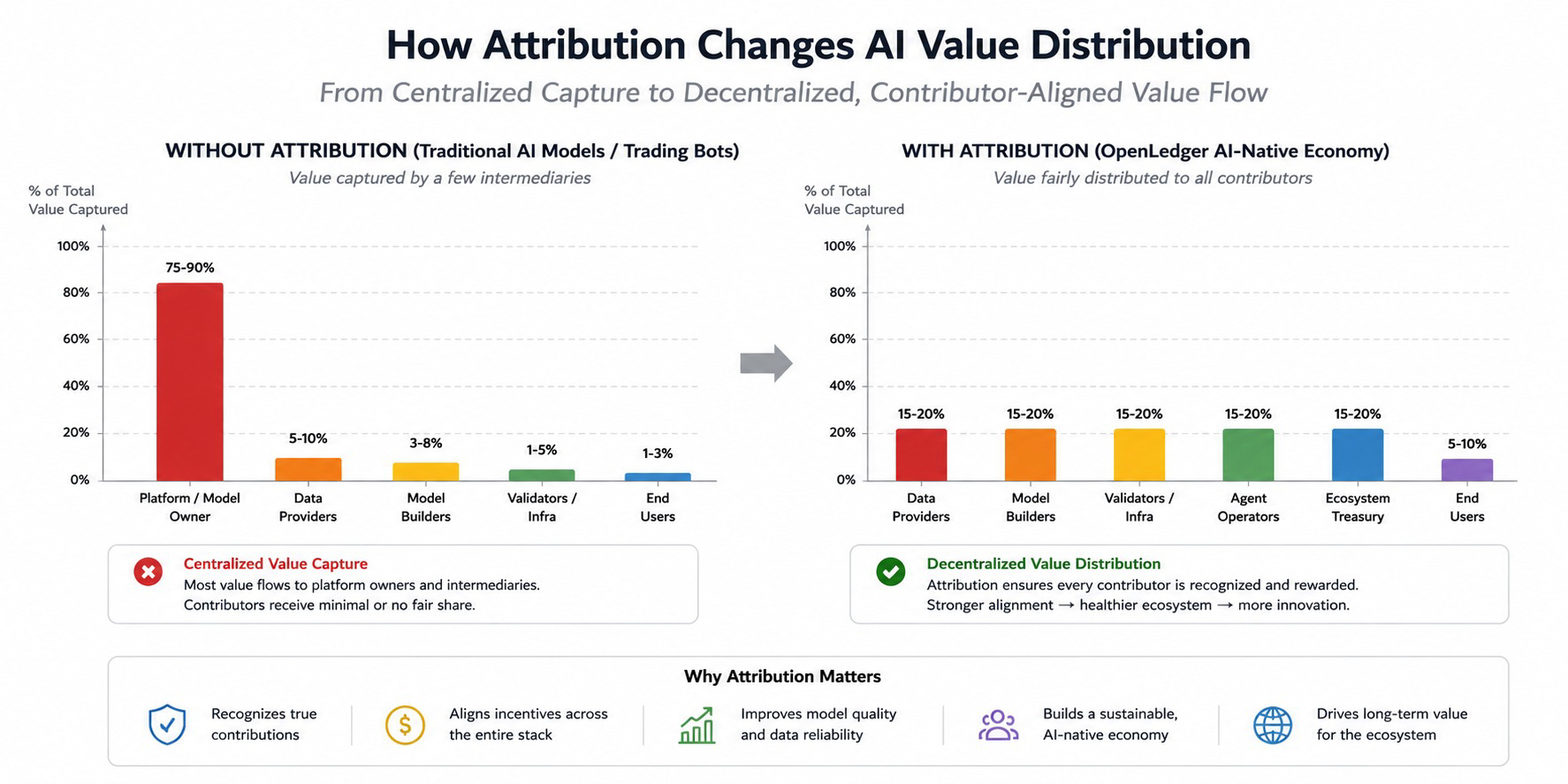
Another thing that stands out is how the protocol treats intelligence economically. Most AI projects still operate like platforms where users consume outputs passively. OpenLedger feels more like an intelligence marketplace where datasets, models, inference providers, validators, and applications continuously exchange value. Trading agents are simply one participant inside that economy. That changes the psychology completely. Instead of intelligence existing behind closed infrastructure, it becomes composable and economically visible on-chain. The whitepaper describes this as building an AI-native economic layer, and honestly that framing feels increasingly important the more autonomous systems enter finance.
Maybe that’s the real reason the OpenLedger thesis stays in my head longer than most AI narratives. Not because I think autonomous trading suddenly removes uncertainty from markets. Nothing removes uncertainty from markets. But because OpenLedger is asking a deeper question underneath the speculation cycle. If AI agents eventually become responsible for interpreting markets, allocating capital, and shaping financial behavior, who owns the intelligence they generate? Who gets rewarded when an agent produces value? And can decentralized systems prove that process transparently instead of hiding it behind black-box infrastructure?
I don’t know yet whether OpenLedger becomes the dominant protocol for autonomous finance. Crypto moves too unpredictably for that kind of certainty. But I do think the project understands something many AI narratives still miss. The future value of AI probably won’t come from intelligence alone. It’ll come from whether intelligence can remain attributable, composable, and economically accountable as it scales across decentralized systems. And if that’s true, then OpenLedger trading agents might matter less as bots and more as the first visible layer of a much larger on chain intelligence economy forming underneath the market.