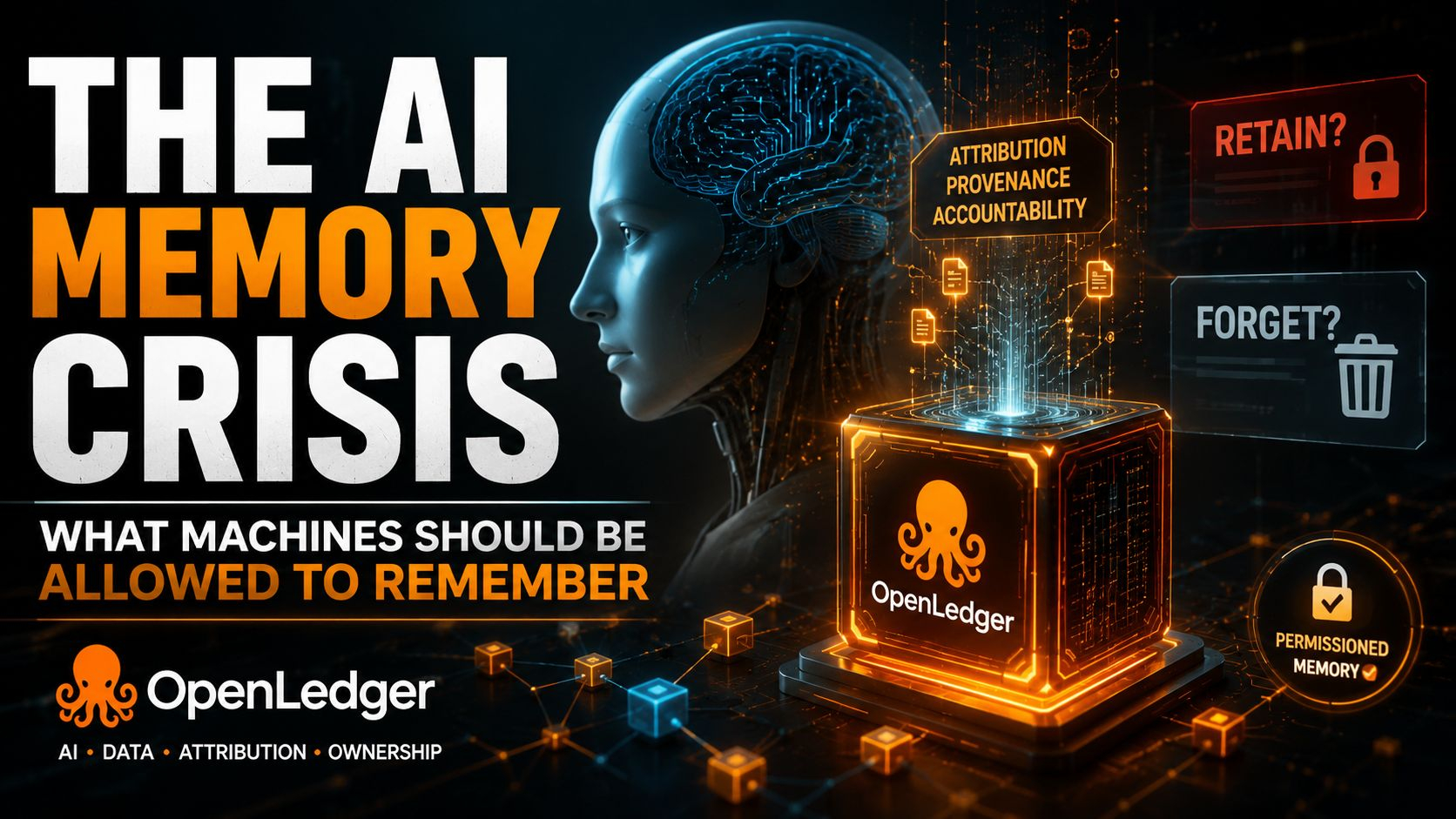
I keep coming back to one uncomfortable thought about AI that the market still does not seem ready to confront.
Everyone is obsessed with what AI systems can learn.
Almost nobody is seriously talking about what those systems should be allowed to remember.
That difference matters more than people think.
For years, the tech industry trained itself to believe that collecting more data was automatically good business. Social platforms stored behavior because maybe it would become useful later. Financial apps kept years of records because retention was cheap. AI companies absorbed massive datasets because more context usually meant better outputs.
The entire system rewarded accumulation.
And honestly, that logic worked for a long time.
But I think we are entering a very different phase now.
Because once intelligence starts making decisions, memory stops being passive storage. It becomes operational influence. It becomes legal exposure. It becomes economic power.
That is partly why OpenLedger caught my attention, though probably not for the same reason most people discuss it.
Most conversations around OpenLedger stay very surface-level. People describe it as decentralized AI infrastructure where contributors provide useful data, builders consume it, models improve, and $OPEN coordinates incentives.
Clean narrative. Easy to market.
But the deeper implication feels far more important to me.
I do not think the real infrastructure battle in AI will only be about helping machines learn faster.
I think it may become about helping machines forget responsibly.
That sounds abstract at first, but the moment you look at how modern AI systems actually work, the problem becomes very real.
People outside technical circles still imagine deletion like removing a file from cloud storage. Press delete, problem solved.
AI does not work that way anymore.
Information spreads across training processes, embeddings, retrieval systems, behavioral tuning, agent memory layers, and probabilistic associations. Once intelligence absorbs something, separating it back out becomes extremely messy.
That is why the entire field of machine unlearning even exists.
And honestly, machine unlearning has always felt strange to me because it quietly admits something the industry rarely says out loud:
Teaching machines is easier than making them forget precisely.
That becomes a serious issue once AI moves beyond entertainment and productivity tools into environments where mistakes carry real consequences.
Think about healthcare systems. Financial advisory platforms. Enterprise compliance workflows. Autonomous agents handling transactions or negotiations.
In those environments, memory becomes dangerous very quickly.
Useful memory and problematic memory often look exactly the same until something goes wrong.
That is where OpenLedger starts becoming structurally interesting.
Because attribution systems change the economics of memory itself.
Today, AI systems retain information because retention is treated as free value. More context improves personalization. More history improves continuity. More data improves predictions.
But once contributors become identifiable and provenance becomes persistent, retained memory stops being free infrastructure.
It starts carrying accountability.
And once accountability enters the equation, forgetting becomes economically rational.
That is the part I think the market is underestimating.
Imagine an enterprise AI assistant trained partly on proprietary customer interactions. At first, that historical intelligence improves performance. The system becomes smarter, more personalized, more useful.
But six months later, regulations shift. A customer changes permissions. A compliance team identifies legal risk. A jurisdiction introduces stricter AI governance rules.
Now the problem is no longer “can we delete the data?”
The real problem becomes much uglier:
Should intelligence shaped by that data still be allowed to operate?
That is not just a technical question anymore. It becomes a governance question. An economic question. Eventually even a political question.
And this is where I think AI is walking toward the same contradiction crypto already experienced years ago.
Crypto once treated permanence like a universal virtue. Immutable ledgers sounded revolutionary until privacy collided with permanence. Suddenly, permanent records did not feel so elegant anymore.
AI may be approaching its own version of that collision.
Right now the market still rewards maximum retention because capability growth remains the obsession. Bigger context windows. Smarter agents. Longer memory.
But responsibility may become scarcer than intelligence itself.
That changes what infrastructure matters.
OpenLedger may absolutely remain what most people currently think it is: an AI contribution network with attribution rails and tokenized incentives.
But the more interesting possibility is much bigger.
It could become part of the infrastructure layer that forces AI systems to justify not only what they know, but why they are still allowed to know it.
That future is complicated.
Because once memory becomes economically traceable, every stakeholder starts fighting for authority over it.
Who controls forgetting? The contributor? The enterprise? The application layer? The regulator? The model operator?
Those groups will not agree, especially when financial incentives become attached to retained intelligence.
And that creates another uncomfortable reality the market still avoids:
Intelligence is becoming cheaper. Responsibility is not.
Anyone can build smarter systems now. Far fewer companies can build systems that negotiate attribution, permissions, compliance, liability, and economic rights around machine memory at scale.
That is a much harder problem.
Which is exactly why I think OpenLedger deserves attention beyond the usual AI crypto narrative.
Not because the outcome is guaranteed. Not because the token automatically succeeds. And definitely not because attribution alone magically solves AI governance.
But because the project sits close to a pressure point the industry is slowly being forced to confront.
The next phase of AI may not be defined by what systems can learn.
It may be defined by what they are permitted to keep.