The more I watch the AI sector evolve, the more I feel like most people are still only seeing the surface of what’s happening.
Right now, AI feels exciting because of the products people interact with every day. Chatbots. AI image generators. Trading assistants. Coding copilots. Automated tools everywhere. It all feels futuristic already.
But underneath all of that, something much bigger is starting to form.
A completely new digital economy is slowly being built around data, models, computation, and autonomous agents.
And honestly, I think most people still underestimate how massive that shift could become over the next few years.
That’s partly why OpenLedger caught my attention.
At first, I thought it was just another AI-related crypto project trying to fit into the current market narrative. Let’s be honest, the AI sector inside crypto is crowded now. Every week there’s another project talking about agents, automation, decentralized intelligence, or machine economies.
After a while, most of it starts sounding the same.
But OpenLedger feels a little different because the idea behind it goes deeper than simply building “AI tools.”
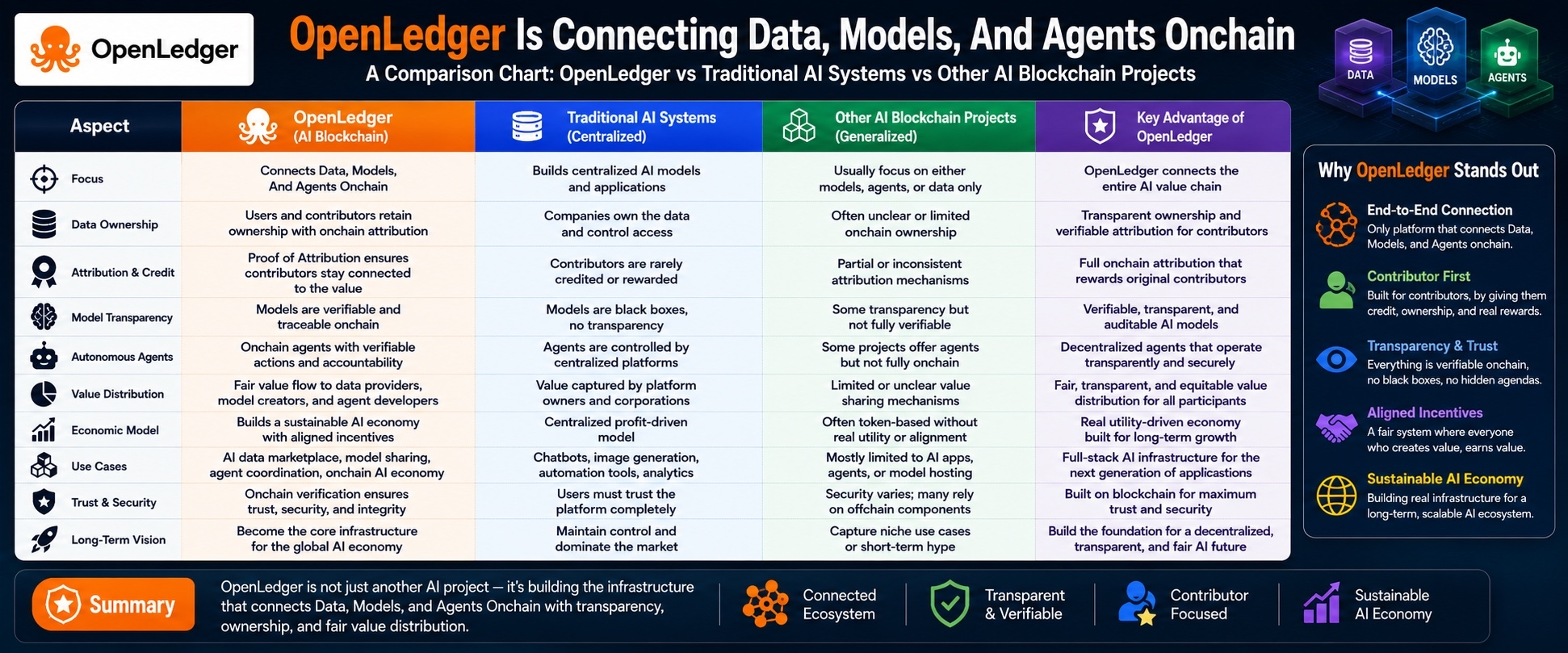
The project seems more focused on building the actual infrastructure layer that could connect data, AI models, and autonomous agents into one transparent economic system.
And that part matters a lot more than people realize.
Right now the AI world is fragmented everywhere.
The data usually comes from one place.
The models are owned somewhere else.
The applications get built by different teams.
Users generate value constantly without realizing it.
And most contributors never really stay connected to the upside once systems scale.
That’s one of the strangest things about the current AI economy.
Millions of people contribute to it every day through content, conversations, research, code, behavior, feedback loops, and interactions… but the value mostly concentrates around whoever controls the model layer.
The contributors slowly disappear into the background.
That model probably becomes difficult to sustain long term.
And I think OpenLedger understands that early.
What makes the project interesting to me is that it doesn’t only ask:
“How do we build stronger AI?”
It also asks:
“How do we build fairer AI?”
“How do contributors stay connected to value creation?”
“How do agents, models, and datasets interact transparently instead of operating like black boxes?”
That changes the conversation completely.
One thing that really stands out is the idea of Proof of Attribution.
Most AI systems today absorb enormous amounts of information during training, but once the model is built, almost nobody can track where value originally came from anymore.
The system becomes opaque.
OpenLedger seems to be pushing toward a structure where contributions remain traceable and economically connected instead of disappearing forever inside centralized infrastructure.
That’s actually a pretty important idea if you think about where AI is heading.
Because AI is no longer just becoming a software sector.
It’s becoming infrastructure itself.
And infrastructure becomes incredibly powerful once entire industries start depending on it.
The internet runs on invisible layers most users never think about.
Cloud systems.
Payment rails.
Data centers.
APIs.
Server infrastructure.
AI may eventually develop the same way.
Most people will only interact with the applications on the surface while enormous coordination systems operate underneath everything.
That’s where OpenLedger seems positioned.
Not only as another AI application, but potentially as a coordination layer between datasets, models, and intelligent agents operating onchain.
And honestly, the timing makes sense.
The AI industry is moving unbelievably fast right now.
Companies are racing to build larger models.
Governments are discussing regulation.
Startups are building AI agents daily.
Capital keeps flowing into compute infrastructure.
And entire industries are starting to rethink how automation changes productivity.
But there’s still a huge unresolved issue underneath all this growth.
Trust.
Where does the data come from?
Who owns the outputs?
How are contributors rewarded?
Can models be verified?
Can agents operate transparently?
Can AI-generated value be distributed fairly?
Most systems today still don’t have great answers for those questions.
That’s why the blockchain side of OpenLedger actually feels logical instead of forced.
A lot of crypto projects try to attach AI narratives onto blockchains without a real reason for using onchain infrastructure.
But attribution, ownership tracking, transparent incentives, and economic coordination are areas where blockchain technology genuinely makes sense.
Especially if autonomous AI agents eventually start handling real economic activity online.
And I think that future is coming faster than people expect.
We’re already seeing AI systems manage trading strategies, analyze markets, automate workflows, summarize research, optimize execution, and coordinate information across platforms.
Over time, agents may evolve into active participants inside digital economies instead of just passive assistants.
Once that happens, verification becomes critical.
Because nobody wants autonomous systems operating inside financial environments with zero transparency.
That’s another reason OpenLedger feels interesting right now.
The project seems less focused on temporary hype and more focused on building rails for how AI economies may actually function later.
And historically, infrastructure layers often look boring before they become extremely valuable.
People ignored cloud infrastructure before the internet economy exploded.
People ignored payment infrastructure before global e-commerce scaled.
People ignored data centers before AI compute demand went vertical.
Infrastructure rarely looks exciting at the beginning.
But once adoption scales, those foundational layers suddenly become some of the most important parts of the entire system.
That’s why I think OpenLedger is worth paying attention to.
Not because it guarantees success.
Nothing in crypto guarantees anything.
The AI sector will become extremely competitive.
Most projects probably won’t survive long term.
Execution matters more than narratives.
But conceptually, OpenLedger feels aligned with the direction AI conversations are naturally moving toward.
The industry is slowly realizing that intelligence alone is not enough.
Ownership matters.
Attribution matters.
Transparency matters.
Coordination matters.
Economic alignment matters.
And the projects thinking about those problems early may eventually become far more important than people currently expect.
For me, that’s the biggest reason OpenLedger stands out.
It doesn’t just feel like another project trying to capitalize on the AI trend.
It feels like a project trying to build the economic structure underneath the next generation of AI itself.