
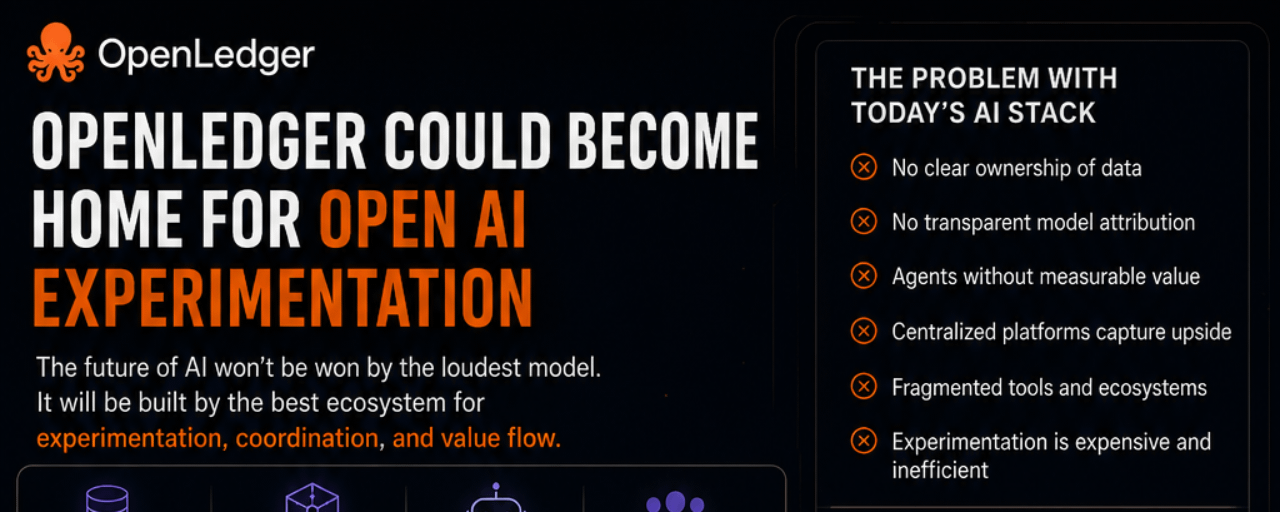
Open AI experimentation sounds exciting until you look at the actual infrastructure behind it.
That is usually where the optimism starts breaking apart.
Most people still imagine AI innovation as a clean process driven by better models and faster outputs. But the deeper AI economy is becoming far more complicated than that. Models depend on data pipelines. Agents depend on models. Contributors depend on incentives. Builders depend on coordination. And almost every valuable layer inside that process is still heavily fragmented or hidden behind closed systems.
This is why I think OpenLedger is aiming at something more important than another AI narrative.
The project is not simply trying to attach blockchain rails to AI.
It seems more focused on building an environment where data, models, and AI agents can operate as visible economic components instead of disappearing into black-box infrastructure.
That distinction matters.
Because the future of AI may depend less on who has the loudest model and more on who creates the most functional coordination layer around experimentation itself.
Right now, experimentation in AI is surprisingly inefficient.
Developers train models without clear ownership structures around the underlying data. Contributors improve systems without meaningful exposure to upside. Small specialized datasets remain trapped inside isolated communities. Agents operate without transparent value attribution. And once value gets generated, most of it flows toward centralized platforms that sit above the ecosystem rather than through the ecosystem itself.
OpenLedger appears to be targeting this exact imbalance.
The interesting part is not just tokenization.
Crypto already tried that shortcut too many times.
The stronger idea is that AI experimentation could become more open, composable, and economically connected if contributors, models, and agents were able to interact through shared infrastructure with visible incentive flows.
That creates a completely different environment for builders.
Instead of treating AI as a closed product stack, OpenLedger seems to frame it more like an evolving economy where datasets, fine-tuned models, and specialized agents become reusable assets participating inside a larger network.
I think this direction becomes more relevant as AI shifts toward specialization.
The market spent years obsessing over giant general-purpose models. But the next stage may look far more fragmented. Industry-specific models. Trading agents. Research agents. Educational systems. Gaming infrastructure. Workflow automation. Niche communities building niche intelligence around niche datasets.
That kind of ecosystem needs more than access to APIs.
It needs coordination.
And coordination is usually where infrastructure becomes valuable.
The reason this catches my attention is because open experimentation only works if participants believe the system rewards contribution fairly enough to keep building.
Otherwise the entire ecosystem collapses back into extraction.
This is where OpenLedger’s structure starts making more sense.
If datasets can be tracked, if models can carry visible attribution, if agents can generate measurable onchain activity, then experimentation stops being purely theoretical. It becomes economic. Builders gain reasons to contribute because value no longer disappears completely behind centralized layers.
That does not make the challenge easy.
Actually, it probably makes things much harder.
Attribution in AI is messy by default. Measuring the value of a dataset is difficult. Measuring the influence of model improvements is even harder. Agent coordination introduces another layer of complexity entirely. Every additional incentive mechanism creates new edge cases and new risks around manipulation or low-quality participation.
Infrastructure for open AI economies cannot survive on elegant diagrams alone.
It needs real usage.
That is the part I am watching most closely with OpenLedger.
Not marketing.
Not AI hype.
Not temporary narrative rotation.
Usage.
Because infrastructure only matters once builders decide it reduces friction enough to become useful.
And honestly, that is where many crypto AI projects fail. They describe the future well but never create systems developers genuinely want to build inside.
OpenLedger still needs to prove that adoption layer.
But I do think the timing is interesting.
AI agents are becoming more autonomous. Models are becoming more modular. Data itself is becoming more valuable. At the same time, developers are increasingly questioning whether closed ecosystems are sustainable long term for innovation.
That creates space for alternative infrastructure models.
Open experimentation becomes far more powerful when participants are not only consuming intelligence but also owning pieces of the value chain behind it.
This is why I do not see OpenLedger primarily as an AI token.
I see it more as an attempt to build economic rails for open AI coordination before the next wave of agent-driven systems arrives.
Maybe that future develops slowly.
Maybe it becomes messy.
Maybe most projects attempting it fail.
But if AI economies continue moving toward decentralized contribution and specialized agents, then platforms capable of organizing value flow across those layers could become much more important than the market currently realizes.
That is why OpenLedger feels worth watching to me.
Not because it promises perfect AI infrastructure.
But because it is asking a serious question early :
What happens when AI experimentation becomes an open economy instead of a closed platform game?