
There is something strange happening in the world of AI right now and most people can feel it even if they cannot fully explain it.
Every day these systems grow smarter. They write faster think faster create faster. They answer questions in seconds that once took people hours to figure out. Companies celebrate the progress investors pour billions into the space and new tools appear almost every week.
But underneath all of that momentum sits a quiet truth that rarely gets enough attention.
None of this intelligence appeared from nowhere.
AI learned from people.
From human conversations. Human creativity. Human mistakes. Human ideas. Millions of artists writers developers researchers and ordinary users unknowingly became part of the machine training process. Their words their knowledge their patterns helped shape the systems now powering the future.
Yet once those systems started generating value most of the people behind that value disappeared from the story completely.
That disconnect is exactly why OpenLedger feels different.
OpenLedger is not trying to position itself as another loud AI project chasing attention for a few months before fading into the background. The project feels more focused on something deeper and honestly more important.
Ownership.
Recognition.
Fairness.
The idea behind OpenLedger is simple in theory but powerful once you sit with it for a moment. If AI systems continue learning from people then the people contributing to those systems should not become invisible afterward.
That changes the emotional center of the conversation.
For years the internet trained people to give everything away for free. Content opinions behavior creativity engagement. Platforms grew larger and wealthier while the people fueling those ecosystems mostly received temporary visibility in return.
AI amplified that imbalance.
Suddenly human knowledge itself became the raw material.
And that is where OpenLedger enters with a completely different approach.
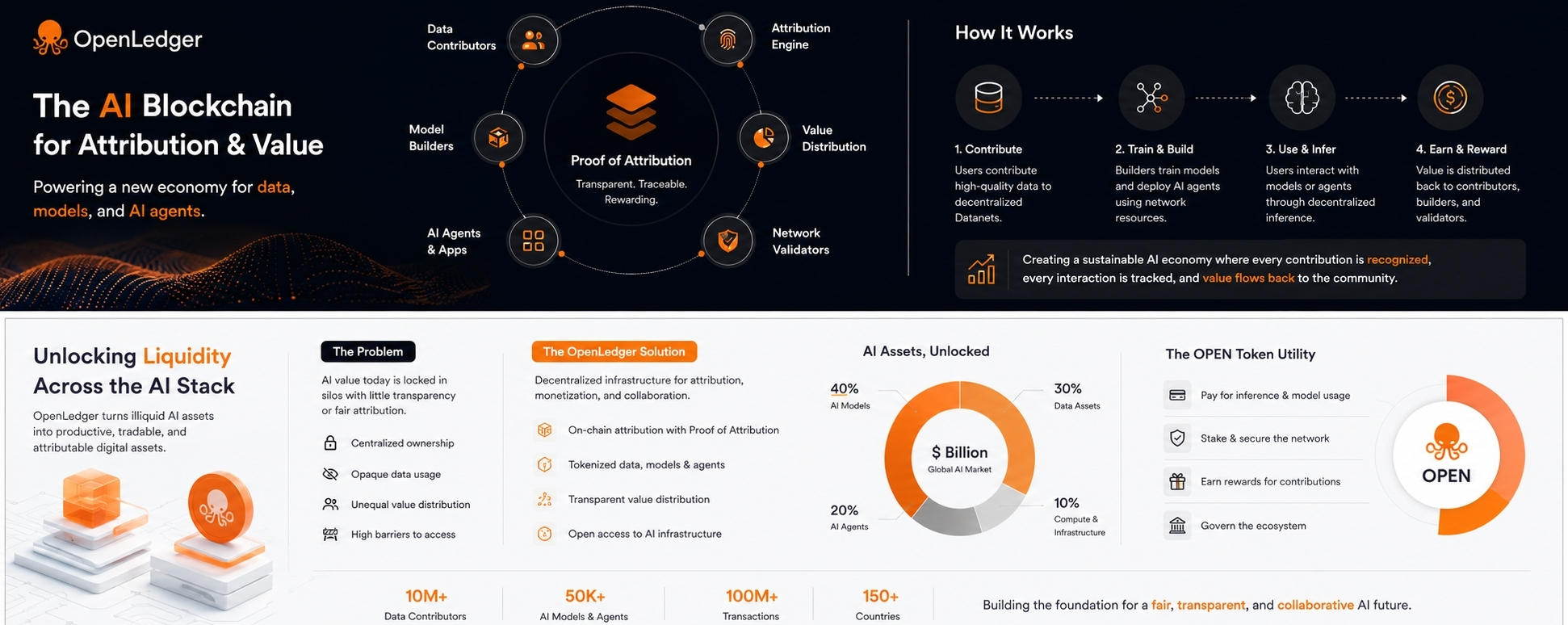
Instead of treating data like something to quietly absorb and lock away the network tries to create an environment where contributions stay connected to value. Datasets models and AI agents are not meant to exist inside closed systems where nobody can trace where the intelligence came from.
The project introduces decentralized data networks where contributors can participate directly in building AI infrastructure. More importantly the system attempts to track attribution so that when models are used the people behind the data can still remain part of the economic flow.
That idea carries emotional weight because it speaks to something bigger than technology.
People want to matter.
Not temporarily. Not symbolically. Actually matter.
There is a growing exhaustion online where creators researchers and communities feel like they are constantly feeding systems that eventually stop seeing them. Their work becomes fuel for algorithms while ownership slowly drifts further away from the individuals who created the original value.
OpenLedger feels like a response to that frustration.
Not through empty slogans but through infrastructure.
The project is building around the belief that the future AI economy should not only reward the final product. It should recognize the entire chain of contribution behind it.
And honestly that feels long overdue.
What also makes OpenLedger interesting is how intentional the ecosystem feels compared to many projects in both crypto and AI.
A lot of platforms try to become everything at once. They build broad narratives around innovation but struggle to explain why the blockchain actually needs to exist there in the first place.
OpenLedger feels more grounded.
The network is centered almost entirely around AI activity itself. Data contribution model deployment inference systems AI agents and monetization all exist as connected parts of the same environment.
Nothing feels randomly attached.
Even the OPEN token has a role tied directly to network usage rather than existing purely as a speculative asset floating around disconnected from real activity.
That distinction matters more than people realize.
The projects that survive long term are usually the ones connected to actual utility actual movement actual participation. Not just temporary excitement.
And when you look at where AI is heading the timing of OpenLedger becomes even more interesting.
The industry is entering a new phase now.
At first people only cared about capability. Could AI become smarter faster more powerful
Now the questions are changing.
Where did the training data come from
Who owns the outputs
Can contributors be recognized
Can systems become transparent instead of operating like invisible black boxes
These questions are no longer theoretical. Governments researchers developers and users are all beginning to push for more accountability inside AI ecosystems.
That pressure will only grow.
At the same time AI itself is becoming more decentralized. The future probably will not belong to one giant model controlling everything. It will likely become an ecosystem filled with specialized agents and smaller intelligent systems interacting with one another across different industries and tasks.
Medical AI. Research agents. Financial systems. Educational assistants. Scientific models trained for very specific purposes.
And once thousands of intelligent systems begin interacting economically the need for transparent infrastructure becomes unavoidable.
Who gets paid
Who contributed
Who owns the intelligence
How is trust established between autonomous systems
Traditional internet infrastructure was never really designed for this kind of future.
OpenLedger appears to understand that early.
But beyond all the technical architecture there is something else that quietly gives the project weight.
It recognizes that human contribution should not become disposable in the age of AI.
That idea sounds simple but emotionally it hits something very real.
Because people are tired of building systems that eventually erase them from the picture.
They want participation to mean something.
They want contribution to carry lasting value.
They want to feel connected to the future they are helping create.
And maybe that is the real reason projects like OpenLedger matter right now.
Not because they promise some perfect solution.
Not because they guarantee success.
But because they are asking the right questions before the next era of AI becomes too large too centralized and too disconnected from the people who made it possible in the first place.
