
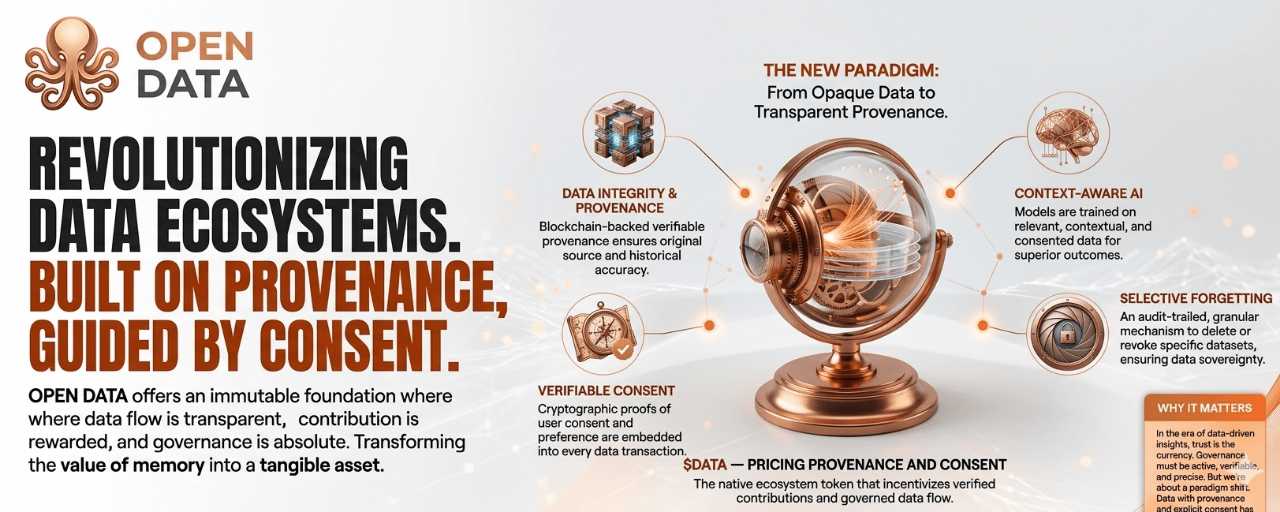
The monetization of artificial intelligence relies on a foundational pipeline that is under constant legal scrutiny: high-quality training data. Massive Web2 companies routinely face complex copyright lawsuits for unauthorized scraping of digital footprints across the web. This model creates severe operational vulnerabilities for developers seeking to build trustworthy applications. @OpenLedger offers an elegant architectural resolution to this crisis with $OPEN introducing a decentralized, secure layout that shifts the paradigm under #OpenLedger from covert data collection to hyper-scalable, crowd-sourced on-chain data distribution.
🏢 Breaking the Monopolistic Grip on AI Infrastructure
Currently, training competitive machine learning configurations requires vast capital expenditures on enterprise server grids. This financial barrier limits artificial intelligence development to a handful of multi-billion-dollar conglomerates. By operating at the intersection of Decentralized Physical Infrastructure Networks (#DePIN) and Web3 crypto economics, the network effectively decentralizes the physical supply chain of AI development.
Rather than relying on a single data center point of failure, individual data providers and storage nodes across the globe can seamlessly sync their dormant computing capacity into a unified network layer. This creates an open-source, resilient data cloud that strips away massive overhead expenses, allowing independent engineers to build custom, localized models at a fraction of standard commercial costs.
⚙️ Resource Distribution and Velocity Mechanisms
The internal economic system that facilitates this global compute marketplace relies entirely on the design properties of the native ecosystem token. The protocol maintains balanced asset velocity through specific operational pathways:
Infrastructure Subsidies: Hardware providers who dedicate storage space or verified data streams are rewarded directly from network incentive emissions, offsetting their localized energy costs.
Dynamic Gas Settlements: AI developer teams utilize the token to fund live training queries, injecting constant utility buy-pressure straight back into the computing grid.
Security Accountability: Node validators lock up the asset to verify that the traffic passing through the pipelines remains clean, compliant, and structured properly.
As the broader blockchain landscape rapidly transitions toward real-world asset physical networks, frameworks that securely bridge sovereign data compilation with scalable compute environments are positioned to lead the next major tech paradigm shift.
