
There is one question I always ask myself before putting my trust into any crypto ecosystem: "If you remove the token, does this ecosystem still function?"
Maybe that sounds obvious.
But the more ecosystems I looked at this cycle, the more I realized how fragile most of them actually are once speculation disappears. 👁️
For most projects, the answer is no. The token is the only magnet holding everything together. But with @OpenLedger, I’m starting to see a different picture—one where the token isn't the glue, but the lubricant for a machine that is already running on its own.
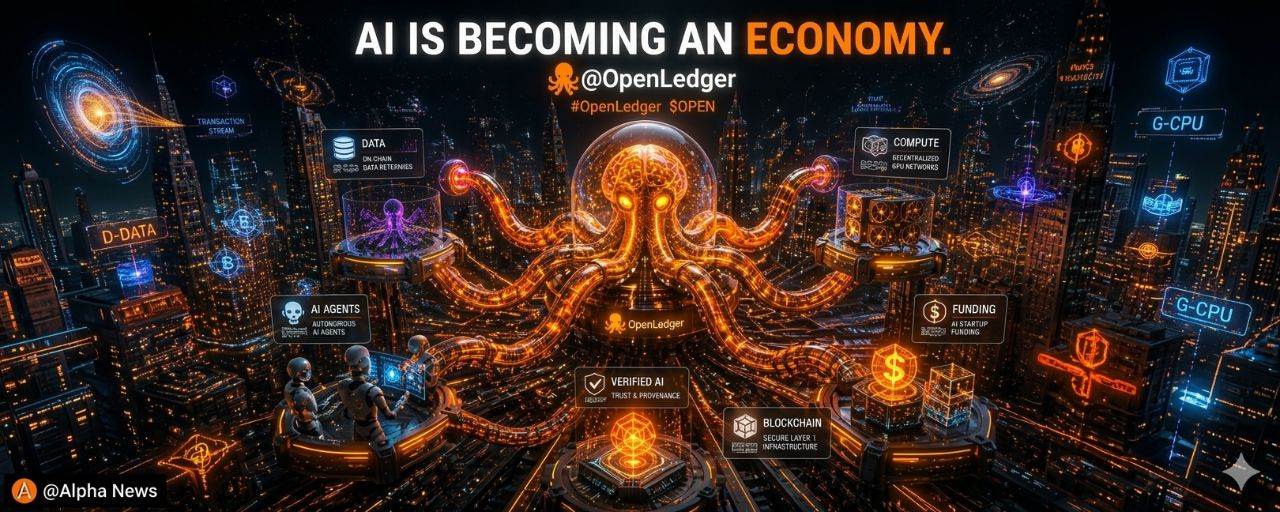
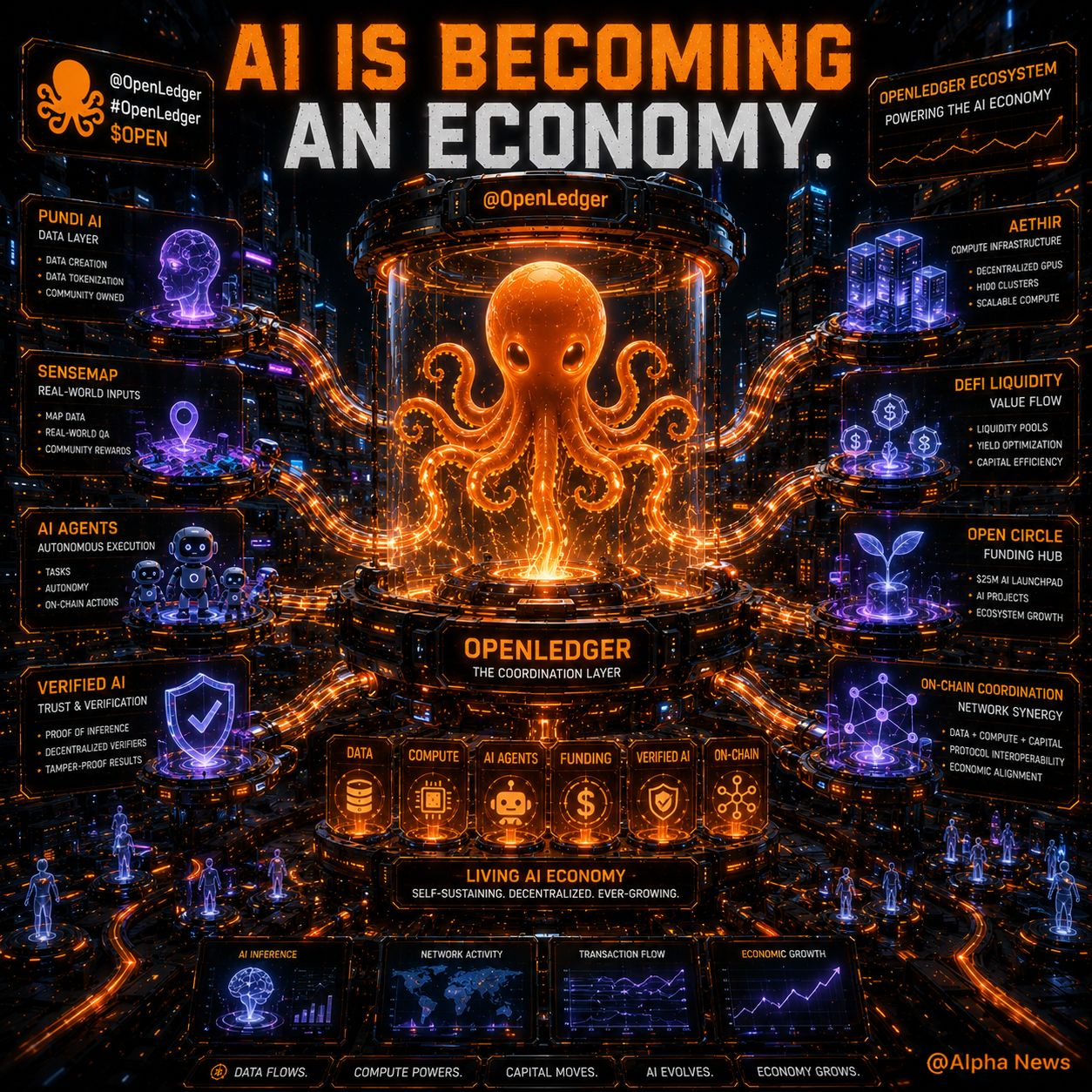
This week, I spent time mapping out the entire OpenLedger ecosystem. It felt like assembling a Lego set and honestly, this is where things started feeling different to me. Most ecosystems look connected on slides.
Very few actually feel economically interconnected once you dig deeper. ⚠️
—each piece seemed isolated at first, but once put together, the full picture became surprisingly clear.
Layer 1: Data – Where Everything Begins
If AI is the engine, data is the fuel. But the problem with most AI today is that this fuel is siphoned from users without anyone getting compensated. OpenLedger solves this with two key pieces:
Pundi AI: This isn't just your typical AI project. Pundi AI builds the infrastructure for the community to create datasets, label them on-chain, and tokenize them as real-world assets. Every dataset has a clear owner, transparent origins, and is ready for model training. When Pundi AI integrates with OpenLedger’s Datanets, data is no longer passively sitting in a warehouse—it becomes a live input for model training and AI agents.
Sapien Protocol: While Pundi AI handles dataset creation, Sapien takes care of verification and distribution. Sapien builds a decentralized data collaboration network where every contribution—from labeling to validation—is transparently recorded and rewarded. Combined with OpenLedger, every action taken by a Sapien agent becomes "provable"—making it not just efficient, but verifiable at every logical step.
Layer 2: Applications – Where Data Turns into Real Products
This is the part that excites me the most. OpenLedger doesn't stop at data collection; they have actual applications running on top of that
SenseMap: Think about Google Maps. In 2023, Google Maps was projected to generate around $11 billion in ad revenue. Yet, the people contributing the data—taking photos, writing reviews, updating traffic conditions—didn't get a single dime. SenseMap flips this model on its head. Users answer questions about their local area: Is it safe? Is it crowded? Is it noisy? Each response is verified by on-chain validators, and contributors get paid. As the network expands, accuracy doesn't drop—it actually improves thanks to a reputation-based validation system. Trusted contributors hold more weight, while spammers face economic penalties. To me, this is one of the most practical crypto + AI use cases I’ve ever come across.
Mira Network: While SenseMap handles the input, Mira handles the output. Every answer generated by an AI—whether it’s a medical diagnosis or a trading recommendation—is hashed, timestamped, and verified by a decentralized swarm of validators. This is the "trust layer" that centralized AI can never provide.
Layer 3: Infrastructure – Where the System Operates
An ecosystem cannot run without infrastructure. OpenLedger gets this and has teamed up with some massive names:
Ether.fi: Partnering with Ether.fi brings OpenLedger a layer of security backed by $6.5 billion in restaking TVL. This isn't just a marketing stunt—it's a deep technical integration to scale and secure the entire ecosystem.
Aethir: Decentralized GPUs. OpenLedger leverages Aethir’s GPU infrastructure—including enterprise-grade NVIDIA H100 clusters—to train AI models without relying on centralized servers. This means even small-scale developers can access enterprise-level compute resources.
Kaito: The information distribution hub of crypto, using AI to connect data, attention, and capital. In an ecosystem where data is an asset, having a transparent information layer is an indispensable piece of the puzzle.
Virtuals: A platform that allows users to create, co-own, and monetize AI Agents. When combined with OpenLedger, these agents don't just execute tasks—they operate with logic that is fully traceable and verifiable on-chain.
Layer 4: Finance – Where Early-Stage Projects Find Room to Grow
This is a piece I don't see many people talking about, but it is absolutely critical: OpenCircle.
OpenCircle is a $25 million launchpad established by OpenLedger to fund AI and Web3 startups building within their ecosystem. No need for a massive Series A or a flashy pitch deck. If you have the code, the data, and the idea—you get funded and start building. Core contributor Ram Kumar once said something that stuck with me: "AI currently is an exploitative economy, profiting from invisible labor and centralized training processes. OpenCircle turns that model inside out."
On top of that, there is the IAO (Initial AI Offering) mechanism—where AI models are tokenized, allowing the community to invest in them as assets. You aren't just buying a project's token; you are buying a fractional ownership stake in the actual AI model they are building. The data users contribute trains the model, and the revenue generated by that model is distributed back to those who helped build it. And honestly?
The more I traced how value moves through the ecosystem, the less it started feeling like a typical token economy…
and more like an actual feedback loop between data, models, users, and capital. 🔄
What Really Catches My Attention
Most crypto ecosystems today share a common flaw: the token is the only thing holding them together. Pull the token out, and nothing works. But with OpenLedger, I see the exact opposite logic: the token is the lubricant, while the machine itself is already running on layers of data, applications, infrastructure, and capital stacked together. SenseMap needs data from Pundi AI. Pundi AI needs infrastructure from Aethir. AI Agents need security from Ether.fi. And OpenCircle injects capital to keep this flywheel spinning.
No piece stands alone. They all feed into one another.
Of course, I’m not saying everything is perfect yet
There are still unanswered questions. SenseMap is in its final testnet phase—no official launch date yet. Pundi AI is still expanding its partnerships. OpenCircle just announced its fund, so few specific deals have been disclosed. And like any young ecosystem, execution risk is real. Maybe some of these projects fail. Maybe parts of the ecosystem never gain traction. That’s normal for early ecosystems.
But what interests me is that the pieces already exist — and they’re starting to connect together in a way that feels economically coherent. 🌐
This is what I appreciate the most
While most of the market is still debating whether "AI Agents are just a temporary trend," OpenLedger has quietly built an entire ecosystem of over 50 projects spanning DeFi, healthcare, mapping, and Web3 culture. They aren't doing AI "for the hype." It feels less like they’re building “another AI protocol”… and more like they’re trying to build the economic rails underneath AI itself. ⚡
One where every contribution is credited, every model has an owner, and every developer has a shot at funding to build.
And as I’ve learned from previous cycles: the ecosystems that survive the bear market aren't the ones with the hardest-pumping tokens, but the ones with products that people actually use.
Have you guys dug into the OpenLedger ecosystem yet? Any project in here that catches your eye or makes you want to try it out? Or do you still see it as just another hype story? Drop your perspectives below—I’d love to hear some counter-arguments.
