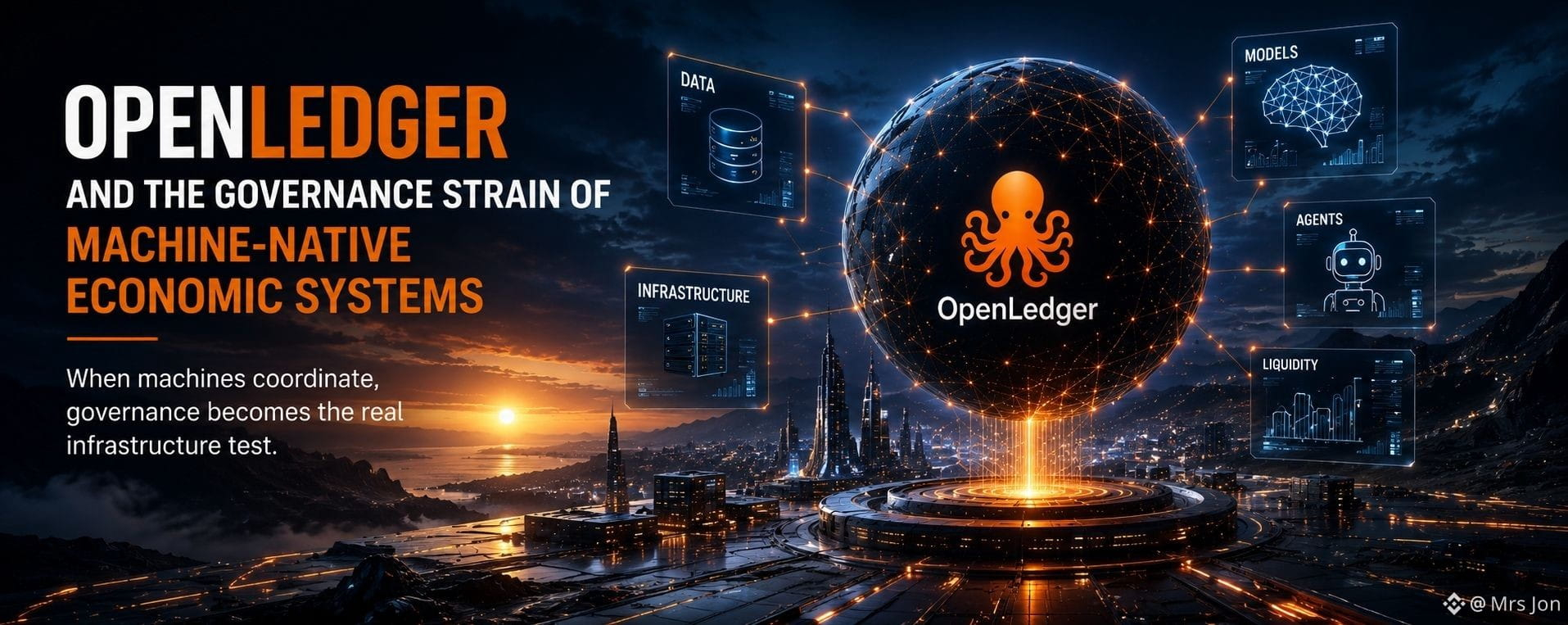
OpenLedger and the Governance Strain of Machine-Native Economic Systems
Most infrastructure failures begin long before the system visibly breaks. The early signals usually appear in governance behavior rather than technical performance. A network continues producing blocks, validators remain online, throughput metrics look healthy, yet decision-making capacity quietly deteriorates underneath the surface. What changes first is not execution. It is the relationship between coordination speed and institutional control.
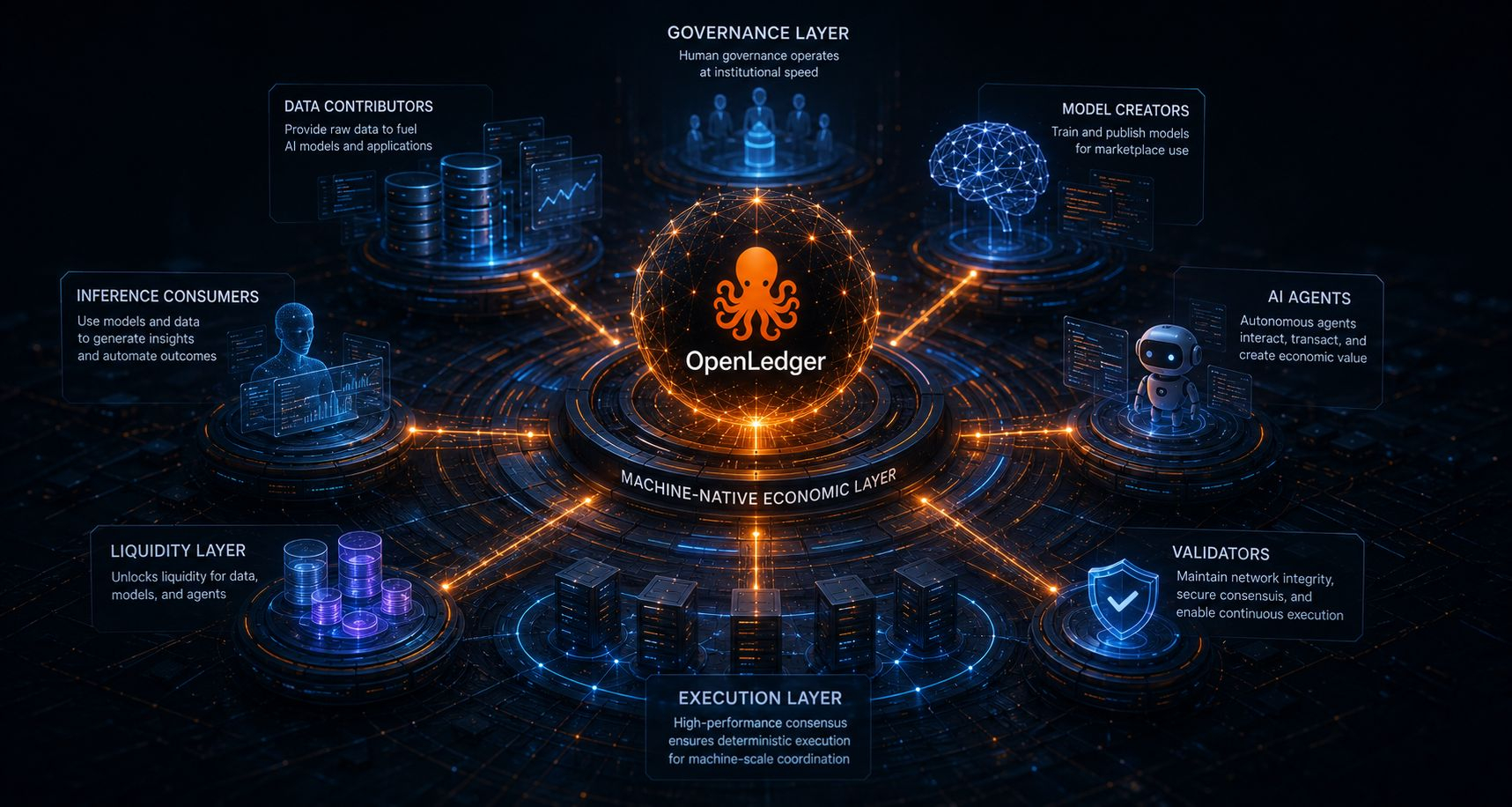
OpenLedger appears exposed to this exact tension because the project is not simply attempting to scale transactions. Its architecture points toward something structurally more difficult: an environment where data flows, model execution, and autonomous agents become economically active participants inside the network itself. That changes the nature of governance pressure entirely.
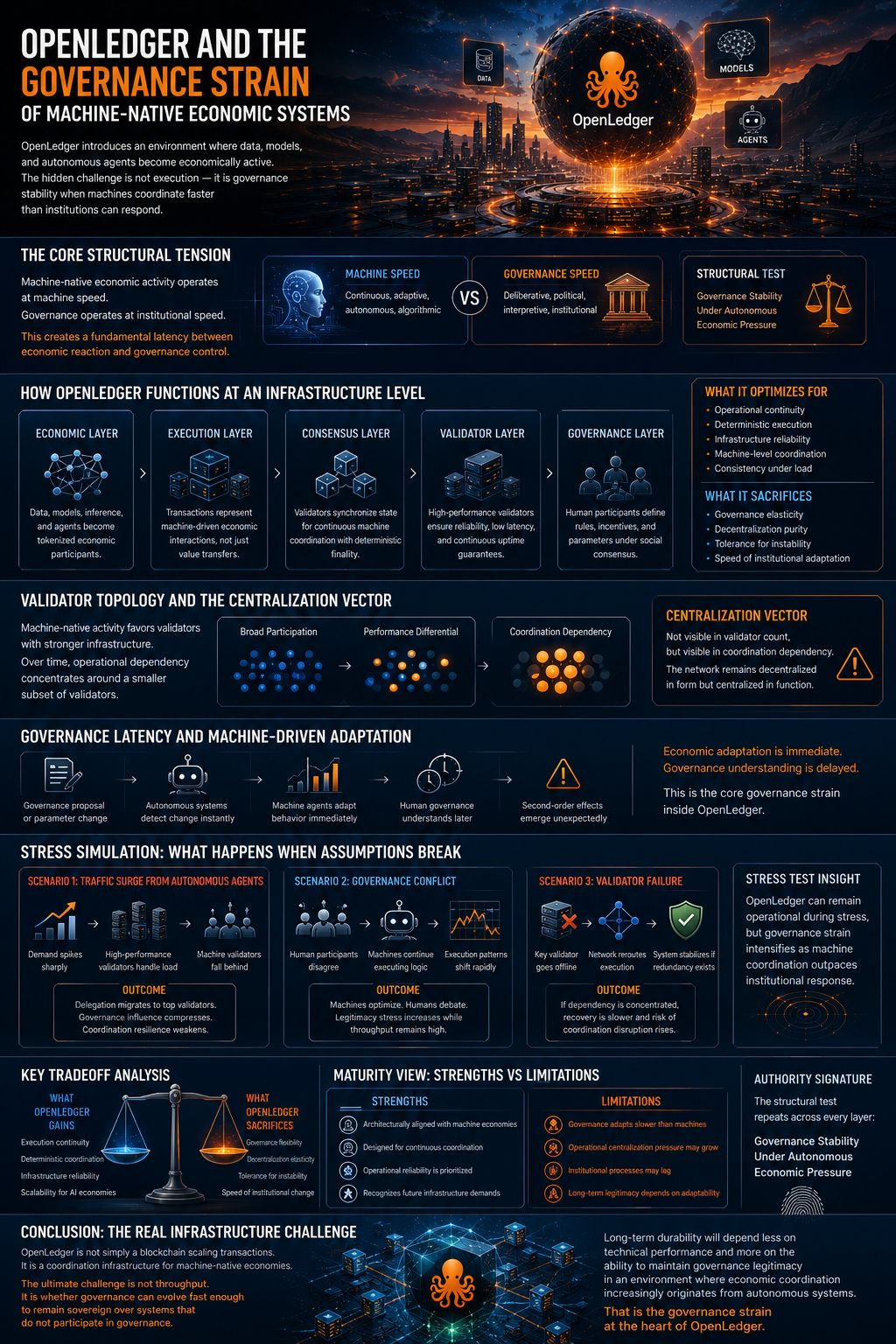
Traditional blockchain governance was designed around human-paced economic behavior. Participants react emotionally, politically, and slowly. Even algorithmic trading systems still operate inside frameworks ultimately shaped by human incentives and interpretation. OpenLedger introduces the possibility of machine-native coordination where execution cycles begin operating faster than governance response cycles. The hidden challenge is no longer whether the infrastructure can process activity. The deeper question is whether governance remains functional once the majority of economically meaningful interactions are generated by systems that do not participate in governance at all.
That becomes the central structural test throughout the entire network: governance stability under autonomous economic pressure.
The architecture itself appears optimized around continuity of machine-level coordination rather than maximal decentralization aesthetics. Consensus in this environment serves a different purpose compared to conventional financial blockchains. Validators are not simply sequencing transfers between users. They increasingly function as synchronization infrastructure for persistent computational interaction. The distinction matters because machine-originated activity behaves differently from speculative retail flow.
Human activity is intermittent. Machine activity tends toward continuity.
A blockchain designed around continuous machine coordination naturally prioritizes deterministic execution, predictable latency, and stable infrastructure conditions. Once autonomous systems begin interacting economically across datasets, models, inference markets, or execution layers, inconsistency becomes structurally expensive. Delayed finality or unstable validator performance no longer produces only market inconvenience. It can interrupt entire chains of automated decision-making.
This creates a subtle but important validator topology pressure.
OpenLedger’s operational environment appears likely to favor validators with stronger infrastructure capacity, lower latency systems, and more resilient uptime guarantees. Over time that dynamic may compress influence toward operators capable of sustaining industrial-grade execution consistency. The network can still maintain broad validator participation numerically while practical coordination dependency quietly centralizes around a smaller infrastructure subset.
This is an important distinction because decentralization metrics often measure participation quantity rather than coordination dependency.
The governance strain emerges from this dependency layer.
If machine-native liquidity coordination becomes the dominant economic activity on the network, governance decisions begin affecting systems that adapt algorithmically rather than socially. A change in execution pricing, validator incentives, or coordination rules may trigger immediate behavioral restructuring across autonomous agents before human governance participants fully process the second-order implications.
Human governance operates through interpretation and negotiation. Machine systems respond through execution logic.
That mismatch creates structural latency between governance intent and economic reaction. OpenLedger appears designed to minimize execution friction, but minimizing execution friction can unintentionally amplify governance fragility because machine systems exploit infrastructure conditions faster than institutional consensus mechanisms can stabilize them.
The project therefore appears to optimize for operational continuity while sacrificing some governance elasticity.
That tradeoff is understandable. Machine-coordinated environments require tighter synchronization discipline than human-centered transaction systems. Networks supporting autonomous economic interactions cannot tolerate prolonged uncertainty inside execution conditions because dependent systems continue operating regardless of political disagreement.
Still, this introduces limitations that deserve serious attention.
Governance resilience historically depends on the ability to absorb disagreement without destabilizing the underlying infrastructure. OpenLedger may encounter difficulty here if validator influence and execution dependency begin converging around the same infrastructure actors. Once operational continuity depends heavily on a narrow validator subset, governance flexibility declines because major governance disruptions threaten execution reliability itself.
This does not necessarily create immediate centralization in the conventional sense. The more subtle risk is coordination dependence.
A system becomes governance-sensitive when replacing key operators becomes economically disruptive even if technically possible. Networks rarely fail because decentralization disappears completely. More often they fail because governance loses the practical ability to challenge infrastructure concentration without damaging system stability.
The governance stability test becomes more visible under stress conditions.
Imagine a scenario where autonomous agents operating across inference coordination markets begin competing aggressively for execution priority during a sudden surge in network utilization. Unlike speculative transaction spikes driven by retail behavior, this activity remains utility-linked and self-reinforcing. Agents continue transacting because execution itself remains economically necessary to ongoing model interactions.
Validator load increases sharply.
Smaller validators with weaker infrastructure begin experiencing latency instability while larger operators maintain execution consistency. Delegation naturally migrates toward high-reliability validators because autonomous systems optimize around predictability rather than ideology. Governance influence subsequently compresses around the same operators already dominating execution continuity.
The network technically remains decentralized, but coordination resilience weakens because governance diversity contracts precisely when operational dependency intensifies.
That is the kind of structural compression most ecosystems fail to recognize early enough.
Another failure scenario emerges during governance conflict itself.
Suppose governance participants become divided over execution pricing adjustments designed to control rising machine-originated congestion. Human participants interpret the issue politically while autonomous systems continue responding economically in real time. Some agents reduce activity. Others increase coordination intensity if incentives remain profitable. Execution patterns shift rapidly before governance consensus stabilizes.
Under those conditions the network may experience simultaneous governance fragmentation and elevated operational demand.
This is where OpenLedger’s design philosophy becomes clearer. The architecture appears less concerned with maximizing ideological decentralization purity and more focused on preserving execution continuity during complex coordination conditions. That gives the infrastructure a certain operational maturity because it acknowledges that machine economies behave differently from human transaction environments.
But every optimization creates an exclusion somewhere else.
By prioritizing continuity and deterministic coordination, the network potentially reduces its tolerance for governance experimentation under pressure. Infrastructure systems optimized for stability often become institutionally conservative because disruption carries higher operational consequences once machine dependencies deepen.
The important point is not whether this outcome is good or bad. The important point is recognizing the tradeoff honestly
OpenLedger should probably not be evaluated as a conventional blockchain competing for user attention through transaction throughput alone. Its more interesting challenge lies in whether governance architecture can remain adaptive once economically meaningful coordination begins occurring faster than human institutional processes can comfortably supervise
That is a much harder infrastructure problem than scaling blocks.
The strongest aspect of the project is that its architecture appears structurally aligned with this future rather than pretending autonomous systems will behave like ordinary users. Many networks discuss AI integration while still relying on governance assumptions inherited from purely human economic systems. OpenLedger at least seems designed with the expectation that machine participation changes infrastructure dynamics fundamentally.
The unresolved question is whether governance institutions can evolve at comparable speed without gradually surrendering practical influence to operational dependency layers forming underneath the validator structure.
That question matters more than throughput statistics because long-term infrastructure durability rarely depends on peak performance during stable periods. It depends on whether governance remains capable of making difficult decisions once the network becomes economically important enough that disruption itself carries systemic cost.
OpenLedger’s future resilience will likely be determined by that governance stability test more than any short-term execution metric. The network does not appear fragile in a technical sense. The deeper issue is whether machine-native economic coordination eventually outpaces the institutional mechanisms responsible for supervising it.
That tension is not temporary. It is structural.