

today i went to the market for some work
nothing special honestly. just a normal day.
but while walking through one of the old streets near the shops, i suddenly met a few old friends after a really long time.
and like always, once crypto people meet each other, the conversation somehow turns into markets automatically
at first we were talking about Bitcoin, memes, AI coins pumping everywhere…
then one of them suddenly mentioned OpenLedger.
that actually caught my attention because normally people around me don’t talk much about AI infrastructure projects.
most conversations stay around: which coin can move fast?” “which narrative is trending?” “which token is getting listed?”
but this discussion felt different.
one of my friends said something interesting:
“AI is growing crazy fast… but nobody really talks about who’s actually feeding intelligence into these systems.”
and honestly… that line stayed in my head the whole day.
because when you really think about it, current AI systems feel a little strange.
millions of people constantly shape AI every day through: conversations, feedback, datasets, corrections, evaluation, usage behavior, specialized knowledge.
but once the model improves… most of those contributors disappear completely from the visible system.
the platform grows more powerful… the intelligence becomes more valuable… but the people underneath it slowly become invisible.
and maybe that’s exactly why OpenLedger keeps feeling different to me.
because the more i read about attribution, Datanets, contributors, decentralized coordination and transparent participation… the less it feels like a normal “AI token project.”
it feels more like infrastructure for something bigger that’s slowly forming underneath the internet itself.
while sitting there with my friends drinking tea, i tried explaining it in a simple way.
i told them: “right now internet economies mostly measure attention.”
views, likes, traffic, engagement, followers.
that’s how platforms became valuable.
but AI systems don’t improve from attention alone.
they improve from contribution.
every useful dataset, every correction, every validator, every interaction, every feedback loop… all of it slowly shapes intelligence over time.
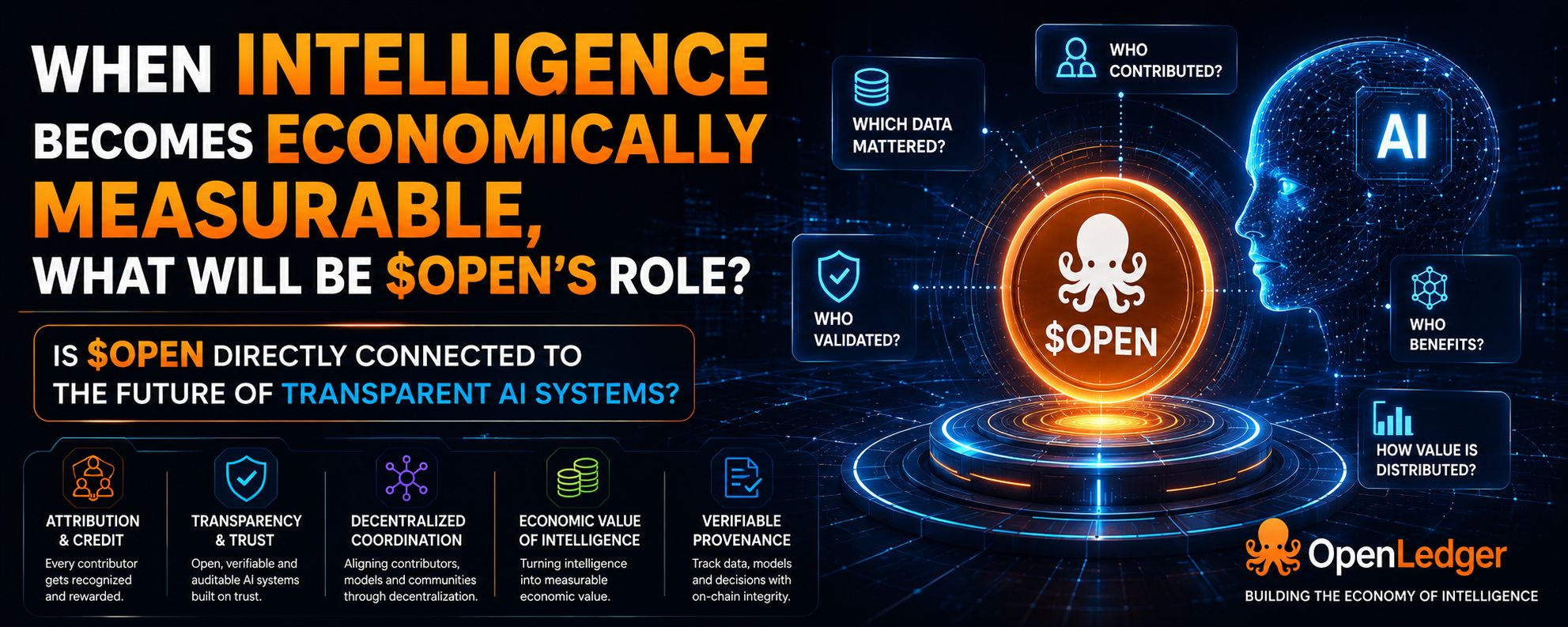
and once intelligence itself starts becoming economically measurable… everything changes.
because suddenly systems need ways to track: who contributed, what created value, which model improved, whose data mattered, who should receive rewards, how trust is maintained across the ecosystem.
that’s not just software anymore.
that’s an economy.
and honestly, that’s the moment where $OPEN started making much more sense to me.
because maybe the token isn’t only there for speculation or trading.
maybe it becomes part of the coordination layer behind decentralized intelligence systems.
almost like infrastructure for organizing how value flows through AI ecosystems.
my friend asked me another question after that…
he said: “but why does transparency matter so much?”
and honestly, i think most people still underestimate that part.
because right now AI still feels small enough that users only care about outputs.
people ask: “does it work?” “is it fast?” “is it smart?”
but future AI systems may end up influencing: information, automation, digital identity, online visibility, financial decisions, market behavior, entire internet interactions.
and once AI reaches that level… trust becomes a much bigger issue.
people will eventually want to know: where intelligence came from, who trained it, what data influenced it, who controls it, whether outputs can be verified, whether contributors are being rewarded fairly.
that’s where transparent systems start becoming important.
and honestly, centralized AI models struggle with this badly.
most of them still behave like black boxes.
you see outputs… but almost nothing underneath them is visible.
contributors disappear. decision structures disappear. economic flows disappear.
and maybe OpenLedger is trying to solve exactly that problem through decentralized attribution systems.
because blockchain suddenly starts making sense differently here.
not just for transactions… but for memory.
a system capable of remembering: contribution, ownership, validation, governance, economic participation, network activity.
almost like OpenLedger is trying to make intelligence accountable instead of invisible.
and if future AI systems really become large-scale intelligence economies… then tokens like $Open could become much more important than people currently realize.
because economies can’t function without coordination.
they need: incentives, validation, distribution, governance, participation, trust layers.
and maybe $Open becomes part of that infrastructure over time.
not just connecting users to a token…
but connecting contributors, validators, models, datasets, and decentralized intelligence networks together.
the strange part is… after coming back home, i kept thinking about that market conversation again.
because maybe the future AI race won’t only be about who builds the smartest models.
maybe it’ll also be about: which systems remain transparent, which ecosystems reward contributors fairly, which networks people actually trust.
and if intelligence itself eventually becomes measurable on a global scale…
then projects like OpenLedger and tokens like $OPEN may end up connected to something far bigger than simple AI hype cycles.
