

OpenLedger and the Bigger Question Facing Web3 AI
The crypto market has entered a phase where narratives move faster than products. Every cycle introduces a new promise—DeFi wanted to rebuild finance, NFTs tried to redefine ownership, and now AI-focused blockchain projects are racing to position themselves as the infrastructure layer for the next generation of the internet.
Among those projects, OpenLedger has started attracting increasing attention.
At first glance, it may seem like another AI + blockchain experiment riding market momentum. But the deeper discussion around OpenLedger is not really about hype. It is about whether decentralized systems can realistically compete with centralized AI platforms that already dominate user attention, data collection, and computational infrastructure.
That question alone makes #OpenLedger worth watching.
@OpenLedger is positioning itself around a powerful idea: creating an ecosystem where data, models, and AI-related contributions can become part of an open and incentivized network rather than remaining locked inside centralized corporate systems.
In a market increasingly driven by artificial intelligence narratives, this approach touches one of the biggest debates in technology today—who should own the future of AI?
Why the AI Narrative Matters in Crypto Right Now
AI has rapidly become one of the strongest narratives across global technology markets. Major corporations are investing billions into AI infrastructure, while consumers are increasingly integrating AI tools into daily workflows.
Crypto naturally wants exposure to that growth story.
But blockchain projects connected to AI face a difficult challenge. Many sound impressive conceptually but struggle to explain why decentralization actually improves the AI experience for users.
This is where OpenLedger becomes interesting.
Instead of simply attaching “AI” branding to a token, the project appears focused on participation economics—how contributors, developers, and users can interact within an incentivized ecosystem where value distribution is more transparent.
That distinction matters because modern users no longer stay loyal to technology purely because it is decentralized. They stay where experiences feel easier, faster, and economically rewarding.
The projects that understand this shift may have an advantage over those relying purely on ideology.
Understanding What OpenLedger Is Trying to Build
At its core, OpenLedger appears to be exploring decentralized AI infrastructure combined with incentive-driven participation systems.
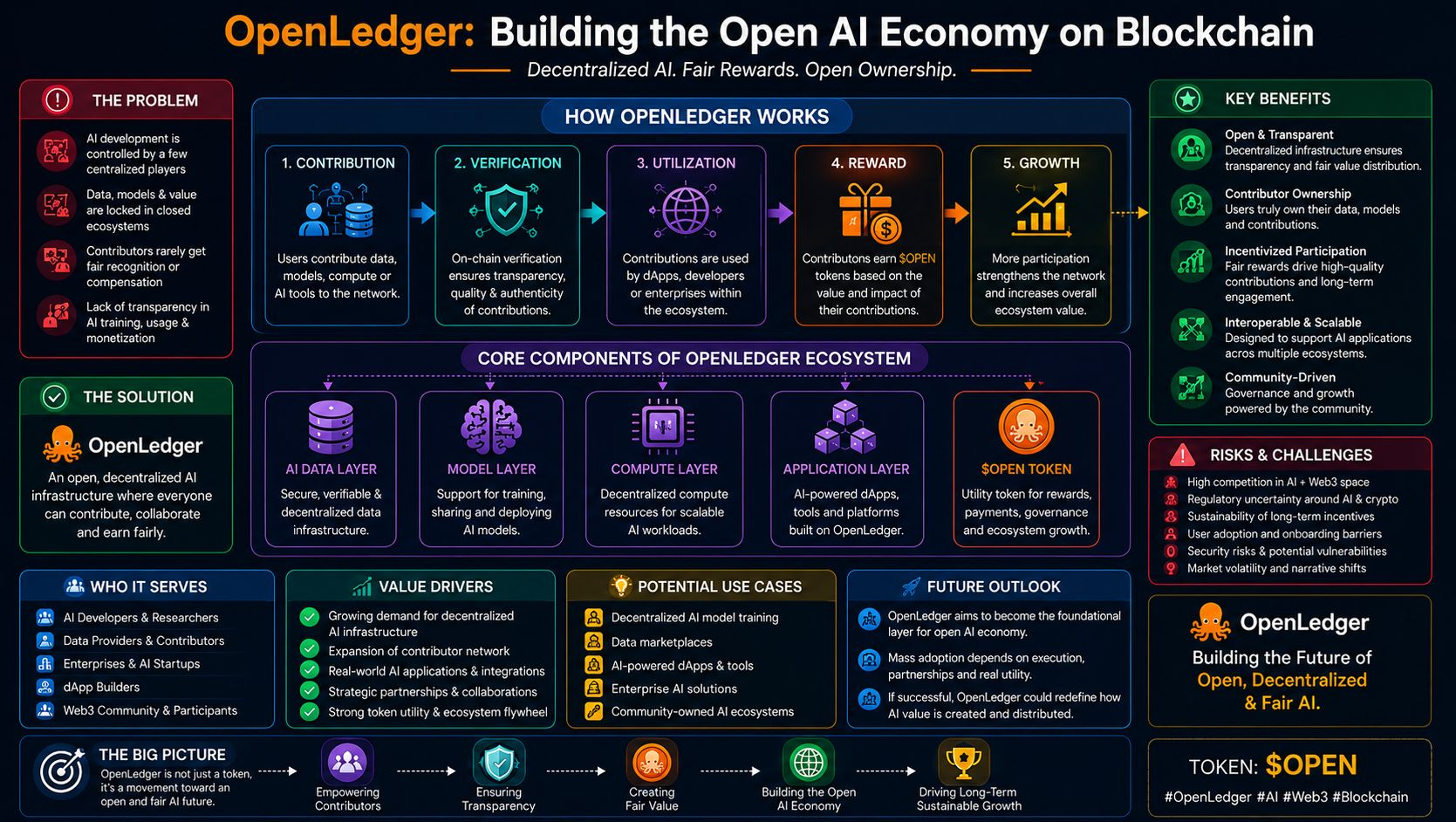
The broader idea can be simplified into three major components:
1. Open Contribution Systems
Traditional AI systems are largely closed environments. Data, model training, and monetization are controlled by a small number of corporations.
OpenLedger seems to explore a different direction—allowing contributors to participate in the ecosystem while receiving incentives tied to network activity and value creation.
If executed effectively, this could help create stronger long-term community engagement compared to projects that rely purely on speculation.
2. Incentivized Network Growth
One of Web3’s greatest strengths has always been tokenized participation.
Instead of depending solely on centralized marketing structures, blockchain ecosystems can reward users directly for helping networks grow.
The $OPEN ecosystem appears designed around this idea.
This could include:
Contributor incentives
Ecosystem participation rewards
AI-related network activity
Community-driven expansion loops
The important factor here is sustainability.
Many previous crypto ecosystems attracted users through aggressive rewards but collapsed once incentives disappeared. OpenLedger’s long-term success may depend on whether it can create real utility beyond reward farming.
3. AI and Web3 Convergence
The convergence between AI and blockchain is becoming increasingly competitive.
Projects across the sector are now attempting to solve problems involving:
Data ownership
Decentralized computing
AI model accessibility
Permissionless infrastructure
Revenue sharing
OpenLedger enters this race at a time when investors are actively searching for AI-related exposure inside crypto markets.
That creates opportunity—but also enormous pressure.
Because eventually, narratives stop being enough. Products must deliver retention, usability, and actual network demand.
Why OpenLedger Is Gaining Attention
Several factors appear to be driving the growing attention around OpenLedger.
The Market Loves AI Narratives
This is the most obvious reason.
AI remains one of the strongest capital attraction themes globally. Any project operating at the intersection of AI and Web3 automatically receives elevated market curiosity.
But attention alone is not valuable unless a project can convert it into sustained ecosystem activity.
That is where OpenLedger’s positioning becomes more strategic.
Community Participation Feels Central to the Vision
One reason some users are becoming interested in OpenLedger is that the project appears to understand an important reality about Web3 adoption:
People stay where they feel economically connected to the ecosystem.
Many blockchain projects focus heavily on technology while underestimating user psychology.
OpenLedger seems more aware of contribution systems, engagement loops, and long-term participation incentives. If that structure remains sustainable, it could help strengthen user retention over time.
Timing Matters
Projects launching into the right narrative environment often gain disproportionate visibility.
The current market environment strongly favors:
AI infrastructure
Decentralized networks
Data ownership discussions
Contributor economies
Open ecosystems
OpenLedger is entering conversations that investors are already actively interested in.
That does not guarantee success—but it improves visibility.
Exchange and Ecosystem Exposure
Visibility inside major crypto communities and platforms can significantly accelerate recognition.
The growing discussion around @OpenLedger on Binance Square and other crypto-focused communities is helping the project reach audiences beyond niche developer circles.
This type of ecosystem exposure matters because attention often becomes the first stage of liquidity, participation, and eventual adoption.
Strengths and Bullish Factors
While the project remains relatively early compared to larger blockchain ecosystems, several aspects stand out positively.
Strong Narrative Alignment
Narratives drive liquidity in crypto.
OpenLedger benefits from alignment with:
AI expansion
Decentralized infrastructure
Contributor economies
Open-data discussions
Web3 participation systems
This gives the project a strong thematic foundation.
Scalability of the Idea
If decentralized AI systems become more relevant globally, ecosystems like OpenLedger could theoretically scale far beyond speculative token trading.
Potential long-term use cases may include:
AI-powered decentralized applications
Contributor marketplaces
Data participation systems
Open AI ecosystems
Community-owned model infrastructure
The opportunity size is substantial if execution matches ambition.
Early-Mover Positioning
In crypto, early positioning inside emerging narratives can matter enormously.
OpenLedger is participating in a sector that is still developing structurally. Many AI-related blockchain ecosystems remain experimental.
That creates risk—but also significant upside potential if the sector matures successfully.
Community-Centric Design
Projects with strong participation systems often outperform purely technical ecosystems because they create emotional and economic alignment between users and the network.
If OpenLedger successfully balances incentives with utility, it may develop stronger long-term engagement than projects dependent entirely on speculation cycles.
Risks and Challenges
Despite the optimism surrounding AI-focused crypto projects, the risks remain substantial.
Competition Is Extremely Aggressive
The AI + blockchain category is becoming crowded rapidly.
Numerous projects are competing for:
Developer attention
User participation
AI partnerships
Infrastructure dominance
Investor capital
OpenLedger must differentiate itself beyond branding alone.
Execution Risk
Many blockchain projects sound impressive conceptually but struggle operationally.
The real challenge is not attracting attention during the narrative phase.
The real challenge is maintaining:
Active users
Developer ecosystems
Sustainable incentives
Product usefulness
Long-term relevance
Execution will likely determine whether OpenLedger evolves into infrastructure or remains a speculative narrative.
Sustainability of Incentives
Crypto history repeatedly shows that unsustainable reward systems eventually collapse.
If users participate only for short-term incentives rather than ecosystem value, growth can disappear quickly once rewards weaken.
This remains one of the biggest structural risks for many Web3 ecosystems—including OpenLedger.
Regulatory Uncertainty
AI and crypto are both sectors facing increasing global regulatory attention.
Projects operating between these two industries may eventually face:
Data governance concerns
Compliance requirements
Token-related regulation
AI accountability standards
Future regulation could influence growth trajectories significantly.
Market Sentiment Around OpenLedger
Current sentiment around OpenLedger appears cautiously optimistic.
The community discussion feels driven more by curiosity and long-term speculation than by extreme hype—at least for now.
That may actually be healthier.
Overhyped ecosystems often attract unsustainable expectations that become difficult to maintain.
OpenLedger currently seems positioned in a phase where:
Users are exploring the concept
Communities are testing participation
Investors are monitoring development
The market is evaluating execution potential
This creates a more balanced environment compared to purely hype-driven launches.
However, sentiment in crypto changes rapidly.
Projects tied closely to narratives can experience explosive momentum during bullish phases but equally sharp declines when attention rotates elsewhere.
The Bigger Question OpenLedger Represents
The most interesting part about OpenLedger may not even be the token itself.
It is the broader experiment.
Can decentralized AI ecosystems realistically compete with centralized giants?
Can contributor-owned systems create better long-term incentives?
Can blockchain participation models improve AI infrastructure economics?
These are difficult questions with no guaranteed answers.
But they are increasingly important questions.
Because the future internet may eventually depend not only on who builds the strongest AI—but on who controls access, incentives, and ownership around it.
That is where projects like OpenLedger become strategically relevant.
Final Thoughts
OpenLedger represents both opportunity and uncertainty.
The project sits at the intersection of two of the most powerful technological narratives in modern markets: artificial intelligence and decentralized networks.
That combination naturally attracts attention.
But attention alone does not create lasting ecosystems.
The projects that survive long term are usually the ones that reduce friction, create sustainable incentives, and deliver experiences users genuinely want to return to.
OpenLedger appears aware of this challenge.
Whether it can execute successfully remains uncertain, but the direction itself is meaningful.
In many ways, OpenLedger reflects the current evolution of Web3 itself: moving away from pure speculation and toward systems attempting to create deeper economic participation.
If decentralized AI ecosystems continue growing, OpenLedger could become part of an important structural shift inside crypto.
If adoption struggles or incentives fail to remain sustainable, it risks becoming another ambitious idea that could not fully bridge theory and real-world execution.
For now, OpenLedger remains a project worth watching carefully—not because success is guaranteed, but because the questions it is trying to answer may become increasingly important for the future of both AI and Web3.