
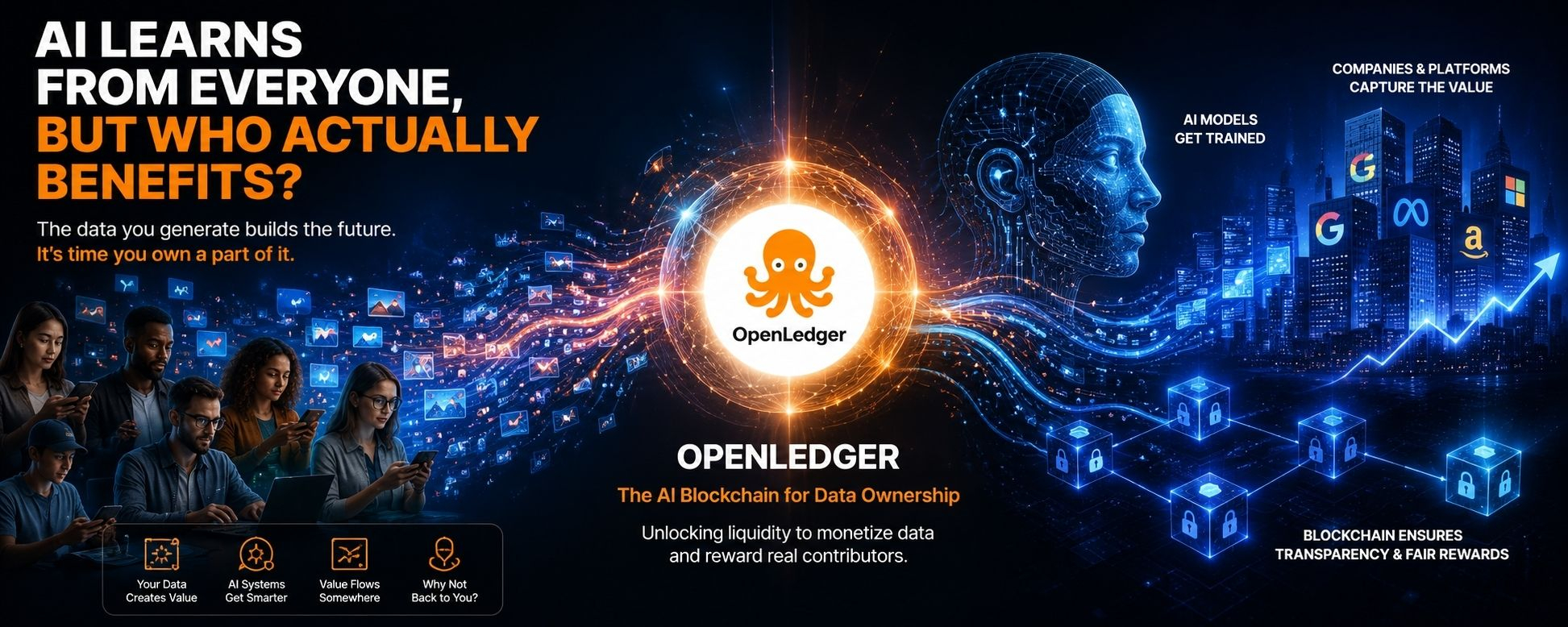
A few years ago, most people never thought about where the data behind artificial intelligence actually came from. AI felt distant, almost abstract, like something produced entirely inside giant servers owned by technology companies. But slowly, a strange realization started becoming harder to ignore. Every search, every conversation, every image upload, every online review, every digital interaction was quietly helping train intelligent systems somewhere in the background. The internet stopped being just a communication layer and became a resource field for machine learning.
What makes this uncomfortable for many people is not simply the collection of data. It is the imbalance behind it. Millions of individuals continuously generate information that improves algorithms, recommendation engines, language models, and automated systems, yet very few of those contributors ever participate in the economic value created afterward. The structure resembles an invisible supply chain where the raw material comes from ordinary users while ownership remains concentrated elsewhere.
For years, blockchain developers tried to challenge parts of this structure. Some projects built decentralized storage systems. Others created marketplaces where datasets could be uploaded and sold. A few attempted to tokenize machine learning infrastructure itself. But many of these ideas struggled because data behaves differently from traditional digital assets. It can be copied endlessly, manipulated easily, and lose context quickly. In most cases, the systems became more speculative than practical.
The harder problem was trust. Not trust in the blockchain itself, but trust in the value of information moving through the network. How do you measure whether one dataset genuinely improved an AI model? How do you reward contributors fairly when thousands of people may have indirectly influenced a system over time? And how do you prevent large players from dominating the entire process simply because they already control massive amounts of information?
That is where projects like started attracting attention. Not because they claimed to solve everything, but because they approached the problem from a slightly different direction. Instead of treating data as a static file sitting in storage, OpenLedger appears to view data as something active, something that keeps generating value as AI systems evolve and consume it repeatedly.
The idea behind the network feels connected to a larger shift happening across technology right now. AI models are no longer limited by algorithms alone. Increasingly, the bottleneck is access to useful, structured, constantly updated information. Companies can build advanced models, but without reliable data pipelines those systems eventually become outdated or less effective. OpenLedger seems to be positioning itself around this growing tension between AI demand and data ownership.
One interesting part of the project is how it tries to connect contribution with attribution. In theory, if someone provides data that improves an AI application, the system should be able to recognize that contribution over time instead of treating the dataset as disposable. This may sound simple when explained casually, but technically it is extremely difficult. Information moves through AI systems in messy and layered ways. Data gets transformed, compressed, refined, and merged with countless other inputs.
What OpenLedger appears to understand is that full on-chain AI computation is probably unrealistic for now. Running advanced machine learning entirely through blockchain infrastructure remains expensive and inefficient. So instead of forcing everything onto the chain, the project seems more focused on coordination. Tracking contributions, validating interactions, and creating economic relationships around AI activity may ultimately matter more than trying to decentralize every single computation step.
There is also a subtle philosophical difference in how projects like this talk about data. Earlier internet platforms treated user activity almost like free fuel. The assumption was that participation alone was enough compensation because users gained access to digital services. But AI changes the scale of extraction. When machine intelligence can continuously learn from human behavior at global scale, questions around ownership become much harder to avoid.
Still, there are reasons to remain cautious. Data markets sound elegant in theory, yet quality control becomes incredibly complicated once incentives enter the picture. If people are rewarded for contributing information, some participants may prioritize volume over usefulness. Others may attempt to manipulate systems entirely. Blockchain can record transactions permanently, but permanence does not automatically create truth.
Privacy also remains an unresolved contradiction inside nearly every AI-blockchain experiment. The most valuable datasets are often sensitive. Healthcare records, enterprise workflows, behavioral patterns, and financial histories all contain information that organizations may never want exposed publicly. Balancing transparency with confidentiality may become one of the defining challenges for networks like OpenLedger in the years ahead.
Another uncomfortable question is whether decentralization actually changes power structures or simply redistributes them slightly. Large institutions already possess enormous data advantages. Even inside open systems, wealthier participants may still dominate because they can contribute larger datasets, operate more infrastructure, and influence governance more aggressively than smaller users. Blockchain networks often begin with idealistic visions before gradually recreating familiar hierarchies.
Yet despite these concerns, the emergence of projects like OpenLedger says something important about where both crypto and AI may be heading. Earlier blockchain cycles focused heavily on speed, speculation, and financial engineering. The newer conversation feels more connected to infrastructure around intelligence itself. Who owns information? Who benefits from machine learning? Who gets excluded from the systems shaping automated decision-making?
In some ways, OpenLedger feels less like a finished answer and more like an experiment responding to a growing discomfort around digital economies. People are starting to notice that modern AI systems are built on vast layers of human contribution that remain largely invisible. Whether blockchain can genuinely create fairer coordination around that process is still uncertain.
The deeper issue may not even be technology. It may be whether society is willing to rethink the relationship between human knowledge and machine intelligence before those systems become too deeply embedded into everyday life. If data becomes one of the most valuable resources of the AI era, then the real question is not only who monetizes it, but who ultimately controls the rules around its use.
