
I’ve been thinking about smart contracts on OpenLedger for a while, and at first it felt quite familiar, nothing too new. Another blockchain platform, another smart contract layer—it sounded just like what we’ve already seen from Ethereum, EOS, and countless other chains before. The concept of “smart contract” has almost become cliché in the crypto space: everyone talks about it, everyone implements it. Honestly, my first reaction was to dismiss it a bit, like: “Okay, another chain, also allowing contracts, also promising trustless execution.”
But if you think more carefully, OpenLedger isn’t just a copy-paste. What’s interesting is that they’re trying to redefine how smart contracts are deployed and managed. Their architecture seems to emphasize modularity—rather than a generic contract environment, they create layers of control and integrated governance mechanisms. Sounds fine, but not necessarily convincing, so I started wondering whether this is a real step forward or just a “permission layer” added to make the system look safer.
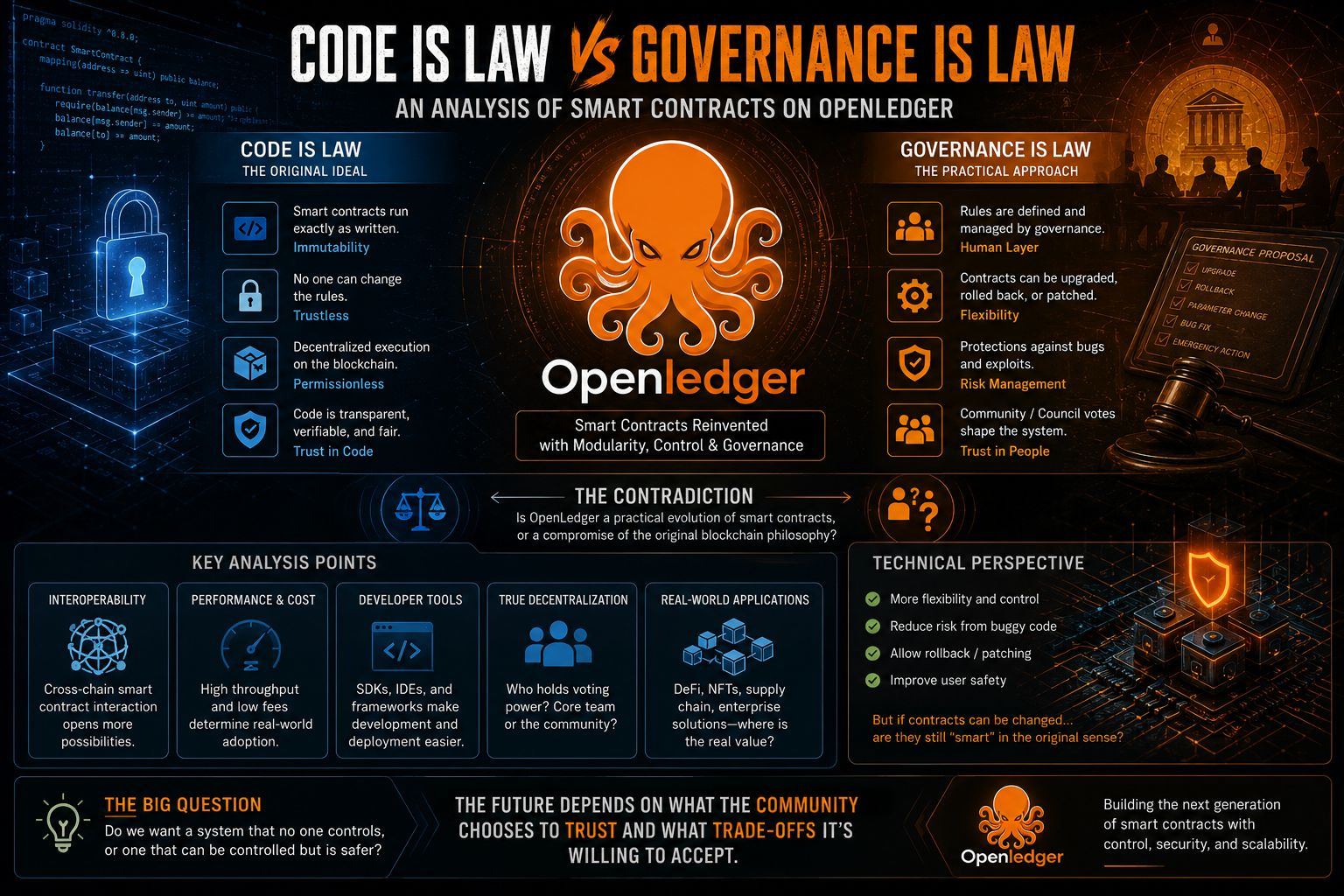
Another point is that smart contracts have long been praised as “code is law.” But on OpenLedger, it seems “law” is defined by someone behind the scenes, by the governance framework they’ve built. The issue is that technology is never neutral. Once you add governance and control mechanisms, you’re shifting trust from code to people—or at least to a group of people. That means instead of being fully trustless, you have to trust how they design, maintain, and handle bugs or exploits. And then the question comes back: who really controls it?
From a technical perspective, smart contracts on OpenLedger might bring more flexibility, reduce risks from poorly written contracts, and allow rollback or patching. That makes sense, since we’ve seen too many hacks and too much money lost over a single line of code. But if contracts can be modified or rolled back, are they still “smart” in the original sense? Or are they just programs running on a permissioned system where “immutability” is more of a slogan?
What’s fascinating is this very contradiction. On one hand, ordinary users might feel safer knowing there are protections and governance. On the other hand, those who believe in the original blockchain philosophy see this as compromise, even regression. And so I wonder—maybe smart contracts were never truly about “code is law” in the absolute sense, but about who gets to define the law, who gets to change it, and where the community places its trust.
Beyond that, several other aspects are worth noting:
Interoperability: If OpenLedger enables cross-chain smart contract interaction, this would be a major advantage compared to platforms locked into their own ecosystems.
Performance and cost: New platforms often emphasize transaction speed and low fees. If OpenLedger optimizes gas fees and throughput, that’s a practical strength.
Developer tools: Providing SDKs, IDEs, or frameworks to help developers write, test, and deploy contracts easily will directly affect adoption.
True decentralization: Governance frameworks sound reasonable, but who actually holds voting power? If it’s only the core team, the system remains centralized.
Real-world applications: What domains are OpenLedger smart contracts being used for? DeFi, NFTs, supply chain, or enterprise solutions? Concrete case studies would demonstrate their actual value.
Honestly, I’m not sure if OpenLedger is heading in the right direction. Maybe this is a more practical approach, or maybe it’s a dilution of the original philosophy. The real issue is whether we want a system that no one controls, or one that can be controlled but is safer. That’s the true test—it all depends on what the community chooses to trust and what trade-offs it’s willing to accept.
$OPEN @OpenLedger #Openledger