
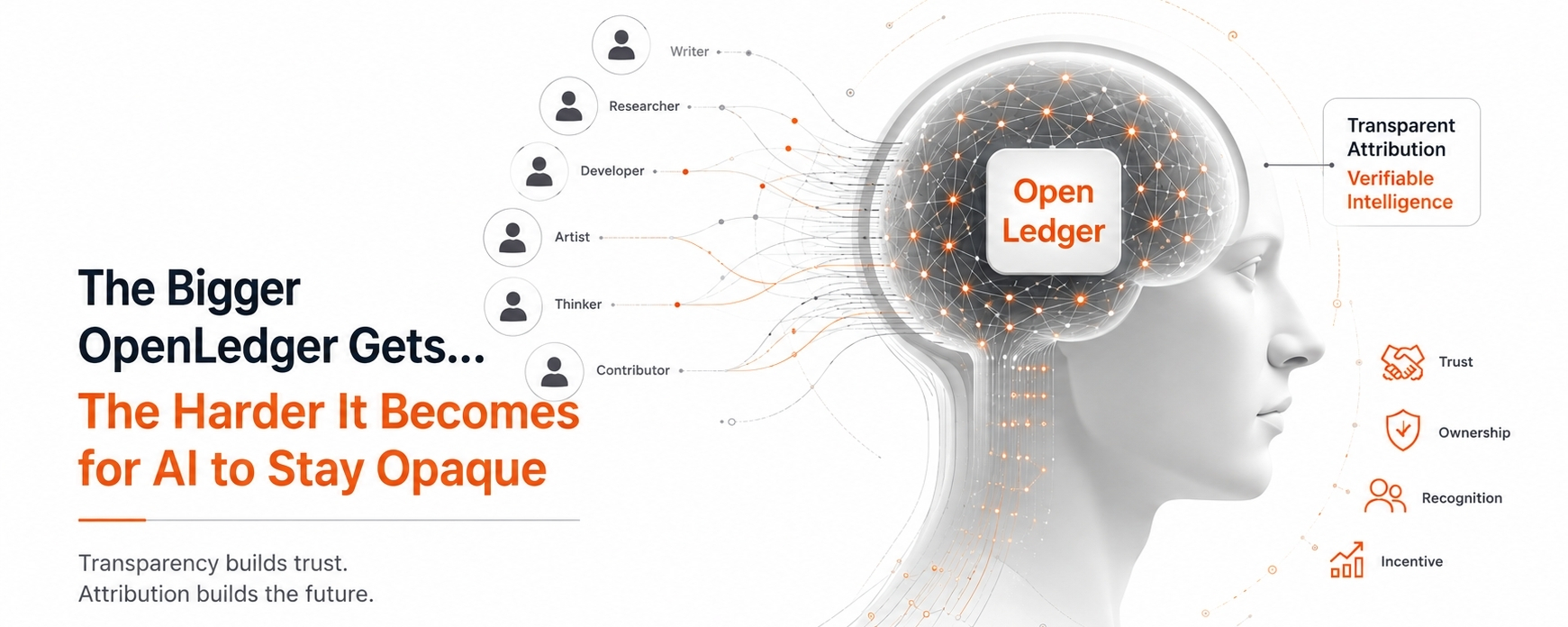

There’s something deeply uncomfortable about modern AI that most people still haven’t fully sat with yet.
The smarter AI becomes… the less visible humans become inside it.
At first that sounds dramatic. Maybe even exaggerated. But the more I think about it, the more I feel like this is quietly becoming one of the biggest psychological shifts happening on the internet right now.
Because AI does not appear from nowhere.
It absorbs people slowly.
Their writing. Their emotions. Their patterns. Their jokes. Their questions. Their arguments. Their late-night thoughts scattered across forums and social platforms for years.
Millions of tiny human signals went into these systems.
But once the final AI output appears, all those individual fingerprints disappear into one clean machine response.
And honestly… I think that changes human behavior more than people realize.
That’s partly why something like OpenLedger keeps pulling my attention lately.
Not because of the usual “AI + blockchain” buzzwords. Most of that stuff fades fast anyway.
What feels different is the psychological direction underneath it.
The idea that maybe intelligence should not become completely opaque as it scales.
Because right now, AI systems are becoming incredibly powerful while simultaneously becoming harder to emotionally understand.
People no longer know: Who contributed. Who influenced the output. Who created value. Who should benefit. Who disappears behind the interface.
Everything starts collapsing into one giant black box.
And humans behave differently around black boxes.
That part matters.
When people feel invisible inside a system, participation changes. Motivation changes. Trust changes.
You can already see hints of this online.
Artists feel drained. Writers feel replaceable. Communities feel harvested. People contribute constantly but increasingly wonder whether any of it still belongs to them once AI absorbs it.
That creates a strange psychological tension.
Because humans actually like feeling traceable.
Not controlled. Not watched.
Just recognized.
There’s a reason people care about credits in movies. Tags on posts. Citations in research. Names on buildings. Likes on tweets. Reputation systems in games.
Humans want proof they existed inside the outcome.
AI quietly removes that feeling.
And the larger AI gets, the more invisible contribution becomes.
That’s why Proof of Attribution feels bigger to me than just another technical feature.
It feels like an attempt to restore memory back into digital intelligence.
Almost like saying: “Wait… before all human contribution disappears into machine abstraction forever, maybe we should keep some trace of where intelligence actually came from.”
Maybe I’m overthinking it.
But I honestly don’t think most people understand how psychologically important attribution is until it disappears.
Because attribution is not only about money.
It’s about identity.
Once systems stop remembering contributors, power naturally shifts toward whoever owns the interface instead.
That is the hidden incentive underneath a lot of modern AI.
Centralization becomes easier when contribution becomes blurry.
If nobody can trace where value came from, then value becomes easier to capture at the top.
That is why opacity is useful.
Opacity protects concentration.
And the scary part is… most users accept it because convenience feels good.
People usually trade transparency for speed without thinking twice.
But over time that changes culture itself.
The internet slowly moves from: “people creating together to
“systems extracting quietly.”
That emotional difference matters more than the technology.
And honestly, I think projects like [OpenLedger](https://openledger.xyz?utm_source=chatgpt.com) are reacting to that deeper shift even if most people still frame it as just infrastructure.
Because infrastructure always shapes behavior eventually.
Always.
Social media changed behavior because incentives changed.
Gaming changed behavior because rewards changed.
AI will change behavior too.
The question is whether humans remain economically and psychologically visible inside those systems… or whether intelligence slowly turns into something owned only by whoever controls the largest models and distribution layers.
That’s the bigger tension I keep coming back to.
Not “Will AI become smarter?”
It obviously will.
The real question is: Will humans still feel connected to the value they helped create once AI becomes the dominant interface for knowledge itself?
Because if contribution becomes permanently invisible, people may eventually stop feeling emotionally attached to the systems they feed every day.
And that creates another problem nobody talks about enough:
Invisible contributors become disengaged contributors.
Communities weaken when people stop feeling seen.
Attribution may sound small today. But psychologically, it changes whether participation feels collaborative… or extractive.
That difference could shape the entire future culture around AI.
Maybe that is why OpenLedger feels interesting to me.
Not because it promises some magical future.
But because it feels like one of the first systems asking a very uncomfortable question that the rest of AI keeps avoiding:
If intelligence was built collectively…
why does ownership suddenly become invisible once the value appears?