
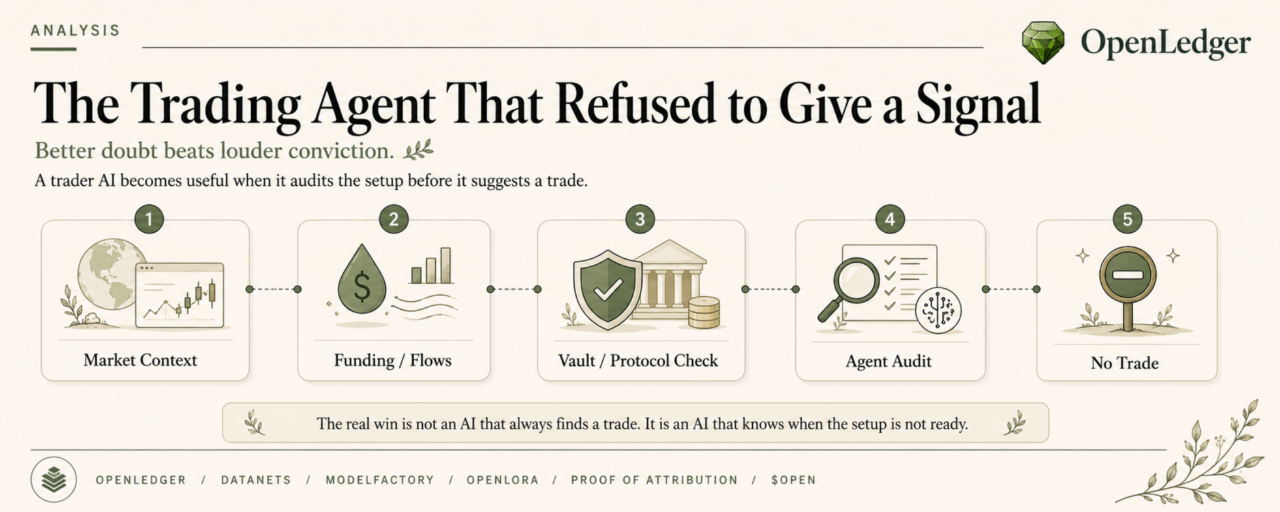
I gave the agent a simple job:
“Find me a trade.”
It came back with something annoying.
“No trade.”
At first, that sounds useless. Traders do not open charts because they want a lecture. They want direction. Long or short. Entry, invalidation, target. Clean answer. Fast.
But the more I looked at the refusal, the more useful it became.
Most losses do not start when the candle moves against you. They start earlier, when the setup looks obvious because half the context is missing.
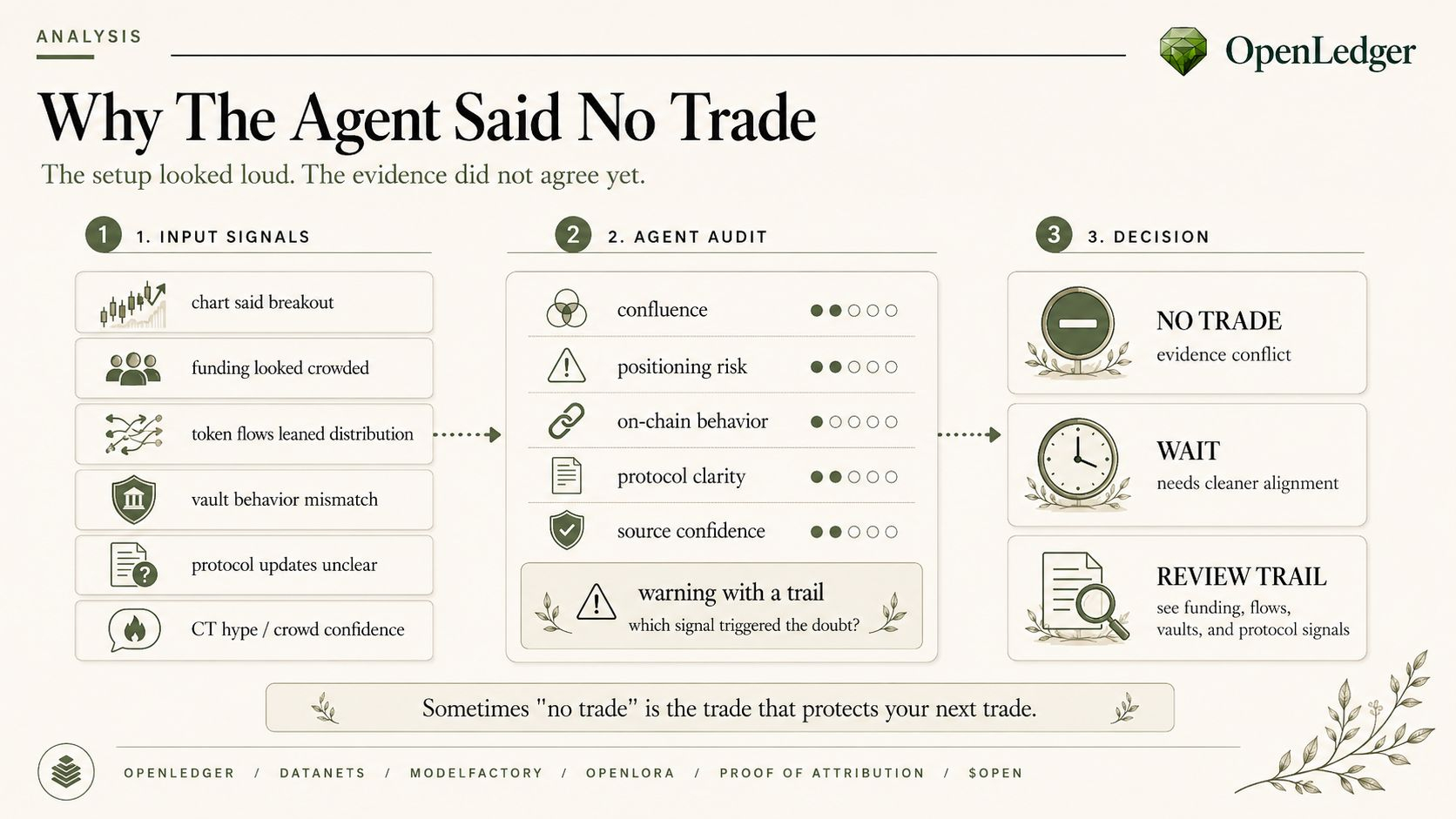
The chart said breakout.
Funding looked crowded.
Token flows leaned distribution.
Vault behavior was not matching the hype.
Protocol updates were still unclear.
CT was screaming confidence.
The agent did not give me a signal. It gave me an audit.
It basically said: your trade idea is not wrong because the candle is ugly. It is weak because the surrounding evidence does not agree yet.
That is the type of AI I would actually want as a trader.
Not a machine that shouts “long” faster than a Telegram group.
A machine that slows me down before I turn noise into conviction.
This is where OpenLedger (@OpenLedger ) fits in a more interesting way. A trading agent is only useful if the backend can separate real context from recycled market noise. Otherwise, it just becomes another confident voice in the crowd.
With OpenLedger, the idea is not just “AI gives an answer.” The better idea is that the answer can carry a source trail.
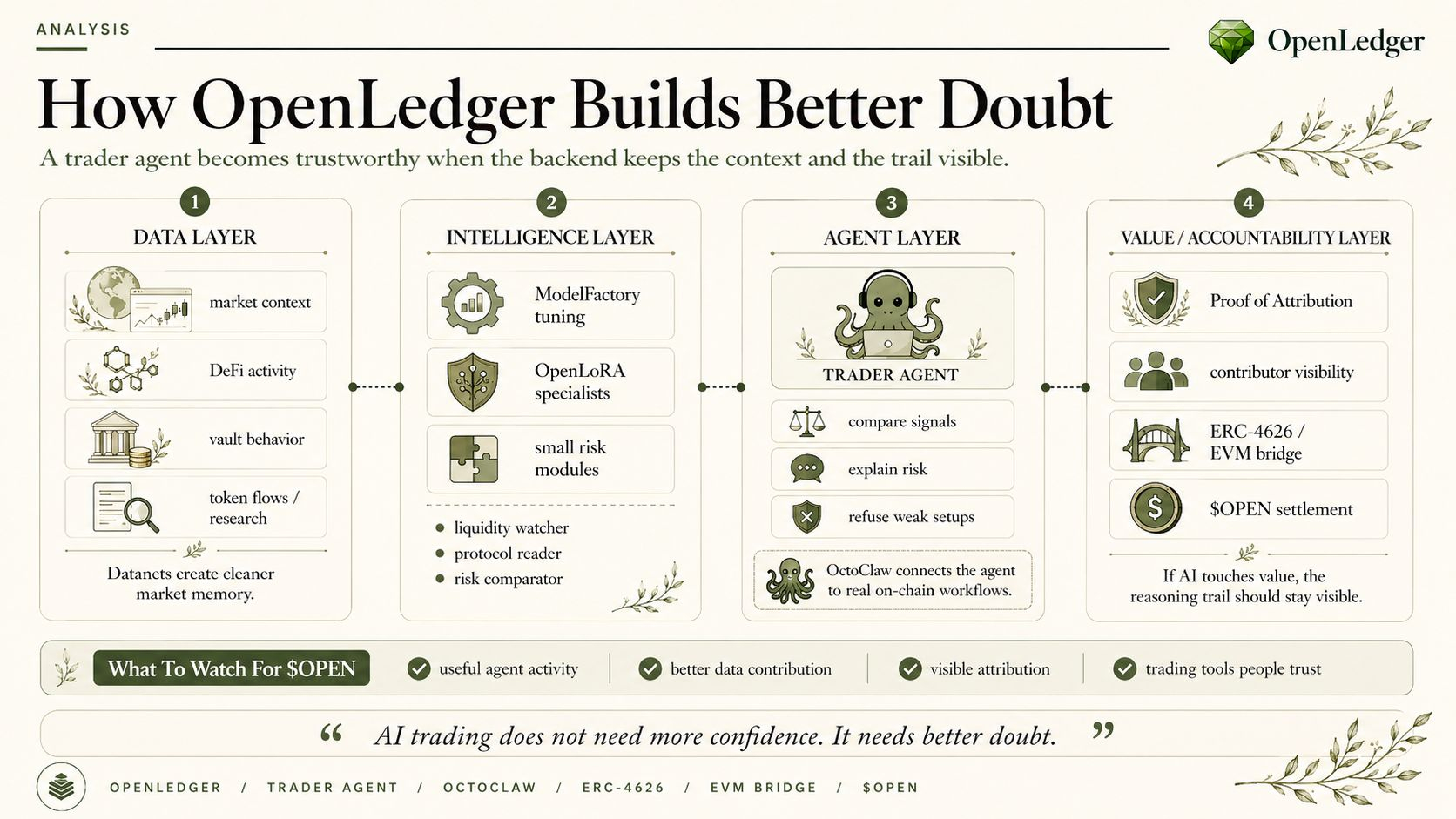
For this kind of agent on OpenLedger, Datanets would work like cleaner market memory. Instead of feeding the model random internet soup, the agent could lean on more focused data environments for things like liquidity behavior, protocol signals, DeFi activity, and trading context.
inside OpenLedger, Proof of Attribution is what makes the refusal more valuable. If the agent says “do not take this setup,” I do not only want the warning. I want to know what triggered it. Was the concern from funding? Vault activity? token movement? protocol data? contributor research?
A warning with a trail is different from a warning with vibes.
The build side also changes. ModelFactory and OpenLoRA make more sense when I think about trader agents as small specialist systems instead of one giant model pretending to understand every market condition. One module can watch liquidity. Another can read protocol changes. Another can compare risk signals. The final answer becomes less like a random prediction and more like a checked report.
Octoclaw on OpenLedger makes this direction feel closer to actual usage too. Trading agents, vibecoding, cloud config, ERC-4626, and EVM bridge support all point toward agents that can move beyond chat and connect with real on-chain workflows.
The real win is not an AI that always finds a trade.
The real win is an AI that knows when the setup is not ready.
Because sometimes “no trade” is the trade that protects your next trade.
For OpenLedger, I would watch whether this loop becomes real: useful agent activity, better data contribution, visible attribution, and trading tools that people trust because the backend does not hide the reasoning.
AI trading does not need more confidence.
It needs better doubt.