

Some narratives in crypto arrive loudly.
Others slowly reshape the way you see the market.
$OPEN feels closer to the second type.
For years, the crypto industry has obsessed over liquidity. Not just capital liquidity, but attention liquidity. Projects fought for trading volume, memes fought for virality, and creators fought for visibility. Yet one thing quietly remained undervalued the actual intelligence people produce every day.
Data.
Models.
Human contribution.
AI behavior.
Digital work that never truly belonged to the people creating it.
That’s why @OpenLedger caught my attention.
Not because it promised another “AI revolution.” We hear that every week now.
But because it asked a more uncomfortable question:
What if the most valuable asset in the next cycle isn’t the token itself… but the intelligence connected to it?
That changes the conversation completely.
Most people still see AI as something controlled by large companies with massive compute power and closed ecosystems. Crypto users, meanwhile, have spent years talking about ownership, decentralization, and incentives.
$OPEN feels like one of the few projects trying to connect those two worlds in a meaningful way.
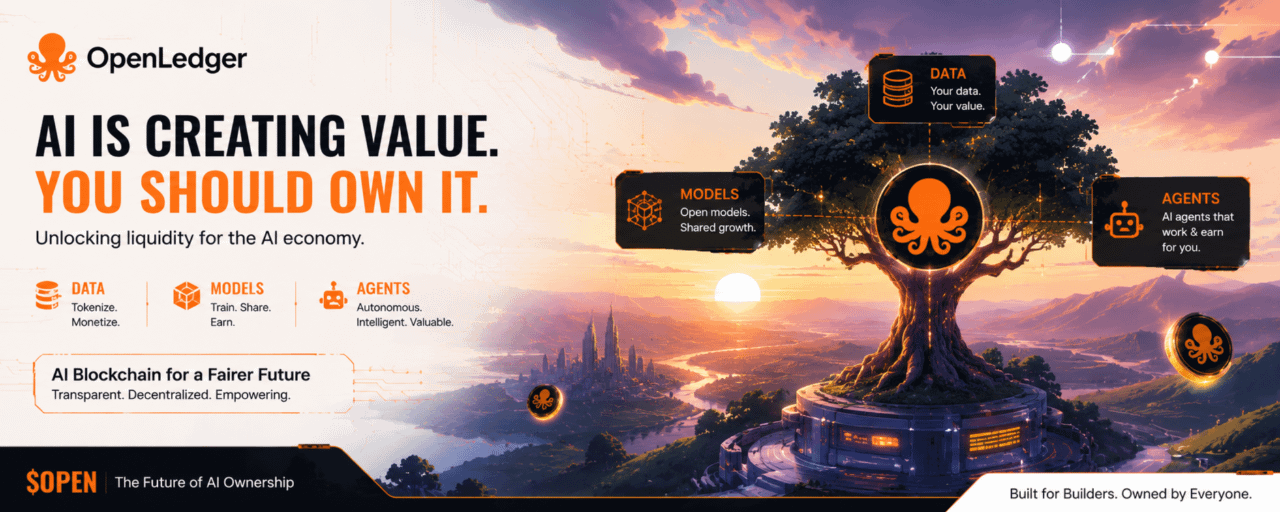
An AI blockchain focused on monetizing data, models, and agents sounds technical at first. But underneath the terminology is something surprisingly human.
People want ownership over the value they create.
Not just artists.
Not just developers.
Everyone.
The internet trained us to give away our data for free. Every search, every click, every preference became fuel for platforms that monetized us better than we monetized ourselves.
AI accelerated that imbalance.
Now models are being trained on enormous amounts of public behavior while the individuals generating that behavior receive almost nothing in return.
That tension is growing quietly beneath the surface of the AI boom.
And markets usually move toward unresolved tension.
I realized this a few months ago while watching how quickly AI narratives dominated crypto timelines. Almost every project suddenly became “AI-powered.” Some sounded innovative. Others felt like branding exercises designed for engagement farming.
But behind the noise, one pattern stood out.
The projects gaining real long-term attention weren’t just adding AI features. They were building systems around AI ownership and contribution.
That distinction matters.
Because eventually, people stop asking:
“Does this project use AI?”
And start asking:
“Who benefits from the intelligence being created?”
That’s where #OpenLedger becomes interesting.
The idea of unlocking liquidity around models, datasets, and autonomous agents introduces a new layer to crypto economics. Instead of treating AI as a centralized black box, it treats intelligence itself as something composable, ownable, and economically active.
It’s a subtle shift, but potentially a massive one.
Think about how DeFi transformed idle capital into productive capital.
Now imagine similar mechanisms applied to AI assets.
Datasets could become monetizable primitives.
Models could become interoperable financial layers.
AI agents could operate across ecosystems while generating value autonomously.
Whether the market is fully ready for that yet is another question.
But timing in crypto has always been strange.
Sometimes infrastructure arrives before people understand why it matters.
I remember when people laughed at decentralized storage because “cloud providers already exist.” Years later, data sovereignty became a real conversation. The same happened with decentralized finance before yield farming exploded into mainstream crypto culture.
The market rarely rewards ideas immediately.
It rewards them once pain becomes obvious.
And right now, the AI economy still has unresolved pain.
Ownership.
Transparency.
Contribution incentives.
Data provenance.
Value distribution.
These are not small issues.
They become even bigger once AI agents begin interacting economically with each other at scale.
That’s why I think projects like $OPEN deserve attention beyond short-term speculation.
Not because every AI blockchain will succeed.
Most won’t.
But because the direction itself feels inevitable.
We are moving toward a world where digital intelligence becomes an economy of its own.
When that happens, the systems deciding who owns, monetizes, and governs that intelligence will matter more than people realize today.
There’s also a psychological layer here that I find fascinating.
Crypto users are emotionally exhausted from empty narratives.
People have seen too many tokens launch with billion-dollar visions and zero meaningful utility. Attention spans became shorter because trust became weaker.
So when a project introduces a concept that actually connects to a real-world shift like AI monetization people become cautiously curious instead of blindly euphoric.
That’s healthier.
The strongest communities are usually built through resonance, not hype.
And honestly, I think that’s one reason conversations around @OpenLedger feel different lately. There’s still speculation, obviously this is crypto but there’s also a deeper curiosity underneath it.
People are trying to understand where AI ownership fits into the next phase of the internet.
Not every project creates that kind of reflection.
One lesson I keep learning in crypto is that narratives matter most when they connect to human behavior.
The projects that survive are rarely the loudest.
They’re the ones aligned with where people are psychologically moving.
Right now, people want more control over digital value.
Over identity.
Over creativity.
Over data.
Over intelligence itself.
That doesn’t mean every AI token will win.
But it does mean the market is searching for infrastructure that feels aligned with that future.
And maybe that’s the real opportunity behind #OpenLedger.
Not simply building another blockchain.
But helping redefine who captures value in the AI era.
The biggest shifts often look abstract before they look obvious.
Curious to hear what others think:
Do you believe AI-generated value should belong more to platforms… or to the people contributing the intelligence behind it?