

I kept bouncing between skepticism and curiosity while reading about OpenLedger. A lot of crypto AI projects feel like they were assembled backward: somebody notices that AI attracts capital, somebody else notices that blockchain still attracts attention, and eventually you get a whitepaper full of diagrams explaining why a token now needs to exist between a chatbot and a database. OpenLedger didn’t immediately escape that suspicion for me. For the first hour or two I genuinely could not tell whether
Payable AI was a real technical framework or just a cleaner branding layer wrapped around revenue sharing.
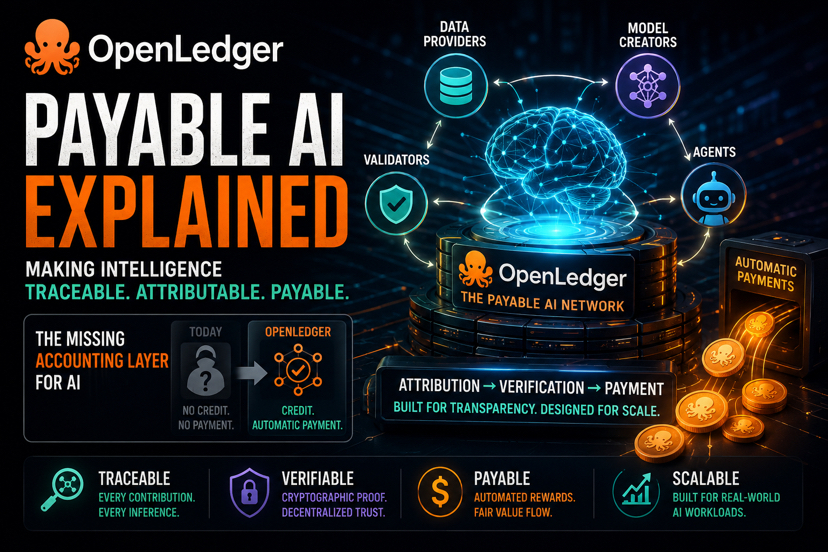
The thing that changed my mind a little was realizing they are less obsessed with the model itself than with the accounting around the model. That sounds dry, but I think it matters. Most AI systems today operate like restaurants where nobody knows who cooked the food, where the ingredients came from, or who should get paid when the place becomes successful. Data goes in, models come out, value accumulates somewhere inside a private company, and the contribution trail disappears. OpenLedger seems to be arguing that this disappearing act is not a side effect of AI but one of its central economic problems
I still don’t fully understand every moving piece in their attribution system. I spent an embarrassing amount of time rereading sections about validator coordination because I couldn’t figure out whether the network is primarily verifying data quality, model performance, or financial distribution logic. Maybe the answer is all three, which is partly why it took me a while to parse. But the broad idea eventually clicked for me: if AI becomes infrastructure, then attribution becomes infrastructure too. Somebody will want proof that a dataset improved a model. Somebody will want proof that an inference request used a certain specialized agent. Somebody will want payment to flow automatically to contributors instead of vanishing into platform margins.
That is where their Payable AI concept started feeling more concrete to me. The goal is not just to build AI that works; plenty of companies already do that. The goal is to make intelligence itself economically traceable. A model generates value, and the system keeps a record of who helped produce that capability in the first place. Data providers, model creators, validators, and agents all become participants in a financial graph instead of invisible labor hidden behind an API call. Crypto projects love inventing abstract economies that nobody actually needs. This felt closer to a bookkeeping problem that the current AI industry has mostly ignored because centralized companies benefit from the ambiguity.
The other part I kept coming back to was OpenLedger’s obsession with technical precision. Not precision in the marketing sense where every startup claims to have advanced infrastructure, but precision in the narrower sense of specialization. They do not seem interested in building one giant universal intelligence that talks like a polished intern about every topic on earth. They lean toward domain focused models and traceable inference systems where performance can actually be measured against context specific tasks. That struck me as more believable than the usual frontier model fantasy. In practice, most useful AI probably won’t look like one omniscient machine. It will look messy and fragmented and highly specialized, with systems tuned for particular industries, particular workflows, particular kinds of reasoning.
I was surprised by how much the project feels shaped by logistics rather than ideology. I expected more rhetoric about decentralization saving humanity. Instead I found a lot of discussion around coordination, verification, and attribution mechanics. It reads less like a manifesto and more like people worrying about audit trails for machine intelligence. Which, admittedly, is not the sort of thing that usually goes viral on crypto Twitter.
I still have unresolved questions. I don’t know whether people will tolerate the extra complexity required for attribution heavy AI systems when centralized platforms remain faster and simpler. I don’t know how efficiently these payment flows hold up at scale once actual enterprise workloads start moving through them. And I am not convinced users care about provenance until something breaks badly enough that they suddenly do. But I also can’t really unsee the underlying problem anymore. AI companies are building enormous value extraction systems on top of data and labor they often cannot clearly account for, and OpenLedger is one of the few projects I have seen trying to treat that ambiguity as a technical issue instead of a public relations issue.