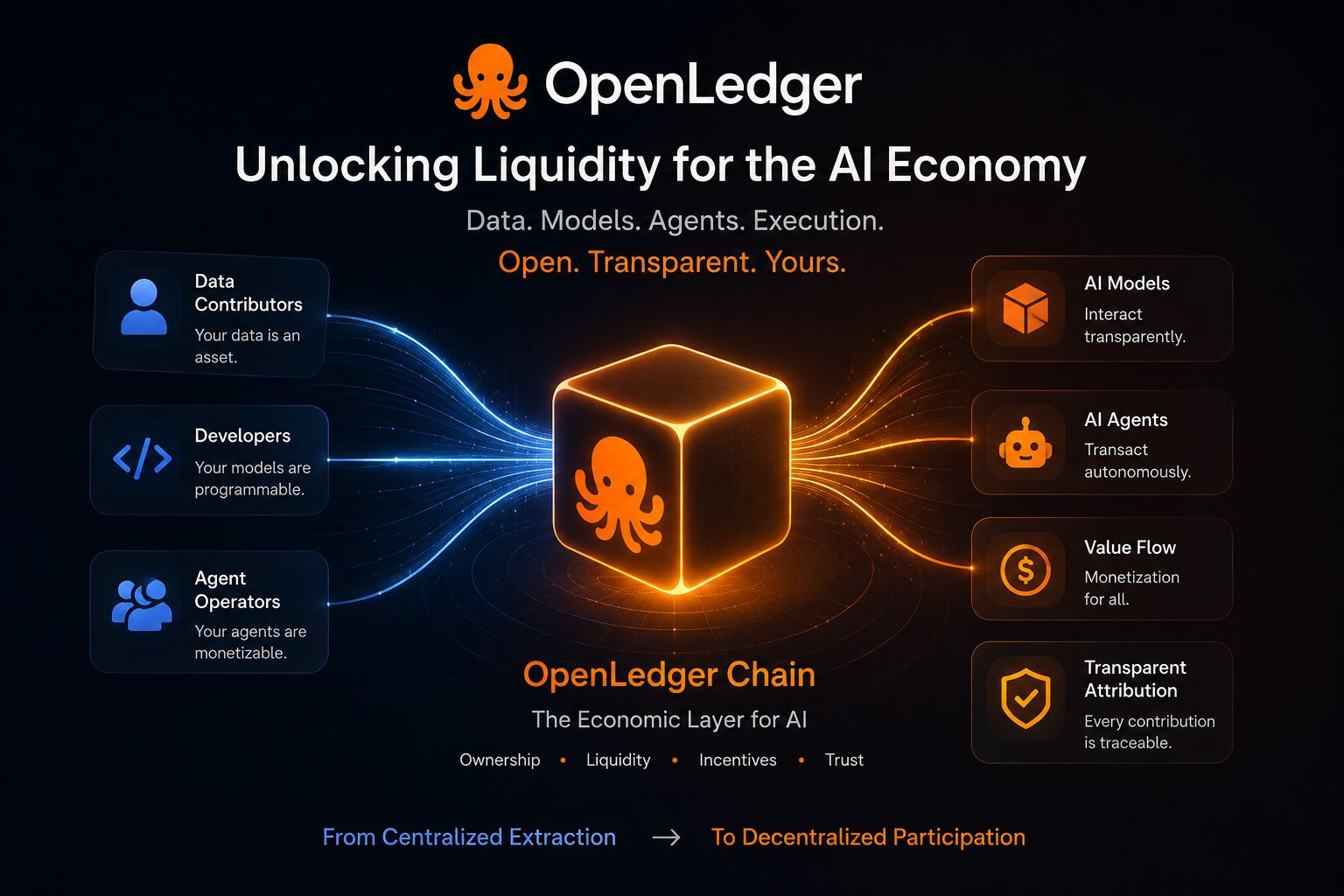
The future of artificial intelligence will not be owned by the platforms building the loudest models.
It will belong to the infrastructure that allows intelligence itself to move freely.
Data.
Models.
Agents.
Execution.
Today, the AI economy is deeply centralized.
Users generate data.
Developers build systems.
Communities contribute intelligence.
Yet the value created flows upward into closed ecosystems where ownership, monetization, and transparency remain inaccessible to the very people powering the network.
That model may not survive the next evolution of AI.
Because intelligence is becoming an economy of its own.
And OpenLedger ($OPEN) is positioning itself at the center of that transformation.
Not as another chain attaching “AI” to a narrative.
But as an AI-native blockchain designed to unlock liquidity across the entire intelligence layer.
A system where data becomes an asset.
Models become programmable.
Agents become monetizable.
And contribution becomes traceable.
That changes everything.
For years, AI development operated like a black box.
Massive datasets entered hidden systems.
Outputs emerged.
Nobody knew where information originated.
Nobody understood attribution.
And contributors rarely captured value.
OpenLedger introduces a fundamentally different structure.
An ecosystem where intelligence can be verified, tracked, and economically aligned.
Imagine an AI model generating value while the original data contributors, developers, and agent operators all participate in the economic flow surrounding that intelligence.
That is the shift @OpenLedger is building toward.
An open coordination layer for AI.
Not just computation.
Not just infrastructure.
But ownership.
As AI agents become increasingly autonomous, they will require more than processing power.
They will require identity.
Liquidity.
Execution layers.
Economic coordination.
Transparent attribution.
Most current systems are not designed for that future.
OpenLedger is.
The interesting part is that this narrative extends far beyond crypto speculation.
Because what OpenLedger is attempting to solve is one of the largest unanswered questions in artificial intelligence:
Who owns the value created by AI?
The corporations controlling the models?
Or the millions contributing the intelligence behind them?
That question will define the next decade.
And infrastructure solving it early may become incredibly important.
The AI sector is entering a phase where the market will gradually separate surface-level narratives from foundational architecture.
Fast agents alone are not enough.
Automation alone is not enough.
Even powerful models alone are not enough.
The systems that matter long term will be the ones capable of coordinating trust, ownership, incentives, and execution at scale.
That is where OpenLedger feels different.
It is not merely building another blockchain.
It is building an economic layer for artificial intelligence itself.
A marketplace where intelligence becomes liquid.
Where models can interact transparently.
Where agents can transact autonomously.
Where data contributors are no longer invisible.
And where AI evolves from centralized extraction into decentralized participation.
If this vision succeeds, the future of AI may not belong to isolated corporations controlling closed ecosystems.
It may belong to open intelligence networks powered by transparent infrastructure.
And OpenLedger $OPEN is quietly positioning itself to become one of those foundations.