
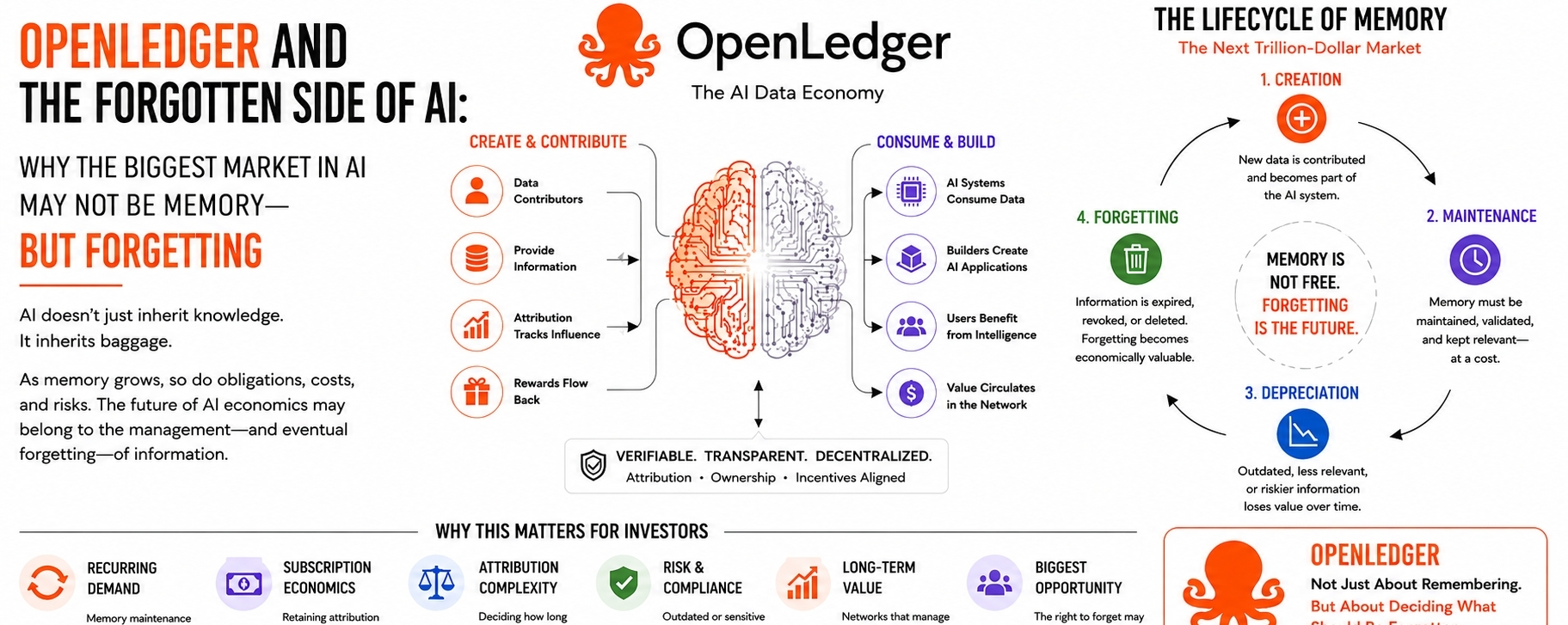
OpenLedger and the Forgotten Side of AI: Why the Biggest Market in Artificial Intelligence May Not Be Memory—But Forgetting
Crypto investors have a habit.
We are naturally attracted to accumulation.
More users.
More transactions.
More data.
More adoption.
More intelligence.
The market loves growth because growth is easy to visualize. A chart moving up is simple. A network expanding is simple. An AI model learning more information is simple.
Accumulation feels intuitive.
That is why most AI infrastructure narratives follow the same script.
The future belongs to whoever gathers the most data.
Whoever trains on the most information.
Whoever captures the largest network of contributors.
Whoever remembers the most.
At first glance, OpenLedger fits neatly into that framework.
Data contributors provide information.
AI systems consume that information.
Attribution tracks influence.
Rewards flow back to contributors.
The token coordinates incentives.
Simple.
Clean.
Understandable.
The kind of narrative that crypto markets usually reward.
But the longer I looked at the idea, the less interested I became in what OpenLedger remembers.
And the more interested I became in what eventually needs to be forgotten.
Because there is a side of AI economics that almost nobody talks about.
A side that becomes more important as intelligence systems become more powerful.
A side that could eventually become larger than attribution itself.
The economics of memory decay.
The economics of forgetting.
And if that future arrives, OpenLedger may be participating in a much larger market than most investors currently realize.
The Hidden Assumption Behind Every AI Narrative
Most AI discussions begin with an assumption that nobody questions.
Memory is good.
More memory is better.
More context improves outputs.
More training data improves intelligence.
More historical knowledge improves performance.
The assumption sounds obvious.
After all, humans benefit from memory.
Organizations benefit from memory.
Civilizations benefit from memory.
So naturally, AI should benefit from memory too.
Right?
Maybe.
But there is another side to memory that markets rarely price correctly.
Memory creates obligations.
The moment information enters a system, responsibilities begin to accumulate.
And responsibilities are expensive.
Very expensive.
Every piece of retained information creates potential consequences.
Who owns it?
Who contributed it?
Who deserves compensation?
Who can revoke access?
Who controls usage rights?
What happens if the information becomes outdated?
What happens if regulations change?
What happens if attribution is disputed?
What happens if the original contributor disappears?
What happens if the information becomes commercially sensitive?
What happens if keeping that memory creates more risk than value?
Suddenly memory stops looking like an asset.
It starts looking like a liability.
And that changes everything.
Intelligence Does Not Just Inherit Knowledge
It Inherits Baggage
This is the part of AI economics that fascinates me.
When people imagine artificial intelligence, they often imagine a machine becoming smarter.
What they rarely imagine is the growing weight attached to that intelligence.
Every system that learns eventually accumulates history.
Every history accumulates obligations.
Every obligation accumulates cost.
Think about the real world.
Companies don't simply collect information forever.
Banks don't keep everything forever.
Governments don't keep everything forever.
Medical systems don't keep everything forever.
Organizations spend enormous resources deciding what information should remain relevant and what information should expire.
Why?
Because memory has carrying costs.
The larger the memory base becomes, the more difficult it becomes to manage.
Now apply that logic to AI.
An intelligence system that continuously absorbs data doesn't simply become smarter.
It becomes entangled.
Entangled with contributors.
Entangled with incentives.
Entangled with ownership claims.
Entangled with compliance requirements.
Entangled with legal responsibilities.
Entangled with economic expectations.
At some point, memory stops being free.
And once memory stops being free, markets emerge.
The Most Interesting AI Market May Not Exist Yet
Let's run a thought experiment.
Imagine a future AI company.
The company uses OpenLedger-style infrastructure to acquire highly specialized domain knowledge.
Thousands of contributors provide valuable information.
Attribution is tracked.
Influence is measured.
Compensation is distributed.
Everyone wins.
Initially.
Then time passes.
Six months later, some of that information becomes outdated.
A year later, regulations change.
Two years later, commercial priorities shift.
Three years later, competitors emerge.
Suddenly information that once created value now creates friction.
The company faces a new problem.
Not how to acquire memory.
How to manage it.
How much should remain active?
How much should be depreciated?
How much influence should contributors continue receiving?
How long should attribution remain valid?
When should historical influence expire?
Who decides?
How is that decision priced?
These questions sound theoretical today.
But they become inevitable once AI systems begin operating at scale.
And once a problem becomes inevitable, economic activity follows.
Why Traders Should Care
Most infrastructure tokens fail for a surprisingly simple reason.
They solve onboarding.
But they don't solve recurrence.
There is a huge difference.
Onboarding creates excitement.
Recurrence creates value.
A contributor joins.
Uploads data.
Receives rewards.
Leaves.
That's activity.
But it isn't necessarily recurring activity.
A builder joins.
Consumes resources.
Launches a product.
Moves on.
Again, activity.
Not necessarily recurrence.
The market often mistakes participation for demand.
They are not the same thing.
Real demand appears when users are forced to return.
Again.
And again.
And again.
Ethereum works because transactions repeat.
Security networks work because protection must continue.
Infrastructure survives when economic obligations persist.
The strongest token models are rarely built around access.
They're built around maintenance.
And maintenance is where memory economics become fascinating.
Because memory is not a one-time decision.
It is a continuous decision.
Every day a system remembers something, someone is paying the cost of remembering.
That cost may be financial.
Operational.
Legal.
Regulatory.
Commercial.
But the cost exists.
And costs create recurring economic loops.
What If Remembering Becomes a Subscription?
This is where things become truly interesting.
Imagine a future where retaining contributor influence is not free.
Every month, organizations effectively pay to preserve access, attribution rights, or memory persistence.
Not because someone forces them to.
Because maintaining historical influence has economic consequences.
Now the network isn't merely monetizing data acquisition.
It is monetizing memory maintenance.
That distinction is enormous.
One is transactional.
The other is recurring.
One is episodic.
The other is structural.
Investors spend enormous amounts of time searching for recurring revenue models in traditional businesses.
Why should token networks be any different?
The strongest infrastructure networks are rarely those that people use once.
They're the networks people cannot stop using.
The Forgotten Side of Attribution
Most discussions around OpenLedger focus on attribution.
That makes sense.
Attribution is visible.
Easy to explain.
Easy to market.
Easy to understand.
But attribution itself creates a second-order problem.
What happens when attribution never ends?
Imagine thousands of contributors influencing a system over multiple years.
How should value be allocated?
Should contributors be compensated forever?
Should influence decay?
Should old contributions lose economic weight?
Should historical attribution expire?
Should relevance matter more than age?
Every answer creates a different economic model.
Every economic model creates different token demand dynamics.
And every demand dynamic creates different market outcomes.
This is why attribution is only the first chapter.
The much larger story may be the management of attribution over time.
The Threat Every Attribution Network Faces
Of course, none of this matters if the measurement system breaks.
And that is a risk investors should take seriously.
Attribution sounds elegant in a diagram.
Reality is usually messier.
How much of an AI-generated answer came from a specific contributor?
Five percent?
Ten percent?
Fifty percent?
How do you prove it?
How do disputes get resolved?
How do you prevent manipulation?
How do you prevent incentive farming?
How do you stop low-quality contributors from gaming rewards?
Every infrastructure network eventually discovers the same truth.
Economic systems attract optimization.
Optimization attracts exploitation.
And exploitation tests every assumption.
A network's durability depends on whether its verification systems survive those tests.
Not whether its marketing materials look convincing.
The Supply Question Nobody Should Ignore
Even if the architecture is brilliant, market structure still matters.
Crypto history is filled with excellent ideas that produced terrible returns.
Why?
Because supply overwhelmed demand.
Because token issuance outpaced adoption.
Because unlock schedules arrived faster than network usage.
Because narratives grew faster than economics.
Infrastructure investors should pay close attention to this.
An elegant thesis does not automatically create price appreciation.
The market eventually asks one question:
Who is buying?
And more importantly:
Who keeps buying?
If demand grows slower than supply, price discovery becomes difficult regardless of technological merit.
That is not a criticism.
It is simply reality.
What I Would Watch
If I were evaluating OpenLedger as a long-term infrastructure thesis, I would spend less time reading announcements and more time watching behavior.
Are contributors active without relying entirely on emissions?
Are builders returning repeatedly?
Are fees increasing?
Is network activity becoming self-sustaining?
Are economic participants behaving as though the network has become operationally necessary?
Because necessity is what ultimately creates durable demand.
Not excitement.
Not speculation.
Not narratives.
Necessity.
Markets can temporarily price stories.
Eventually they price dependence.
The Bigger Idea
I think many investors are looking at AI infrastructure through the wrong lens.
They are asking whether AI needs more data.
Whether AI needs attribution.
Whether AI needs contributors.
Those are important questions.
But they are not the deepest questions.
The deeper question is what happens after intelligence accumulates enough memory.
What happens when memory becomes expensive?
What happens when attribution becomes complex?
What happens when retaining influence becomes a liability?
What happens when forgetting becomes economically valuable?
Because history suggests something remarkable.
Every system that accumulates information eventually develops mechanisms to manage information.
Every mechanism eventually develops incentives.
Every incentive eventually creates markets.
And every market eventually creates winners.
The market may be pricing AI memory today.
But the larger opportunity may emerge tomorrow.
Not around intelligence itself.
Not around attribution itself.
But around the lifecycle of memory.
The creation of memory.
The maintenance of memory.
The depreciation of memory.
And ultimately...
The right to forget.
That is why OpenLedger interests me.
Not because it might help AI remember.
But because the future of intelligence may require an economy that decides what should no longer be remembered at all.
And if that future arrives, the market opportunity could be far larger than most people currently imagine.