
The market has a tiring habit of turning every new buzzword into the next “revolution.” After watching multiple cycles play out, I’ve become more cautious about that excitement. Most narratives are rarely as new as they appear. In many cases, it’s old infrastructure repackaged with fresh marketing to attract temporary liquidity. Token launches and incentive campaigns may look innovative on the surface, but underneath, the same structural weaknesses often remain unresolved.
One of the more persistent issues in DeFi is the fragmentation of yield vault infrastructure. Every protocol seems to operate with its own standards and custom architecture. When capital tries to move between platforms in search of stronger yields, it runs into unnecessary complexity. Different smart contract behaviors, incompatible accounting systems, and isolated vault logic create friction everywhere. Developers absorb integration headaches, while users indirectly pay through inefficiency and risk. The ecosystem often feels like a collection of incompatible systems forced to interact without a universal framework.
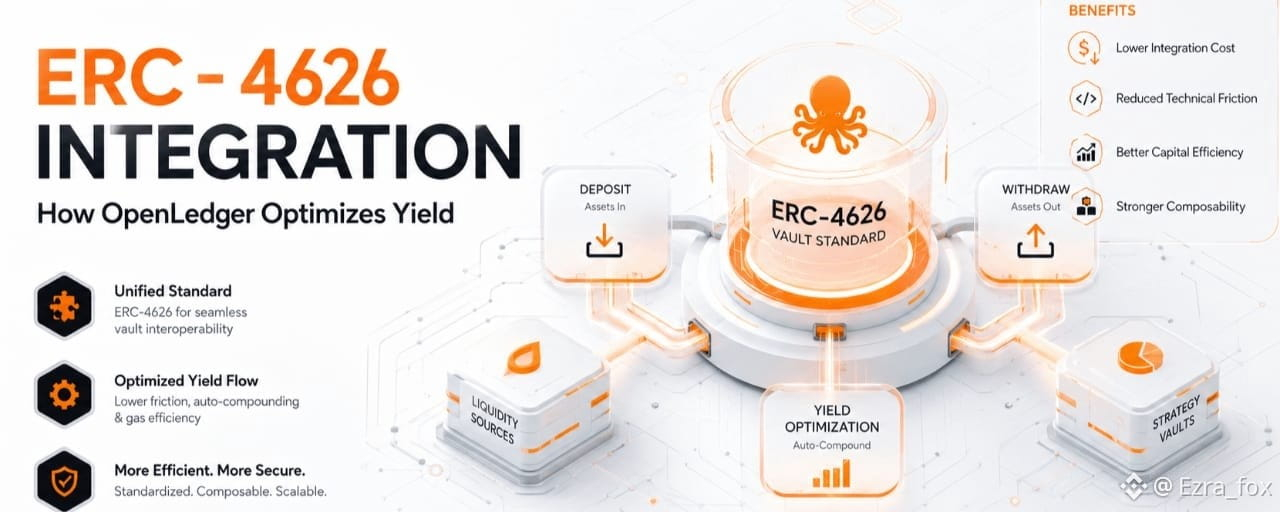
This is where OpenLedger starts to look interesting to me. Rather than inventing an entirely new yield narrative, they appear to be addressing the infrastructure layer by integrating ERC-4626. That matters because ERC-4626 creates a standardized framework for tokenized vaults. Instead of every protocol reinventing deposit logic, withdrawal mechanics, and reward accounting, a common structure allows strategies to interact more smoothly across platforms.
From what I see, OpenLedger isn’t magically creating higher yields out of nowhere. The optimization comes from reducing friction. Standardized vault interactions simplify integrations, lower development overhead, reduce the chance of contract incompatibilities, and improve capital efficiency. Deposits, withdrawals, and yield calculations become more predictable through a shared interface. Even automated compounding strategies can operate more efficiently with lower gas overhead and cleaner interoperability. It’s less about creating a new machine and more about fixing the inefficiencies of existing ones.
Of course, theory and reality are two different things. Technical elegance alone does not guarantee long-term success. Standardization can improve the movement of liquidity, but it does not automatically make yield sources safer or more sustainable. Markets ultimately care about resilience during volatility, actual adoption, and whether capital truly flows into the system at scale.
I still keep a healthy level of skepticism. OpenLedger’s decision to focus on standards rather than hype feels like a more mature approach compared to the usual short-term narratives dominating the space. But whether this infrastructure-focused direction is enough to trigger meaningful and lasting capital migration is something only time and real usage metrics will answer.
For now, I’m continuing to watch closely and monitor how TVL and ecosystem participation evolve over the coming months.