
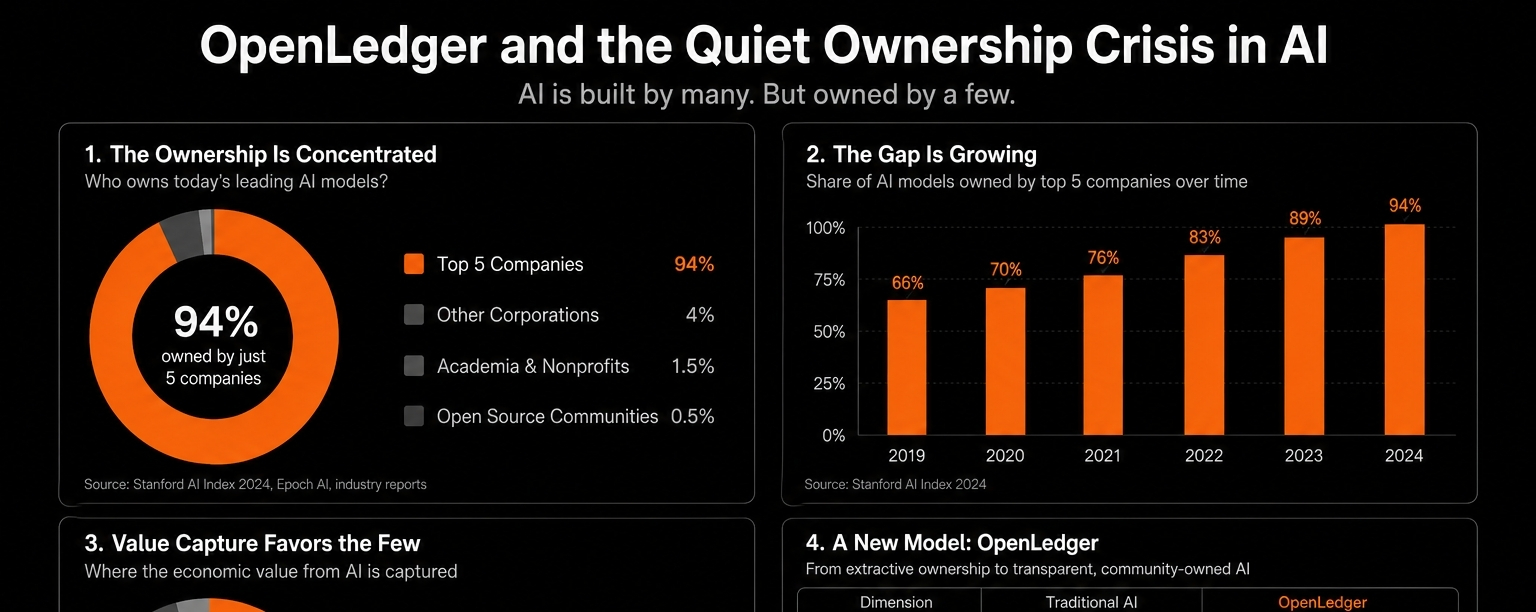
OpenLedger keeps reminding me how l.ve strange the AI industry has become once you stop looking at the surface and start watching where the value actually moves. Everyone talks about intelligence now like it’s some clean futuristic layer floating above reality, but most of it still depends on endless invisible human input underneath. That part rarely gets discussed honestly. The systems sound automated. The economics definitely are not.
The more I look at projects like this, the more it feels like the entire AI space is quietly built on people giving away pieces of themselves constantly without realizing how much they’re contributing. Every search, correction, interaction, preference, conversation, pattern, reaction — all of it feeding larger systems somewhere. And over time those systems become more valuable while the people supplying the raw material slowly disappear from the equation entirely.
That imbalance has been growing for years.
OpenLedger feels like a response to that more than anything else. Not a perfect solution. Not some grand revolution. Just a project that seems aware something underneath the current AI economy feels off. Most companies in this space avoid that discomfort because the current structure benefits them enormously. Data flows upward. Value concentrates upward. Ownership becomes blurry the second information enters a large enough system.
Then eventually a polished AI product appears and everyone acts like intelligence materialized out of thin air.
But it didn’t.
It came from millions of invisible contributions spread across the internet over long periods of time. Human behavior became training material. Human habits became infrastructure. Human creativity became fuel. And somewhere along the way the relationship between contributors and platforms became deeply uneven.
That’s the tension I keep thinking about when OpenLedger comes up.
Because underneath all the blockchain language and AI narratives, the project seems rooted in a very old frustration. People create value. Systems absorb it. The creators become harder to see once monetization begins. Technology changes. The pattern usually doesn’t.
Crypto has always circled around this irritation in different forms. Ownership of money. Ownership of content. Ownership of networks. Now ownership of intelligence itself is starting to enter the conversation. And honestly that was probably inevitable once AI became commercially important.
Still, I’ve been around this industry long enough to know recognition of a problem does not automatically produce a stable solution.
That’s where things get complicated fast.
The moment you try turning data, models, or agents into economic assets, human behavior changes immediately. Incentives reshape everything. People start optimizing for rewards instead of usefulness. Bad data floods systems if quality controls weaken even slightly. Reputation mechanisms get manipulated. Markets become speculative long before infrastructure becomes reliable.
Every decentralized ecosystem eventually runs into this wall.
And AI systems add another layer of instability because quality itself becomes difficult to measure consistently. A model works well until it suddenly doesn’t. Data looks useful until context changes. Agents perform impressively until real-world unpredictability exposes weaknesses nobody noticed during demos.
That’s why I can’t look at projects like OpenLedger emotionally anymore. The industry trained a lot of people to confuse interesting ideas with durable systems. Those are not the same thing at all.
But even with all that skepticism, something about this project keeps pulling attention back toward it quietly. Maybe because the frustration underneath it feels real. There genuinely is a growing discomfort around how AI extracts value from human participation while pretending participation itself is almost incidental.
It isn’t incidental.
The entire machine depends on it.
And I think people are slowly starting to realize that modern AI economies are not just technical systems. They are behavioral systems. Economic systems. Power systems. Whoever controls the data pipelines eventually shapes the intelligence layer built on top of them. Whoever captures the monetization layer controls who benefits from the growth later.
That realization changes how projects like OpenLedger feel.
Instead of looking like another trendy AI blockchain, it starts looking more like an attempt to renegotiate relationships inside systems that already became heavily unbalanced. Whether it succeeds is a completely different question. Honestly most projects struggle once theory collides with actual user behavior at scale.
Because users are messy.
Markets are messy.
Incentives become messy almost immediately.
The early stages always sound philosophical and idealistic. Then real pressure arrives. Speculators enter. Contributors demand more compensation. Low-quality participation increases. Governance disagreements appear. People stop acting cooperative once meaningful money enters the system. That transition reveals whether infrastructure was actually designed for stress or only designed for presentations.
I keep thinking that the hardest part for OpenLedger probably won’t be attracting attention. The AI narrative alone guarantees people will look at it. The difficult part will be maintaining usefulness once the ecosystem becomes economically crowded and behavior starts distorting naturally around incentives.
That’s where a lot of projects quietly break apart.
Not during hype cycles.
During ordinary usage.
Still, I respect projects more when they at least orbit around real tensions instead of inventing artificial ones for marketing purposes. And the tension around AI ownership, contribution, and monetization is very real now. You can feel it spreading across the industry even if most companies still avoid talking about it directly.
There’s this growing sense that people are feeding systems becoming increasingly valuable while remaining disconnected from the upside generated later. The smoother AI products become, the easier it is to forget how dependent they are on constant human participation underneath. OpenLedger feels aware of that dependency in a way that keeps it interesting.
Not impressive.
Interesting.
There’s a difference.
Impressive projects usually know exactly what they want people to believe. Interesting projects leave space for uncertainty because the problems they’re touching are still unresolved in the real world. OpenLedger feels closer to that second category right now.
And honestly that might be the healthiest place for it to exist for now.