
There is a small discomfort sitting under a lot of AI progress.
People feel it, even when they do not always name it clearly.
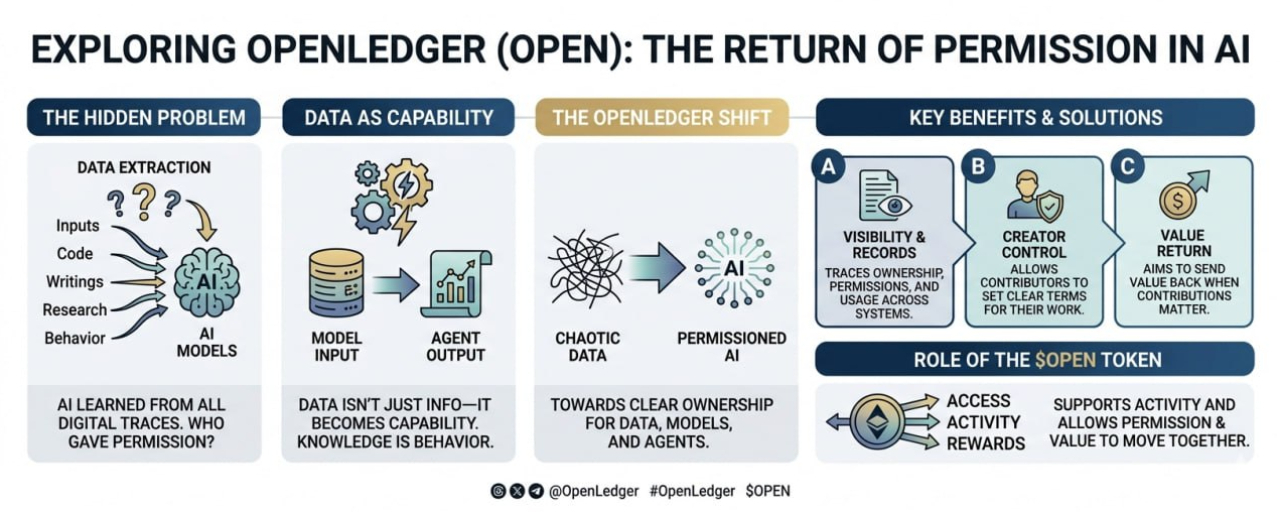
AI systems are learning from the world. From writing, images, code, research, behavior, conversations, records, and all kinds of digital traces. Some of that material is public. Some of it is licensed. Some of it sits in a gray area. Some of it belongs to people who never imagined it would become fuel for machine intelligence.
And after a while, the question becomes hard to avoid.
Who gave permission?
Not in a dramatic way. Not as a simple argument against AI. More like a practical question that keeps returning. If data helps a model become useful, and that model helps an agent perform valuable work, then the original input was not meaningless. It played a role.
OpenLedger can be looked at from this angle.
Not just as an AI blockchain. Not just as a way to monetize data, models, and agents. But as part of a broader shift toward permissioned AI, where the resources behind intelligence are not treated as invisible material that anyone can absorb without a clear path back.
That feels like a quieter, more serious idea.
For a long time, the internet trained people to accept a strange trade. We uploaded, posted, shared, clicked, wrote, reviewed, and created. Platforms turned that activity into value. Most users received convenience in return. Sometimes reach. Sometimes attention. Sometimes nothing at all.
AI makes that trade feel different.
Because AI does not only display content beside ads or organize information into feeds. It can turn information into capability. A piece of writing can help a model write better. A dataset can help a system predict better. A set of examples can help an agent act better. Knowledge becomes behavior.
That is where things get interesting.
When data becomes capability, permission matters more.
OpenLedger seems to be exploring a world where data, models, and agents have clearer ownership and usage paths. That may sound technical, but the human idea is simple. People and builders should have more control over how their contributions are used, and there should be a way for value to return when those contributions matter.
This is not only about money.
Money is part of it, of course. If something creates value repeatedly, people will naturally ask whether the creator should receive some part of that value. But permission is also about respect, boundaries, and choice. It is about knowing whether something can be used, under what conditions, by whom, and for what purpose.
The current AI world does not always make that easy.
A dataset may move through systems without a clear trail. A model may be trained, fine-tuned, copied, wrapped into an app, and used by agents. A user may benefit from the final output without any idea what was underneath it. The original contributors may be completely separated from the results.
Sometimes that separation is acceptable. Sometimes it is not.
The problem is that we do not yet have enough simple ways to tell the difference.
OpenLedger’s role could be to make those differences more visible. If AI assets can carry records of ownership, permissions, and usage, then builders do not have to rely only on trust or vague claims. They can see more of what they are using. Contributors can set clearer terms. Users can, at least in theory, interact with systems that have cleaner foundations.
You can usually tell when a system ignores permission for too long. At first, it grows quickly. Then the questions begin. Creators ask where their work went. Companies worry about using unclear data. Builders hesitate because they do not know what they are allowed to build on. Regulators step in. Users become unsure.
The speed starts to meet friction.
That friction is not always bad. Sometimes it is the market asking for better rules.
This is why OpenLedger’s approach feels relevant. It does not need to frame AI as good or bad. It starts from a more grounded observation: if AI resources are going to be reused across many systems, then permission cannot remain informal forever.
A model should know what it depends on.
An agent should know what it can access.
A dataset should have terms that travel with it.
A contributor should not vanish the moment their work becomes useful.
That sounds basic, but basic things are often missing in fast markets.
The OPEN token sits inside this system as a way to support activity, access, and rewards. But the more interesting part is not the token alone. It is the idea that permission and value can move together. A resource can be used because it is allowed to be used. And when it is used, that action can leave a record and possibly send value back.
That is different from the older pattern of extraction first and negotiation later.
Of course, this kind of system has its own difficulties.
Permission can become complicated. Too many rules can slow builders down. Too little control can make contributors feel exposed. Some data should not be monetized at all. Some information should remain private. Some contributors may overvalue what they provide. Some users may not care about clean sourcing until something goes wrong.
So the balance is delicate.
OpenLedger would need to make permission feel natural, not heavy. It would need to help people share useful AI assets without turning every action into a legal puzzle. It would need to support openness while still respecting boundaries.
That is not an easy line to walk.
But the need is becoming easier to see.
AI is moving into more serious parts of work and life. As it does, the story behind the output will matter more. Not only whether the answer is good, but whether the system had the right to use what it used. Whether the data came from somewhere clear. Whether the people behind the intelligence had any say in the process.
Maybe that is the quiet angle around OpenLedger.
It is not only trying to unlock value from AI assets. It is also asking whether AI can grow with clearer consent around the materials that make it useful.
And that question feels like it will stay with the industry for a long time.