I’ve been around crypto long enough to develop a reflex.
The moment I hear a founder say “AI-powered blockchain ecosystem,” my brain usually checks out. I’ve sat through too many conference panels with purple neon lighting and twenty-something founders promising to “reshape digital coordination” while showing absolutely zero evidence that normal people would ever use their product. By 2022, the phrase “Ethereum killer” had become almost comedic. Honestly, it reminded me of the dot-com era when companies slapped “.com” onto their names and watched investors lose common sense in real time.
Most of those projects disappeared quietly. A few are still technically alive, like abandoned shopping malls with one store still open.
So when OpenLedger landed on my radar, I expected more of the same. Fancy branding. Big promises. A token attached to a problem nobody actually has.
Instead, I found something more grounded than I expected.
Not perfect. Not guaranteed. But grounded.
And that alone makes it unusual in this market.
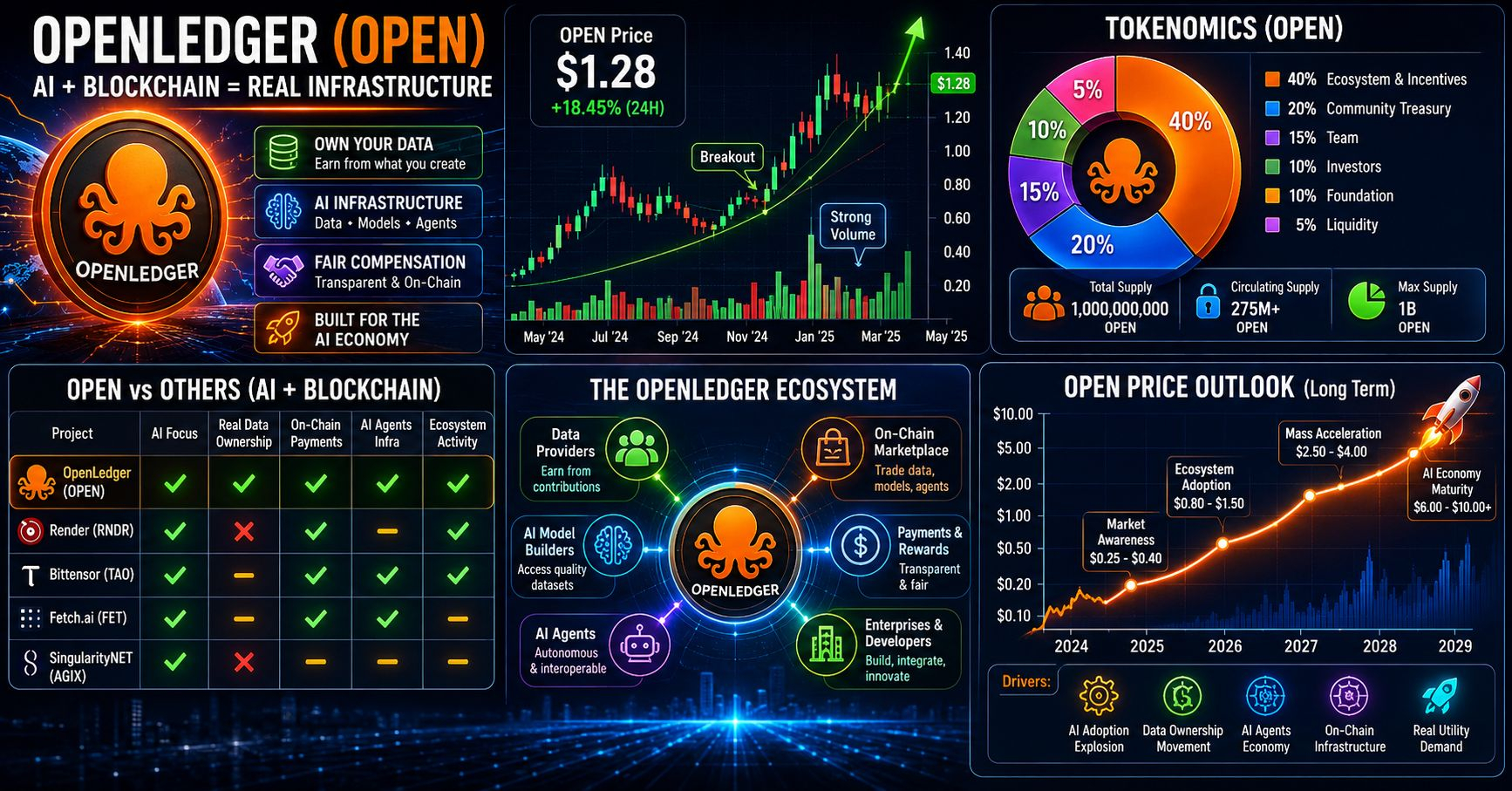
The core idea behind OpenLedger is actually pretty easy to explain to someone outside crypto, which is usually a good sign. If your data helps train AI systems worth billions of dollars, shouldn’t you share in the upside?
That’s it. That’s the argument.
And honestly… it’s hard to dismiss.
Right now, giant AI companies are vacuuming up enormous amounts of human-generated information. Every Reddit post, product review, customer support ticket, YouTube transcript, online discussion, and user interaction becomes part of the machine eventually. Most people don’t even realize they’re contributing. They’re just living online. Meanwhile, the companies building the models are raising money at valuations that would’ve sounded insane five years ago.
I was talking to a developer friend recently who works with training datasets for enterprise AI tools. He laughed when I asked where most of the valuable data comes from.
“Regular people,” he said. “They just don’t get paid for it.”
That sentence stuck with me.
Because he’s right.
We’ve somehow normalized a system where the public supplies the raw material while a handful of companies own the infrastructure, the models, and most of the profits. OpenLedger is basically betting that this arrangement won’t hold forever.
And maybe it won’t.
The project wants to create a system where datasets, AI models, and eventually autonomous AI agents can be owned, traded, and monetized more transparently through blockchain infrastructure. Now, before people roll their eyes at the blockchain part — fair reaction, honestly — this is one of the few areas where decentralized systems might actually make practical sense.
Not because decentralization is magically superior. It usually isn’t.
But because questions around ownership, attribution, and payments become messy very quickly once AI systems start operating at scale.
Who owns the output?
Who contributed the training data?
Who gets compensated?
Who verifies usage?
Traditional systems aren’t great at answering those questions cleanly.
And this is where OpenLedger gets interesting. The project isn’t just chasing the “AI” label for attention. At least from what I can see, it’s trying to build economic rails around AI itself. Around the data economy. Around machine-to-machine interaction.
That’s a more serious ambition than launching another speculative token with cartoon branding and vague promises about “community.”
Still, I’ve learned not to get carried away.
Crypto has a talent for turning decent ideas into unusable products.
I remember the ICO boom in 2017 when every whitepaper claimed it would decentralize something. Decentralized storage. Decentralized ride-sharing. Decentralized cloud computing. Half those projects raised millions before anyone asked a very basic question: “Wait… does this actually need a blockchain?”
Most didn’t.
OpenLedger might. That’s the difference.
Especially when you start looking at where AI is heading next.
People still think AI means chatbots writing emails or generating anime pictures. That phase already feels old. The industry is moving toward autonomous agents — systems capable of handling workflows, making decisions, coordinating tasks, and interacting with software on their own. I’ve seen early enterprise demos of these agents managing inventory systems and customer operations with barely any human intervention. Clunky today, yes. But you can see where this is going.
And once software starts acting independently, it needs infrastructure built for autonomy.
Payments.
Permissions.
Access control.
Reputation systems.
Service marketplaces.
Basically, economic plumbing.
That’s where blockchain technology suddenly stops sounding ridiculous and starts sounding… logical. Slightly boring, even. Which, in my opinion, is a compliment.
The best technology eventually becomes boring.
Nobody gets excited about TCP/IP anymore. Nobody brags about cloud architecture while ordering an Uber. Consumers care about outcomes, not infrastructure diagrams. Crypto still hasn’t fully learned this lesson. Too many projects are obsessed with ideology and engineering purity while normal users just want products that work without friction.
OpenLedger’s real challenge isn’t building impressive technology.
It’s disappearing.
Can they create systems people use without constantly thinking about wallets, tokens, gas fees, or validator nodes? Because if users have to understand the underlying mechanics in order to participate, the product probably already failed.
That’s the uncomfortable truth.
The crypto industry spent years building tools mostly for other crypto people. Meanwhile, the rest of the world moved on.
And look, I’m still skeptical here. Deeply skeptical in some areas.
Execution is brutal in both AI and blockchain. Combining the two doesn’t simplify anything — it multiplies the difficulty. AI infrastructure is expensive. Blockchain systems historically struggle with speed and efficiency. Then you add governance problems, token incentives, regulatory pressure, and the usual speculative chaos that infects almost every crypto ecosystem eventually.
That’s a nasty combination.
OpenLedger’s token, OPEN, also raises the standard concerns. Every project claims its token powers an ecosystem. I’ve heard that story a thousand times. Sometimes it’s true. Often it’s financial theater dressed up as utility.
So I’d ignore the social media hype entirely.
Seriously.
Crypto Twitter can make a half-finished prototype look like the invention of electricity. I watched people call algorithmic stablecoins “the future of finance” right before Terra collapsed and vaporized billions. The market has a short memory when prices go up.
What matters is the boring stuff.
Are developers sticking around after incentives dry up?
Are companies contributing meaningful datasets?
Are businesses using the infrastructure outside speculative trading?
Does activity survive a bear market?
That’s where you find the truth.
And to OpenLedger’s credit, the timing may actually work in its favor. Public sentiment around AI is shifting fast. A year ago, people were mostly fascinated. Now there’s growing discomfort underneath the excitement. Concerns about monopolies, surveillance, copyright abuse, synthetic content, and concentrated power aren’t niche conversations anymore. They’re becoming mainstream political and economic issues.
Even regular users are starting to ask uncomfortable questions.
Why are a few companies allowed to absorb so much public data and privatize the rewards?
Why does contribution feel invisible?
Why does AI wealth flow upward so aggressively?
OpenLedger isn’t the only project asking those questions. But at least it’s pointing at a real tension instead of inventing fake demand.
That matters.
Will it succeed? I honestly have no idea. Most projects in this sector won’t. Some deserve to fail. There’s still too much hype, too much money chasing trends, and too many founders building products nobody asked for.
But every now and then, buried underneath the noise, you find a project chasing a problem that genuinely feels inevitable.
Ownership of AI infrastructure feels inevitable.
Data compensation feels inevitable.
Machine-to-machine economies probably do too.
The current model — where users feed systems endlessly while corporations capture nearly all the upside — feels unstable long term. Not morally unstable. Economically unstable.
Eventually people want a stake in the systems they help build.
OpenLedger is betting on that shift.
And for the first time in a while, I can at least understand why.