
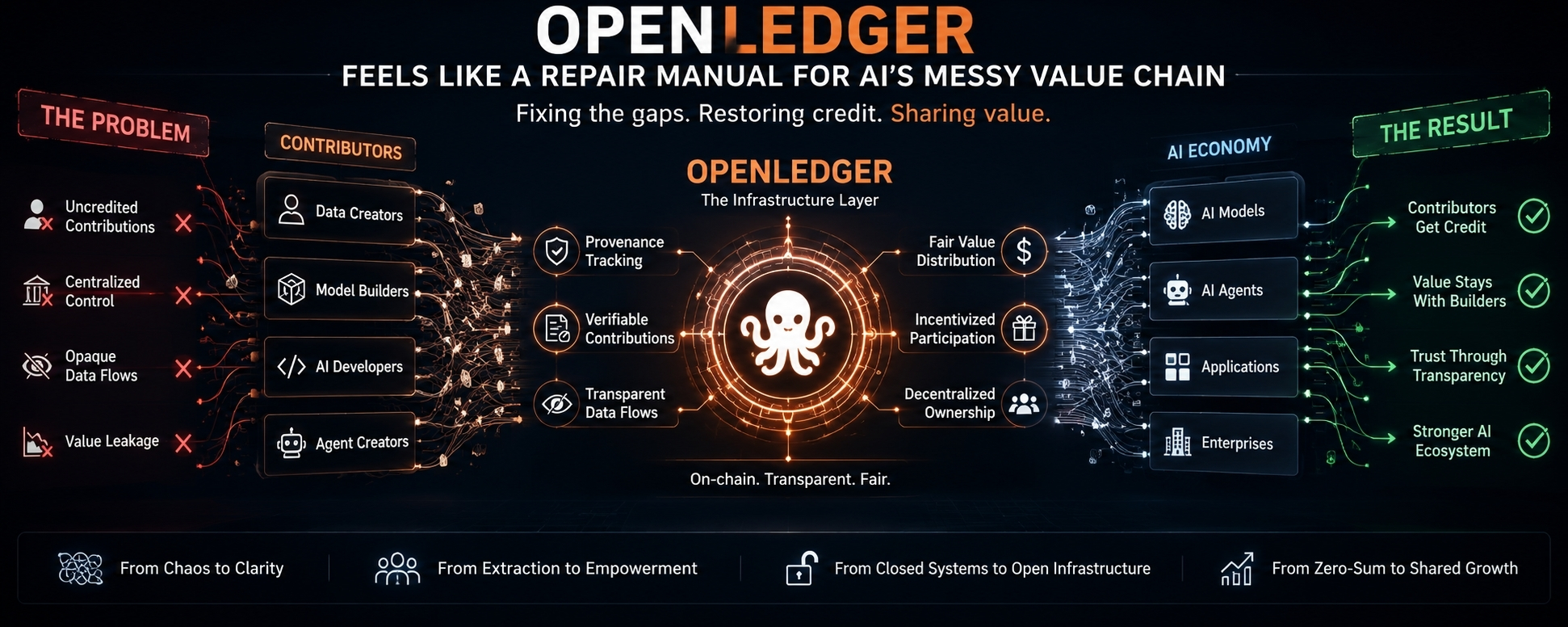

OpenLedger is one of those projects I can’t look at without thinking about how tired crypto has made everyone.
Not tired like “bear market tired.”
Tired like we’ve seen the same mess repeat too many times.
Bad airdrops. Fake users. Bots everywhere. Real people getting filtered out while wallet farms somehow survive. Projects asking communities to test, post, bridge, mint, swap, sign, connect, wait, and then maybe get rewarded if some mysterious spreadsheet says they were “eligible.”
Look, that stuff leaves a mark.
So when OpenLedger talks about data, models, agents, and liquidity around AI, I don’t hear some shiny future pitch. I hear another attempt to deal with the ugly part nobody wants to talk about.
Who actually created the value?
Who gets paid?
Who gets ignored?
That’s the mess.
And honestly, AI makes the mess worse. Everyone keeps saying data is the new oil, but most people providing that data don’t see anything from it. Their work gets scraped, packaged, trained on, monetized, and then sold back to them with a subscription button.
Great system.
Very fair.
OpenLedger seems to be trying to build around that uncomfortable layer. The place under the hood where data, models, and AI agents need some kind of accounting. Some kind of record. Some kind of way to prove contribution and maybe reward it without everything going through one giant platform.
That’s not sexy.
It’s plumbing.
But crypto probably needs more plumbing and fewer fireworks.
The thing is, I don’t want to make it sound easy. It isn’t. Tracking value in AI is hard. Data quality is hard. Figuring out which model is useful is hard. Stopping fake activity is hard. Making sure contributors actually get rewarded without turning the whole thing into another farming game is very hard.
We’ve already seen what happens when incentives are loose.
People game them.
Every time.
So OpenLedger has to deal with crypto users being crypto users. That alone is a full-time problem.
If there’s a reward system, people will farm it. If there’s a token, people will speculate on it. If there’s a points system, people will run ten wallets and call it “strategy.” If there’s an AI angle, people will slap the word AI on garbage and hope nobody checks too closely.
That’s the world this project has to survive in.
Not the clean version from a pitch deck.
The real one.
And that’s why I’m cautious about OPEN too. A token can help if it actually does something. It can coordinate people. It can reward useful work. It can be part of the network’s incentives.
But it can also become the whole show.
We’ve seen that movie. The product becomes background noise. The token becomes the conversation. Everyone talks about listings, unlocks, FDV, and “community strength,” while the actual thing being built gets buried somewhere under the hype.
Honestly, that’s the part that worries me.
Because OpenLedger’s idea is only interesting if people use it for real reasons. Not just because they expect an airdrop. Not just because AI coins are hot. Not just because someone on X made a thread with too many flame emojis.
Real users.
Real data.
Real models.
Real demand.
That’s a much harder road.
Still, I get why it exists. There is a real wound here. Crypto has always struggled with fair contribution. AI has the same problem, just bigger and quieter. People create value in small ways, invisible ways, boring ways, and then the upside usually flows somewhere else.
OpenLedger is trying to put rails around that.
Maybe it works.
Maybe it doesn’t.
But the problem is real.
The AI side also needs trust. That word gets thrown around too much, but here it actually matters. If a model claims to be useful, who checks? If data claims to be valuable, who decides? If an agent is supposed to act or transact, how do you know it won’t just break, lie, or do something stupid with confidence?
Because AI does that.
A lot.
So this is not just a blockchain problem. It’s not just an AI problem either. It’s a coordination problem. A verification problem. A “how do we stop the whole thing from turning into spam?” problem.
Not flashy.
Necessary.
And maybe that’s the only reason I find OpenLedger worth watching. Not because it sounds perfect. It doesn’t. Not because AI plus crypto automatically means anything. It doesn’t. But because the ugly backend of AI value is going to matter more over time, and someone has to build infrastructure that actually works there.
That might take time.
It might be clunky.
It might attract the wrong crowd first, because crypto always does.
But if OpenLedger can move past the narrative layer and become useful plumbing for data, models, and agents, then there may be something real underneath.
I’m not calling it a winner. I’m not making predictions. I’m not pretending the token solves everything.
I’m just saying the pain point makes sense.
And after years of watching crypto reward noise better than contribution, anything trying to clean up that part of the mess deserves at least a skeptical look.
Not blind faith.
A look.