
Most people still talk about data expiration like it is a storage problem. They think about retention policies, cleanup cycles, privacy rules, compression and archiving. I used to think about it the way. I thought it was something that just sat quietly in the background of infrastructure.. After spending time studying systems like OpenLedger I started to notice that expiration actually changes behavior a lot more than people admit.
A lot of the AI industry today is built around accumulation. They want datasets, longer retention more historical context and more scraping. People usually think this is progress. They assume that more data means intelligence, better predictions and better products.. I kept wondering what happens when data is treated less like permanent property and more like something that has a lifespan.
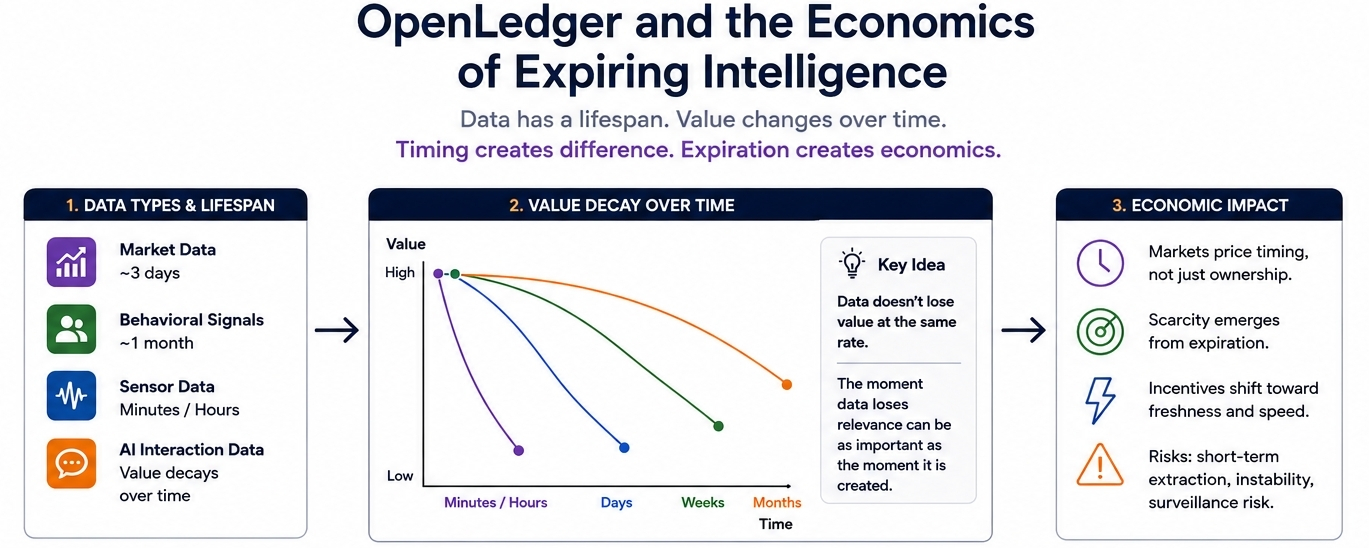
This shift sounds small at first.. Financially it changes almost everything. I noticed that most markets price assets that continue to exist. Tokens stay alive storage contracts. Compute cycles repeat.. Expiring data behaves differently because its value can decay naturally over time. Sometimes this happens quickly. Sometimes it happens unevenly. A dataset about market conditions may matter for three days but behavioral signals may matter for a month. Sensor information might lose value within minutes.. Most infrastructure still pretends that all information deserves to be preserved forever.
What stood out to me in OpenLedger was not the idea of monetizing data. A lot of projects already say that. What felt different was the possibility that expiration itself could become economically important. The moment data loses relevance can affect incentives as much as the moment data is created. I started thinking about this after watching how traders react to time- information. A leaked narrative before a market move has value for a short window and then it suddenly becomes historical noise.
The same thing happens quietly inside AI systems. Fresh interaction data shapes outputs differently from information.. Most conversations about AI economics focus on ownership while ignoring timing. Timing may actually be the problem. In internet models companies usually captured value by storing everything forever. Data accumulation became a moat. The longer they retained information the stronger their position became.. Decentralized systems introduce another question: what if value comes not from permanent control but from managing the lifecycle of information responsibly?
This creates tradeoffs. Short expiration cycles improve privacy in some cases. Reduce long-term reproducibility. Permanent storage helps research. Increases surveillance risk. Fresh datasets improve adaptability. Also create instability because incentives constantly shift toward whatever is newest. I do not think there is a balance here. Likely every system chooses a different compromise depending on what it values most.
I also noticed something people rarely discuss openly: expiration creates scarcity. Digital systems normally destroy scarcity because copying is cheap.. If useful data naturally expires then access windows become economically meaningful. Certain information may only hold power briefly before decaying. In that environment the market is not pricing ownership it is pricing timing, precision, trust and distribution speed. That starts to look like traditional software economics and more like financial market structure.
At the time I think there are risks in turning expiration into a financial event. Once markets form around decaying information people may optimize for short-term extraction of durable knowledge creation. Contributors might prioritize data streams over slower research work. Systems could become addicted to freshness metrics because freshness is easier to monetize than depth.
I kept coming to this while comparing centralized AI firms with decentralized alternatives. Centralized firms usually hide expiration logic internally. Nobody outside really knows how long information stays influential inside recommendation systems or models. In systems those rules may become visible and economically exposed. That transparency sounds healthier in theory. It also introduces complexity that most users probably never think about.
Another thing that stayed with me is how expiration changes trust. When data lasts forever people worry about misuse. When data disappears people worry about verification. Both fears are rational. If information expires aggressively it becomes difficult to audit decisions later.. If nothing expires then power quietly concentrates around whoever controls historical archives. I think OpenLedger is interesting partly because it sits inside that tension of pretending the tension does not exist.
The longer I study decentralized AI systems the more I feel that the future argument will not be about who owns intelligence. It will also be, about who decides when information stops mattering and who benefits economically from that transition. That decision carries consequences, but also social ones. Over time I have started to believe that healthy systems are probably not the ones that preserve everything forever or delete everything quickly. They are the ones that make expiration understandable, predictable and accountable. Trust builds slowly when people understand how value changes over time and why certain information is rewarded while other information fades away.