
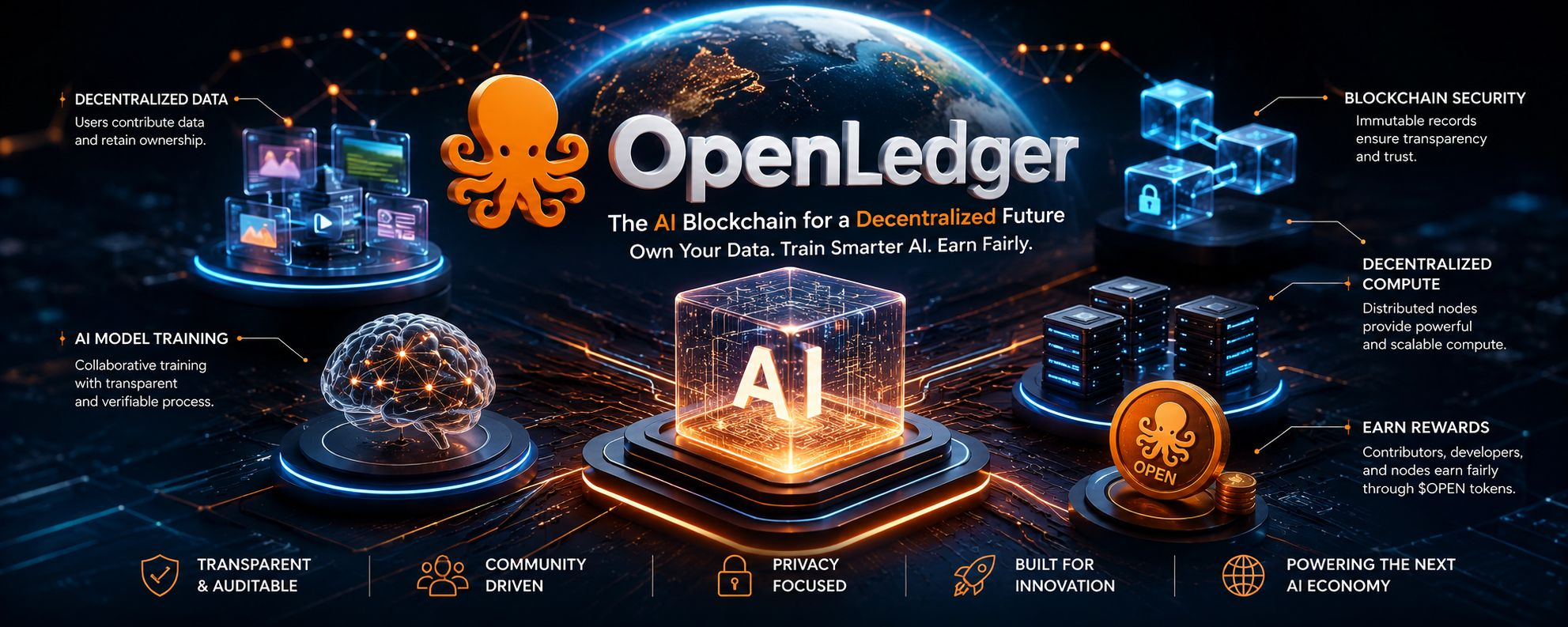
The blockchain industry keeps evolving, but I think the current wave feels different from the previous cycles. Earlier, most projects focused mainly on trading, hype, or speed competition. Now the market is moving toward utility, and that’s where OpenLedger starts standing out. It isn’t trying to become just another cryptocurrency network. Instead, it’s building an ecosystem where Artificial Intelligence and blockchain technology can work together in a practical and transparent way.
I’ve noticed that AI is now becoming part of almost every industry. From finance and healthcare to education and content creation, companies are rushing to integrate AI into their systems. But there’s still a major issue that people often ignore. Most AI infrastructure is heavily centralized. Large corporations control the models, the servers, and most importantly, the data. Users contribute enormous amounts of information every day, yet they rarely own any part of the value created from it.
That’s where OpenLedger becomes interesting to me. The project is trying to reshape how data ownership works inside the AI economy. Instead of allowing only big companies to benefit, it’s creating a decentralized framework where contributors, developers, and communities can all participate in the ecosystem. I think this idea connects strongly with the original purpose of blockchain technology, which is decentralization, transparency, and user empowerment.
One thing I appreciate about OpenLedger is that it doesn’t feel like a project forcing AI terminology into a blockchain product just to attract attention. Its structure actually revolves around AI infrastructure. The platform focuses on decentralized data contribution, transparent AI training systems, and incentive-driven participation. In my opinion, that gives it more credibility compared to projects that simply use AI as a marketing narrative.
The current market appreciation around OpenLedger also makes sense when I look at broader technology trends. AI has become one of the strongest investment sectors globally, while blockchain continues searching for more real-world use cases. OpenLedger sits directly between these two powerful industries. That positioning alone gives it significant potential because investors and developers are actively looking for projects capable of combining both sectors effectively.
Another reason I think OpenLedger matters is because data is becoming one of the most valuable digital assets in the world. AI models depend completely on quality datasets. Without data, even the most advanced AI systems can’t improve. Right now, centralized corporations dominate this process. They collect user data at massive scale and monetize it privately. OpenLedger is challenging this model by creating systems where contributors can actually receive rewards for providing valuable datasets.
I think this approach could change how people view digital ownership in the future. Instead of users being passive participants, they become active stakeholders inside AI ecosystems. That creates a stronger balance between innovation and fairness. It also increases transparency because blockchain records can help verify where data comes from and how it’s used.
The technical direction of OpenLedger is also worth paying attention to. AI development requires enormous computational power, and smaller developers often struggle to compete with large technology firms. OpenLedger’s decentralized infrastructure could potentially distribute workloads across participants, making AI development more accessible. If the project succeeds in scaling this model properly, it could lower entry barriers for independent creators and startups.
I also think timing plays a huge role in OpenLedger’s growing popularity. The global conversation around AI ethics, transparency, and trust is becoming more serious every year. People are worried about manipulated information, deepfakes, biased AI outputs, and centralized control. Governments are starting to discuss regulations, while industries are searching for more transparent systems. OpenLedger enters the market at a moment when these concerns are becoming impossible to ignore.
What makes blockchain integration important here is traceability. Through decentralized verification systems, AI-generated outputs and training data could become more transparent and auditable. I believe this could become extremely valuable in industries where trust matters most, such as healthcare, finance, research, and education. Businesses will eventually need systems capable of proving how AI decisions were created, and OpenLedger appears to be moving toward that direction.
Another point I find impressive is the community-driven aspect of the project. Successful blockchain ecosystems usually grow through strong developer participation and active user engagement. OpenLedger seems focused on encouraging collaborative development instead of operating as a closed environment. That’s important because ecosystems survive through network effects, not only through technology alone.
Of course, I don’t think the road ahead will be easy. The AI infrastructure sector is becoming extremely competitive. Many blockchain projects are now entering the same space because they recognize how powerful the AI narrative has become. OpenLedger will need consistent innovation, strong partnerships, and real adoption if it wants to remain relevant long term.
Scalability could also become a major challenge. AI systems consume huge computational resources, and decentralized infrastructure still has limitations compared to centralized cloud giants. Regulatory pressure may create additional obstacles as governments continue developing rules around AI technologies and data usage. These are real challenges that the entire decentralized AI sector will need to solve over time.
Still, I believe OpenLedger represents more than just another crypto trend. It reflects a broader transformation happening across the digital economy. People are beginning to demand more ownership, more transparency, and more participation in the systems they help create. OpenLedger’s vision aligns naturally with these demands, which is why I think the project is receiving increasing attention from both investors and developers.
Looking toward the future, I can see decentralized AI becoming one of the next major technological movements. Businesses won’t only care about AI performance anymore. They’ll also care about data ethics, transparency, and trust. Projects that solve these issues early could gain enormous long-term advantages. OpenLedger appears to understand this shift and is building its infrastructure around it.
In my opinion, the project’s biggest strength is that it’s trying to solve real structural problems instead of chasing short-term hype. That doesn’t guarantee success, but it definitely gives OpenLedger a stronger foundation compared to many temporary market narratives. If the team continues developing its ecosystem effectively, OpenLedger could eventually become one of the important platforms powering the future relationship between AI and decentralized technology.