
Artificial intelligence is becoming part of daily life so naturally that many people barely notice how deeply it is already entering the global economy. People interact with AI when they search online, use chatbots, receive recommendations, generate images, automate business tasks, or even when they scroll through social media feeds. But behind all these visible tools sits a much larger system that most users never see. AI depends on enormous amounts of data, continuous model training, infrastructure providers, developers, researchers, and millions of contributors whose work slowly shapes machine intelligence over time. The strange reality is that most of the people contributing to this system rarely remain connected to the value created later. Data gets absorbed into centralized systems, models become private assets, and economic rewards usually flow toward the companies controlling the infrastructure rather than the communities helping build the intelligence itself.
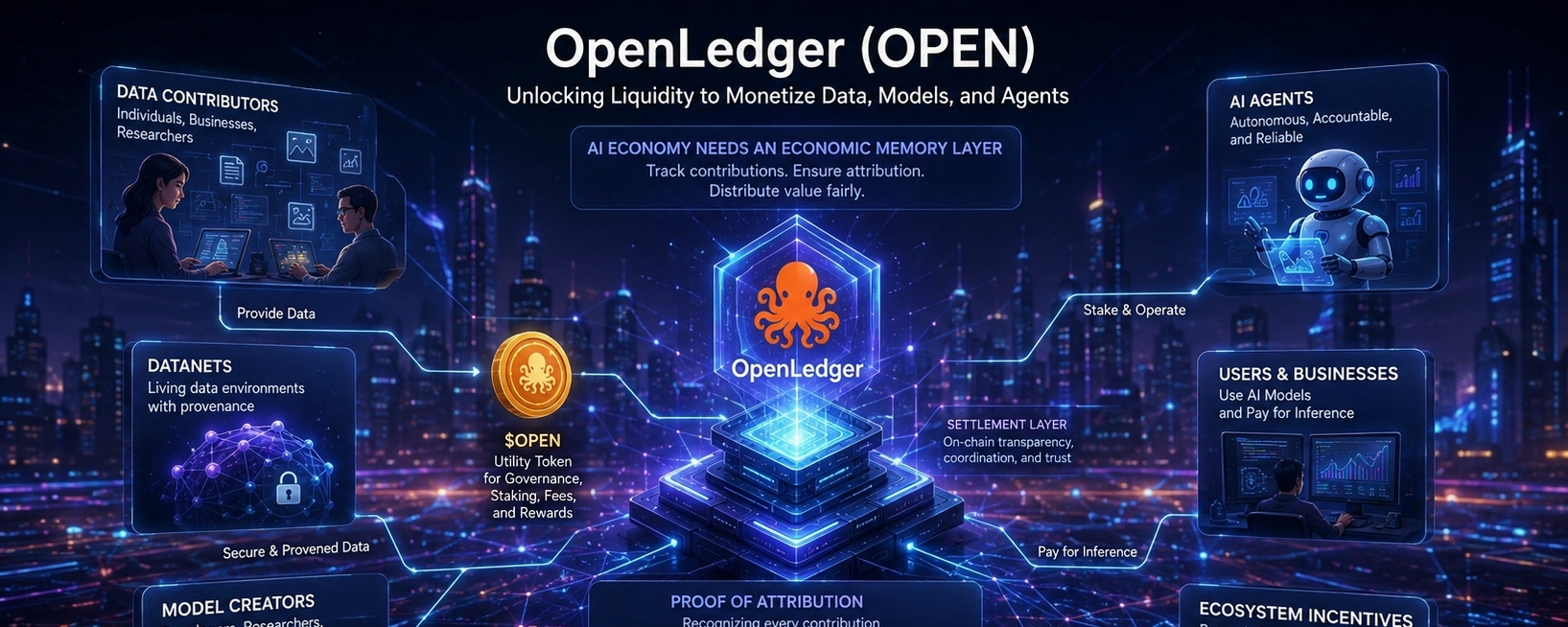
OpenLedger is trying to approach this problem from a different angle. Instead of viewing AI as a closed product owned by a few platforms, the project treats AI more like an open economic network where contributors, datasets, models, and agents remain connected through transparent coordination. The idea is not simply to combine blockchain with AI because both are popular technologies. The deeper goal is to create a system where machine intelligence carries memory about where its value originally came from. In many ways, OpenLedger is trying to build an economic layer underneath artificial intelligence itself.
The easiest way to understand this is by thinking about how today’s AI economy actually works. Modern AI systems depend heavily on human generated information. They learn from conversations, documents, images, workflows, code, research, and behavioral patterns collected from across the internet and from specialized industries. Yet once this information enters centralized training pipelines, contributors usually disappear from the system completely. The models improve, companies grow larger, products become more valuable, but the connection between the original contributors and the resulting economic value is mostly lost. OpenLedger is built around the idea that this disconnect may become one of the defining structural problems of the future AI economy.
This becomes even more important as AI systems move beyond general internet knowledge and start relying on highly specialized datasets. Healthcare AI needs medical information and clinical patterns. Industrial AI needs manufacturing and operational data. Financial AI depends on transaction behavior and risk analysis. Legal AI requires structured legal knowledge and case histories. Much of this information belongs to businesses, researchers, institutions, and communities that are cautious about sharing sensitive data into systems where ownership and accountability are unclear. OpenLedger attempts to create a framework where data can participate economically without completely losing its provenance or visibility.
One of the central ideas behind the project is something called Proof of Attribution. The name sounds technical, but the basic idea is actually very human. If a model becomes valuable because it learned from certain contributors or datasets, then those contributors should not become invisible afterward. OpenLedger tries to build infrastructure where the system can recognize and track how value flows through AI networks. Instead of treating datasets as disposable raw material, the network treats them more like productive economic assets that continue participating in value creation over time.
This idea matters because AI systems are becoming increasingly important in real world decision making. In the future, AI may influence healthcare recommendations, industrial automation, logistics management, education systems, legal workflows, and financial operations. As these systems become more deeply integrated into society, questions around accountability naturally become more serious. People will eventually ask where the training data came from, who contributed to the models, who benefits economically from the system, and who carries responsibility when failures happen. Most current AI systems are not designed to answer these questions transparently. OpenLedger is part of a broader movement trying to build infrastructure around these concerns before they become impossible to manage later.
The blockchain component of the project exists mainly to support this coordination layer. OpenLedger uses blockchain less like a speculative financial tool and more like a transparent accounting system for AI activity. The network records relationships between datasets, contributors, models, inference usage, and AI agents. In simple terms, it tries to create memory around how machine intelligence is built and how economic value moves through the system. Traditional financial systems rely heavily on settlement infrastructure that tracks ownership and value transfer. OpenLedger applies similar logic to AI itself, attempting to create a settlement layer not just for money, but for intelligence and contribution.
This is one reason why the project feels different from many short term AI crypto narratives. A large part of the crypto market often focuses on speed, hype cycles, and speculative attention. OpenLedger is trying to address a deeper infrastructure problem related to coordination and attribution inside AI ecosystems. Whether the project succeeds or not, the direction itself reflects how blockchain technology is slowly evolving beyond simple financial speculation and toward more complex coordination systems.
The OPEN token functions as the operational asset inside this structure. But understanding the token properly requires looking beyond trading activity. The token is designed to connect different parts of the ecosystem together through governance, rewards, transaction fees, inference payments, staking systems, and contributor incentives. The long term importance of the token depends less on market speculation and more on whether real AI activity eventually creates sustainable demand inside the network itself.
One of the more interesting aspects of the system is how it approaches AI agents. As artificial intelligence evolves, autonomous software agents may eventually perform tasks, coordinate workflows, analyze information, negotiate transactions, or interact with users independently. OpenLedger introduces the idea that these agents should carry economic accountability. By requiring staking mechanisms, agents effectively place collateral behind their participation in the network. If they behave dishonestly or unreliably, penalties can theoretically be applied. This concept borrows ideas from proof of stake blockchain systems and extends them into machine level behavior.
The importance of this idea becomes clearer when thinking about the future relationship between humans and AI systems. Trust will likely become one of the largest coordination problems in digital economies. People will not only ask whether an AI system is intelligent. They will also ask whether it is transparent, accountable, reliable, and economically aligned with users rather than purely optimized for extraction or manipulation. OpenLedger is trying to create infrastructure around those concerns early, before AI systems become too deeply embedded into society to redesign safely.
Still, the project faces serious challenges that cannot be ignored. Attribution inside AI systems is extremely difficult to measure precisely because models learn from massive combinations of data simultaneously. It is almost impossible to calculate perfectly how much one contributor influenced a final output. OpenLedger does not completely solve this problem, and realistically no project fully can today. But the network is important because it treats attribution as a real problem worth solving rather than ignoring it entirely.
Another major challenge involves data quality and incentives. Any system rewarding participation financially will naturally attract spam and manipulation attempts. Contributors may upload duplicated, synthetic, or low quality datasets simply to capture rewards. This means the network must continuously improve filtering systems, reputation mechanisms, and quality evaluation processes. Without strong coordination systems, decentralized incentive models can quickly become economically noisy instead of productive.
Infrastructure concentration is another difficult reality facing the entire decentralized AI sector. AI computation is expensive, and large infrastructure providers still control most advanced hardware resources globally. Even decentralized systems can slowly centralize around operators with superior compute access. This is one of the hardest structural problems in modern AI because decentralizing coordination is easier than decentralizing physical computation itself.
Legal and regulatory pressure may also become significant over time. AI datasets increasingly intersect with privacy law, copyright disputes, biometric regulation, and national data restrictions. Open systems attempting to monetize or coordinate datasets may eventually face legal conflicts around ownership, consent, and cross border information flows. Projects like OpenLedger will likely need to navigate these challenges carefully if they want long term sustainability.
There is also a deeper philosophical issue underneath all of this. Not every form of human collaboration works best when turned into a financial system. Open source communities, research environments, and knowledge networks often succeed because people cooperate freely rather than because every interaction is monetized. If token incentives dominate too aggressively, networks can unintentionally weaken the trust and collaboration that made them valuable in the first place. OpenLedger will need to balance economic incentives carefully so the system strengthens productive participation instead of reducing everything to extraction behavior.
Even with these risks, the project represents an important shift in how blockchain systems are being imagined. Earlier crypto cycles focused heavily on trading infrastructure, leverage, speculative markets, and rapid financial experimentation. OpenLedger points toward something more structural and long term. It explores whether blockchains can eventually become coordination layers for intelligence, accountability, incentives, and economic trust across AI ecosystems.
That question may become increasingly important over the next decade. AI systems are growing more powerful every year, but the infrastructure governing ownership, attribution, and accountability still remains immature. Right now, much of the AI economy operates through hidden relationships where data is collected quietly, models are trained privately, and value accumulates inside centralized systems that most people cannot audit properly. OpenLedger is experimenting with an alternative direction where AI systems carry transparent economic memory rather than functioning as invisible black boxes.
There is no guarantee that this approach will succeed. Building decentralized coordination systems around artificial intelligence is extremely difficult, both technically and economically. Many projects in this sector will likely struggle because the complexity is enormous. But the attempt itself still matters because future AI economies will need more than raw intelligence alone. They will also need systems for trust, attribution, coordination, and accountability under real world pressure.
When infrastructure fails, when legal disputes emerge, when model errors create damage, or when questions around ownership become politically sensitive, systems without transparency tend to lose trust very quickly. OpenLedger’s deeper importance lies in trying to prepare for those future pressures before they become unavoidable. In the long run, that may matter far more than temporary hype cycles or speculative attention surrounding AI and crypto markets today.
