

The strange thing about artificial intelligence is how invisible most of it has become.
People open an app, type a sentence, get an answer, and move on with their day. It feels simple on the surface. Almost weightless. But underneath that smooth experience sits an enormous machine built from human behavior, public knowledge, private infrastructure, and endless streams of data gathered from people who rarely see any ownership in return.
That tension is becoming harder to ignore.
The more useful AI becomes, the more centralized it seems to get. A handful of companies control the strongest models, the largest compute clusters, and the deepest reservoirs of data. Meanwhile, millions of people contribute to these systems indirectly every single day without really knowing where the value flows afterward.
OpenLedger feels like an attempt to interrupt that pattern before it becomes permanent.
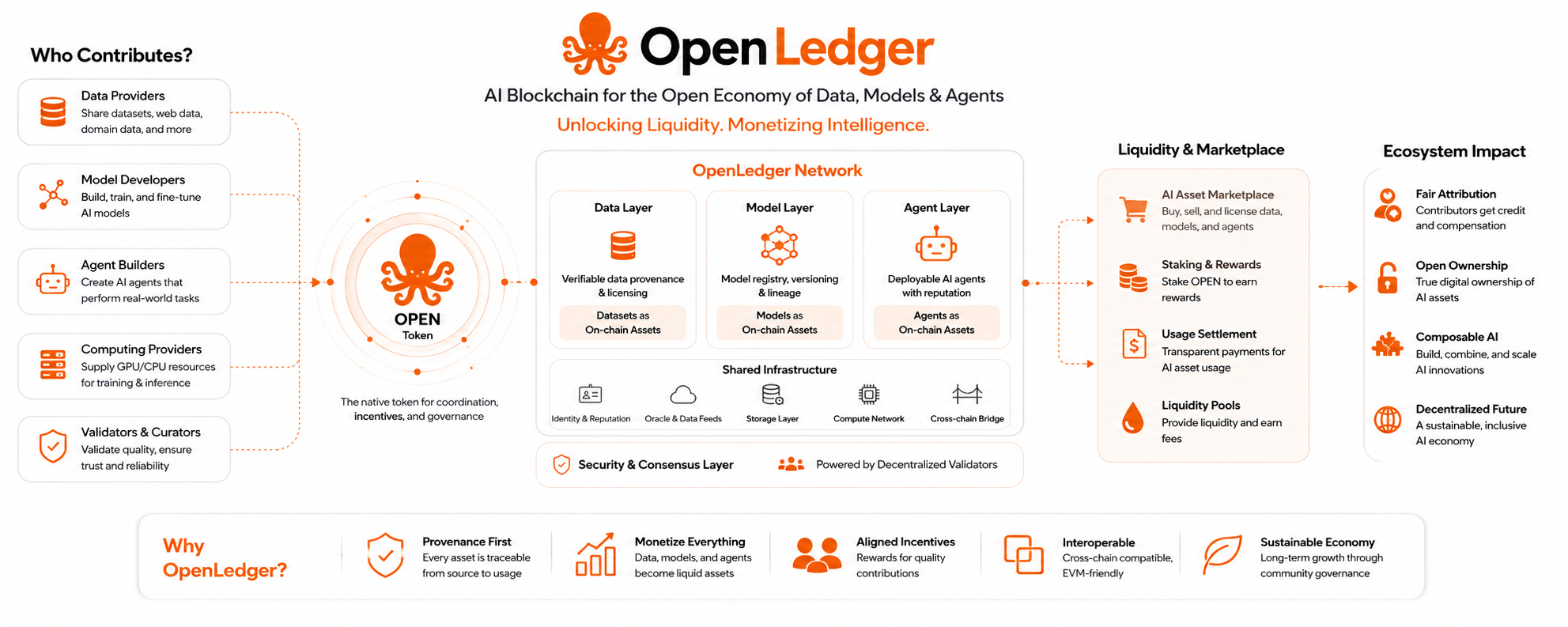
Not in a loud way. Not with the usual “this changes everything” tone that follows so many crypto projects. If anything, the idea behind OpenLedger feels quieter and more structural. It is trying to build a system where data, AI models, and autonomous agents can exist inside an open economic network instead of disappearing into closed platforms.
And honestly, the longer you think about that idea, the more understandable it becomes.
Right now, AI is turning into infrastructure. Slowly, almost invisibly. The same way the internet once did. At first it feels like a collection of tools, then suddenly entire industries depend on it. Once that happens, ownership matters. Governance matters. Access matters.
OpenLedger seems built around the belief that intelligence itself should not become something controlled entirely by a small number of institutions.
At its core, the project is trying to create traceability around AI systems. In simple terms, it wants to know where things came from. Which data helped train a model. Which contributors improved it. Which agents generated useful outcomes. Instead of treating AI like a sealed black box, OpenLedger tries to make the system economically visible.
That sounds technical, but emotionally it is actually very human.
People want recognition for contribution. They want transparency. They want some sense that the systems absorbing collective knowledge are not completely detached from the people feeding them.
The problem is that AI systems are incredibly messy once you look closely.
A model is rarely built from one clean source. It evolves through layers upon layers of training, adjustments, corrections, fine-tuning, and interaction. Thousands of invisible decisions shape the final result. Trying to fairly measure contribution inside that process is difficult in the same way it is difficult to identify every drop of water inside a river.
OpenLedger approaches this through blockchain infrastructure, using transparent records to track activity across the network. Data contributions, model interactions, and agent behavior can theoretically leave permanent traces that help define ownership and reward distribution later.
At least in theory.
Reality is where things become more complicated.
One of the hardest truths about decentralized systems is that openness usually comes with friction. Centralized companies move quickly because they control the entire environment. Decisions happen internally. Infrastructure stays tightly coordinated. Performance gets optimized aggressively.
Decentralized systems do not move that way.
Everything takes more coordination because trust is distributed rather than assumed. Verification layers add overhead. Governance introduces delays. Incentive systems need constant balancing. Even simple decisions can become surprisingly heavy once thousands of participants are involved.
This creates a genuine tension inside projects like OpenLedger.
The system wants transparency, fairness, and shared ownership. But the AI industry rewards speed, scale, and operational efficiency. Those priorities do not always align cleanly.
And to be fair, OpenLedger does not completely ignore that reality. It seems less focused on fully decentralizing all of AI itself and more focused on decentralizing the economic relationships surrounding AI systems.
That is an important distinction.
Because the truth is, some parts of AI naturally centralize. Training massive models requires extraordinary amounts of computation, electricity, and capital. No blockchain narrative changes that. Physics still matters. Scale still matters.
What OpenLedger appears to be asking instead is whether the value created around these systems can remain more open, transparent, and participatory.
That feels like a more grounded ambition.
The project also leans heavily into the idea of liquidity, but not just in the financial sense people usually associate with crypto. Here, liquidity is tied to movement and usability of intelligence itself. Datasets become usable assets. Models become modular building blocks. AI agents become economic participants capable of interacting across environments.
In a strange way, OpenLedger treats intelligence less like software and more like infrastructure with memory.
And maybe that framing makes sense for where the world is heading.
AI agents are already starting to behave less like static tools and more like semi-independent systems capable of handling workflows, executing tasks, and coordinating information. As that grows, questions around ownership and attribution become much more serious.
Who benefits when autonomous systems generate value?
Who gets rewarded when a model improves over time through collective interaction?
Who controls the infrastructure those systems depend on?
These questions sit quietly underneath almost every conversation about AI now, even when people are not directly saying them out loud.
Still, there are real weaknesses here too.
Projects operating at the intersection of AI and blockchain often underestimate how difficult long-term execution becomes. Both industries evolve at exhausting speed. Technical assumptions change quickly. Incentive systems break under pressure. Governance models that seem elegant in theory can become messy once money and influence accumulate unevenly.
And influence always accumulates unevenly eventually.
That is another uncomfortable reality many decentralized projects eventually face. Power does not disappear simply because a system uses tokens or distributed infrastructure. Sometimes it just changes shape. Large holders gain leverage. Compute providers gain leverage. Core developers gain leverage.
Decentralization is rarely absolute. Usually it is just an attempt to prevent power from becoming too permanent or too invisible.
OpenLedger will likely face those same pressures over time.
There is also the issue of quality control, which may quietly become one of the project’s biggest long-term challenges. If contributors are rewarded economically, some participants will naturally optimize for rewards rather than usefulness. Low-quality data, spam interactions, and artificial activity become difficult problems in open systems.
And AI systems are especially vulnerable to polluted inputs.
So the real test may not be whether OpenLedger can attract participation. Crypto projects are often very good at attracting participation during optimistic periods. The harder question is whether the network can maintain meaningful quality once incentives begin distorting behavior.
That is where mature infrastructure either survives or slowly collapses under its own noise.
Still, despite all the uncertainty, there is something valuable about projects willing to explore these questions seriously.
Because beneath the technical language, OpenLedger is responding to a growing cultural feeling that intelligence is becoming concentrated too quickly. People sense that AI is shaping the future while ownership narrows behind closed systems most individuals cannot access or influence.
OpenLedger may not fully solve that problem. Realistically, no current project does.
But it represents an attempt to build alternative structures before the landscape hardens completely around centralized control.
Maybe that matters more than people realize right now.
The internet itself once carried similar hopes about openness before power gradually consolidated into platforms. AI could easily follow the same path. Projects like OpenLedger feel like early efforts to keep at least part of the ecosystem economically visible and publicly participatory before everything disappears behind corporate walls.
That does not guarantee success.
The project could struggle technically. Adoption could stall. The economics could become unsustainable. Centralized AI providers may simply outpace decentralized systems through sheer operational efficiency.
All of those outcomes are possible.
But even then, experiments like this still shape the conversation. They force people to think more carefully about ownership, contribution, and control at a moment when those questions are becoming increasingly important.
And maybe that is the healthiest way to look at OpenLedger.
Not as a miracle.
Not as a guaranteed failure.
Just as an honest attempt to rethink how value moves through intelligent systems before those systems become too large, too centralized, and too deeply embedded to question later.