
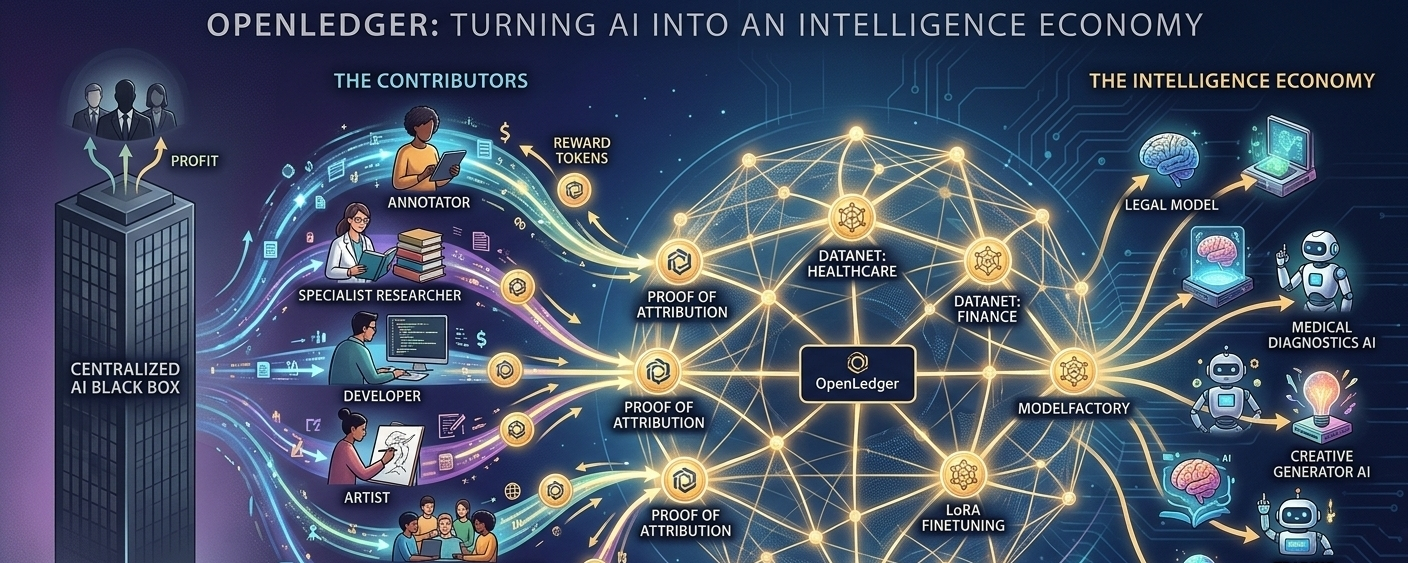
Most people interact with AI the same way people use electricity. Flip the switch. Get the result. Don’t think too hard about what’s happening behind the walls.
You ask a chatbot something. A polished answer appears in two seconds. Cool. Efficient. Almost eerie sometimes.
But the deeper I’ve gone into AI over the last year, the more one question keeps bothering me:
Who actually gets rewarded for creating the intelligence?
Not the company selling subscriptions. I mean the real contributors. The people feeding these systems with data, corrections, conversations, edge cases, feedback loops, specialized knowledge, cultural nuance, human behavior — all the messy stuff machines quietly absorb and monetize later.
Right now? Most of those people disappear into the background.
And honestly, that’s part of why OpenLedger caught my attention in the first place.
Not because it slapped “AI” onto a token and called it innovation. God knows crypto has enough of that already. Every other project suddenly becomes “AI-powered” the moment the market gets excited about machine learning.
This feels different.
OpenLedger is basically making a very bold argument: intelligence itself should become an economic network. Not a sealed corporate black box where value flows upward forever while contributors stay invisible.
That idea hits harder the longer you sit with it.
Because when you really think about it, modern AI systems are built on oceans of human contribution. Writers. Developers. Open-source communities. Researchers. Annotators. Random internet users unknowingly generating behavioral data every single day. Entire cultures, honestly.
Yet somehow, once the model becomes valuable, ownership collapses into a tiny handful of centralized entities.
Feels lopsided, doesn’t it?
OpenLedger’s answer to that imbalance is something called Proof of Attribution. And yeah, the name sounds technical at first. Almost academic. But the underlying idea is surprisingly human.
If your data, your contribution, or your expertise helps an AI system become smarter, more accurate, or more useful, there should be a way to trace that impact and reward it.
Simple concept.
Wildly complicated execution.
Because AI models are chaos under the hood. Neural networks don’t exactly leave clean fingerprints behind saying, “Hey, this output came 12% from Dataset A and 4% from Contributor B.” That’s part of the challenge here. Attribution inside large-scale AI systems is brutally difficult.
Still… the fact that somebody is even trying to solve this problem feels important.
Most AI companies don’t really want transparency. Their moat depends on opacity. The less you understand about how the machine creates value, the easier it becomes for the platform layer to absorb all the economics.
OpenLedger is pushing in the opposite direction. More traceability. More attribution. More visibility into how intelligence gets built.
And personally, I think that conversation is going to become unavoidable over the next few years.
Because AI is heading toward a collision with ownership economics whether people are ready or not.
You can already feel it happening.
Artists arguing about training data. Writers frustrated by scraping. Developers debating open-source monetization. Researchers fighting over credit. Entire industries quietly realizing their knowledge is being harvested into systems they don’t control.
There’s tension in the air now. Real tension.
And honestly? I don’t think the current structure holds forever.
That’s where OpenLedger starts getting genuinely interesting to me.
The project talks a lot about “Datanets,” which, underneath the branding, are basically attributed data ecosystems. Specialized networks organizing valuable datasets around particular domains.
At first I thought, okay, standard crypto jargon. But the more I looked at it, the more the idea made sense.
Because the future of AI probably doesn’t belong to one gigantic omniscient model doing everything perfectly. That narrative feels increasingly shaky. What seems more realistic is an explosion of highly specialized intelligence.
Healthcare models trained on medical datasets. Legal models trained around jurisdiction-specific knowledge. Gaming AI tuned around player behavior and economies. Financial reasoning systems optimized for niche market structures.
Different intelligence layers. Different contributors. Different incentives.
That changes everything.
Suddenly data quality matters more than raw scale. Specialized expertise becomes economically valuable. Communities can coordinate around building niche intelligence systems instead of feeding giant centralized models for free.
And that’s where blockchain actually starts feeling useful here — not as a buzzword, but as infrastructure for coordination, attribution, and incentive alignment.
That distinction matters a lot.
Because if I’m being honest, most crypto-AI projects I’ve seen still feel shallow. They usually orbit around hype cycles: decentralized GPUs, AI agents, automated trading bots, whatever narrative is pumping that month.
OpenLedger feels more foundational than that.
Less “look what AI can do.”
More “who owns the value AI creates?”
Completely different conversation.
Then there’s OpenLoRA, which I think people outside AI circles underestimate massively.
Most people hear about AI training and imagine the hard part is building the model once. It’s not. Maintaining, adapting, and fine-tuning these systems at scale is where things get ugly fast. Expensive. Resource-hungry. Centralizing by default.
LoRA infrastructure changes some of that dynamic by making specialization cheaper and lighter.
That might sound like a technical footnote, but it actually changes who gets to participate.
And historically, whenever technology becomes easier to customize, weird things happen. Good weird. Explosive weird.
The internet exploded when publishing became accessible. Mobile ecosystems exploded when app creation became accessible. Crypto exploded when finance became programmable.
AI probably follows the same pattern.
Once smaller developers, niche communities, researchers, and even ordinary businesses can cheaply adapt intelligence systems for their own use cases, the surface area of innovation expands dramatically.
You stop getting one monolithic AI future.
You get thousands of parallel ones.
That’s part of why ModelFactory stood out to me too.
Most AI tooling still feels intimidating unless you live inside technical ecosystems already. There’s this invisible wall around the industry where people with valuable expertise often can’t meaningfully participate because the infrastructure is too specialized.
ModelFactory seems aimed at lowering that wall.
And honestly, usability matters more than crypto people sometimes want to admit. A technically brilliant system nobody can navigate usually dies slowly while easier products eat the market alive.
People don’t adopt complexity because it’s elegant.
They adopt what feels usable at 2 a.m. when they’re tired and trying to get something working.
That human layer matters.
A lot.
The bigger point underneath all of this is that OpenLedger isn’t just trying to build AI infrastructure. It’s trying to build an economy around intelligence production itself.
That’s the part I keep coming back to.
Because AI creates a giant coordination problem underneath the surface glamour.
Who contributed?
Who gets paid?
Who governs upgrades?
Who owns model outputs?
How do you measure influence?
How do you stop value from concentrating into permanent extraction monopolies?
Those are not small questions.
They’re foundational ones.
And weirdly enough, blockchain systems are actually pretty well-suited for dealing with coordination, incentives, provenance, and transparent economic flows. That’s where the overlap between crypto and AI suddenly starts feeling natural instead of forced.
Not every project in this sector understands that.
OpenLedger seems to.
Now, to be fair, there’s still enormous execution risk here. I don’t think anybody should pretend otherwise. Attribution at scale is insanely difficult. AI systems are probabilistic and deeply interconnected. Measuring influence cleanly inside neural architectures may end up being far messier than the theory suggests.
Maybe even impossible in some contexts.
But even attempting to move AI economics toward transparency feels meaningful to me.
Because right now, the industry is drifting toward concentration at terrifying speed. A handful of companies control the models, the compute, the distribution, the data pipelines, and increasingly the economic upside too.
That trajectory has consequences.
And I think more people are starting to feel uneasy about it, even if they can’t fully articulate why yet.
Personally, the more I study projects at the intersection of crypto and AI, the less interested I become in short-term hype narratives. The flashy stuff fades fast. Always does.
What matters is whether a project is trying to solve a real structural problem.
OpenLedger at least appears to understand the real problem:
AI is not just a technology race anymore.
It’s becoming a fight over ownership, attribution, incentives, and economic power in a world increasingly shaped by machine intelligence.
And honestly? That conversation is only getting started.
