
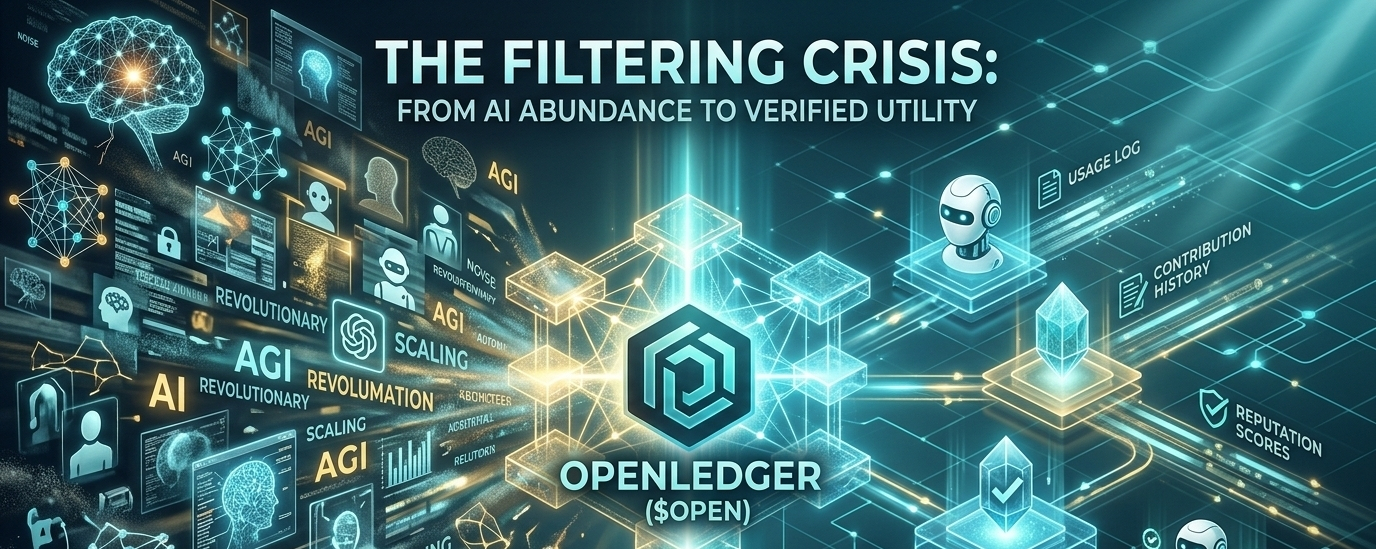
@OpenLedger There was a time when the biggest concern around AI was scarcity. People wanted more models, more tools, more computing power, more access. The assumption felt simple: if AI expands, everything gets better. More options mean more innovation. More builders mean more ideas. More systems mean faster progress. For a while, that story made sense because the industry was still young enough that every new breakthrough felt meaningful. But something feels different now. AI has not slowed down—it has accelerated. And strangely, that speed may be creating a completely different issue. There is no shortage anymore. There is abundance. Endless abundance.
Every week introduces another model claiming to be smarter, another AI assistant promising to transform productivity, another agent saying it can automate tasks better than anything before it. New datasets arrive with polished branding and ambitious descriptions. New workflows appear almost daily. On the surface, that sounds exciting because innovation should feel exciting. But after spending enough time watching the space, excitement starts changing into something else. It becomes harder to understand what actually matters. When every tool claims to solve important problems, importance itself becomes difficult to measure.
That is why OpenLedger started feeling interesting to me, not simply as another blockchain project connected to AI and not only as a place where data, models, and agents can be monetized. What caught my attention is the possibility that it might be trying to solve a quieter issue that people do not discuss enough. AI does not only have a creation problem anymore. It increasingly has a filtering problem.
Building itself is not the issue. More experimentation is healthy. Some of the best innovations come from unfinished ideas and strange experiments that initially seem small or unimportant. The real challenge begins when the ecosystem becomes so crowded that judging value becomes difficult. A dataset can sound revolutionary, but no one immediately knows whether it is clean, reliable, or useful. A model can post impressive benchmark numbers, but benchmarks alone do not reveal how it performs in real environments. An AI agent can promise complete automation, but promises do not tell anyone whether people continue using it after the first week. Even popularity becomes misleading because attention and usefulness are no longer the same thing.
Eventually every fast-growing market reaches a stage where people stop asking what something says and start asking for proof that it actually matters. That shift changes everything. Suddenly the important questions become deeper and more practical. Which datasets consistently improve systems? Which models keep delivering results in narrow tasks? Which agents survive beyond early hype? Which contributors continue creating real value over time? Those questions sound simple, but they become incredibly important once AI moves beyond demos and enters real workflows.
That is where OpenLedger starts to look more interesting. If AI assets can carry records connected to ownership, usage patterns, contributions, and actual interaction across a network, then people gain something stronger than marketing claims. Not perfect truth, because no system creates perfect truth, but stronger signals. Better signals than a website. Better signals than a thread online. Better signals than a polished launch video.
Because the reality is that bad AI rarely fails dramatically. Most failures happen quietly. A dataset may be slightly outdated. A model may be slightly inaccurate. An agent may work well most of the time but fail just enough to create friction. Those small weaknesses seem harmless individually, but over time they compound. A weak dataset affects model quality. Weak models affect automation. Poor automation damages trust. Eventually people stop trusting the entire workflow. Not because of one major disaster, but because small imperfections slowly build into larger problems.
The interesting part is that OpenLedger seems designed around a different philosophy. Instead of forcing value onto everything equally, it creates room for useful things to reveal themselves naturally over time. If an asset consistently contributes value, there should be visible signals. If a model repeatedly helps people build stronger systems, that should matter. If a dataset quietly becomes an important foundation for other tools, there should be evidence of that usefulness. And if something receives attention without creating meaningful activity, that should become visible too.
That changes the atmosphere around AI. Suddenly size becomes less important than reliability. Noise becomes less important than consistency. A smaller model used every day in real environments may matter more than a giant model with vague promises. A simple AI agent handling one repetitive task successfully may create more value than an advanced system trying to do ten things poorly. Sometimes boring usefulness wins over impressive complexity.
Maybe AI needs more of that humility. The industry often rewards massive visions and dramatic claims because they attract attention. But real work usually rewards something quieter. It rewards tools that continue showing up and delivering value long after excitement fades. It rewards reliability. It rewards trust. It rewards usefulness.
Of course none of this becomes automatic. Activity alone does not equal quality. Metrics can be manipulated. Networks can be gamed. Popularity can still be artificial. Real systems require context, reputation, and stronger ways to separate genuine value from empty movement. That challenge is difficult. But the demand for that solution feels increasingly real.
Because as AI keeps expanding, the next major problem may not be access. Access is becoming easier every day. The harder challenge might be confidence. Confidence that the parts you choose are actually worth using. Confidence that a workflow deserves trust. Confidence that useful things can separate themselves from noise.
And maybe that is the quiet idea sitting underneath OpenLedger and $OPEN. Not simply creating another AI economy, but creating a system where usefulness leaves evidence behind. In a future where AI becomes abundant, intelligence itself may stop being rare.
Trust might become the scarce resource instead.