 People still talk about AI like they’re shopping for apps.Which model writes better. Which chatbot feels smarter. Which assistant saves more time during work.
That entire framing already feels outdated.
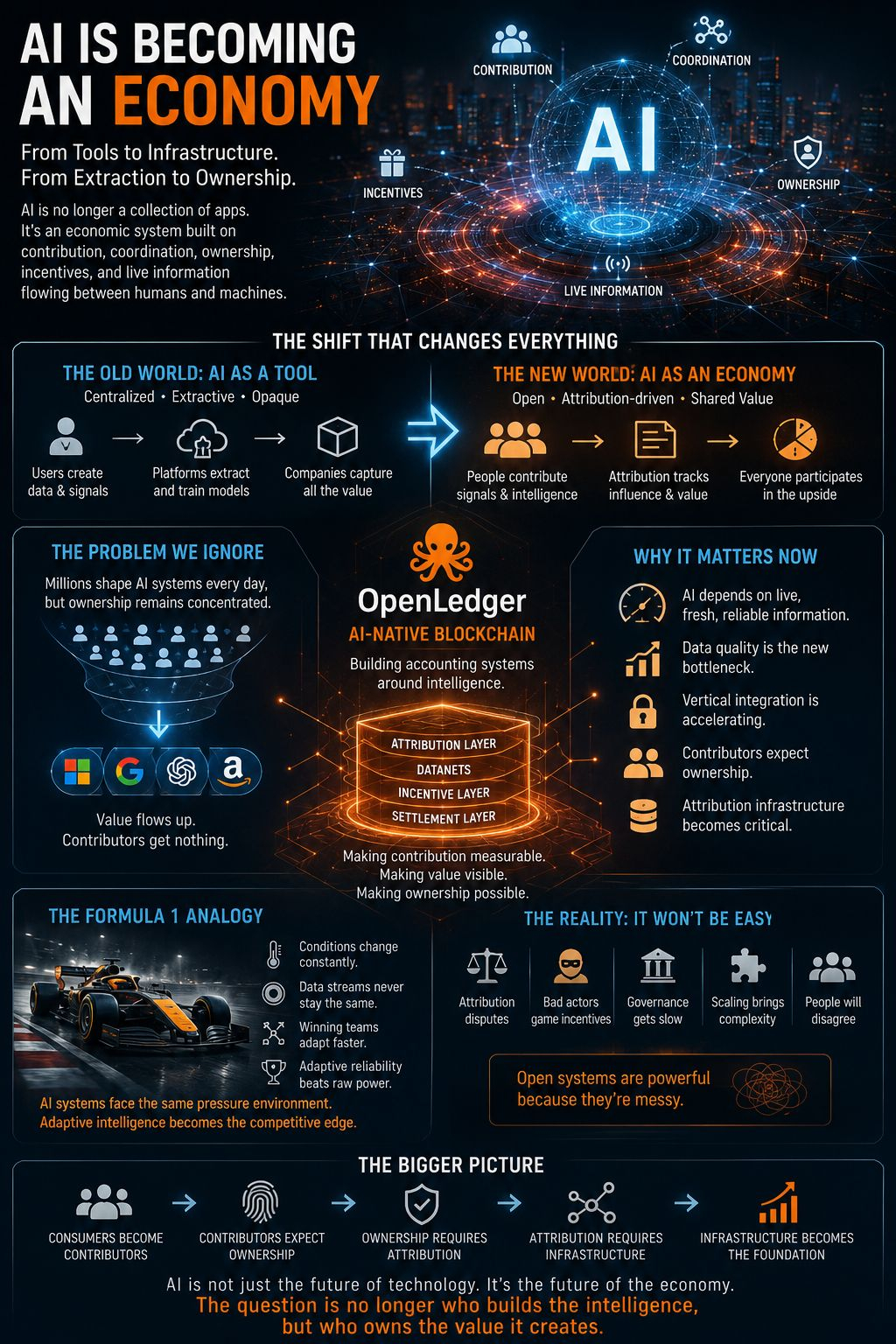
Something quieter is happening underneath all of this, and honestly, it changes the conversation completely. AI is no longer behaving like a standalone tool category. It’s starting to resemble an economic system one that runs on contribution, coordination, ownership, incentives, and constant streams of live information flowing between humans and machines.
That shift matters more than most product launches.
Because once intelligence starts operating like infrastructure instead of software, the obvious questions disappear. Suddenly nobody cares only about who built the best model. The harder question becomes who controls the value those systems generate over time.
That’s where openledger.xyz started making more sense to me.
Not immediately though.
The phrase “AI-native blockchain” has the same problem almost every crypto slogan has now: people have heard too many of them. The market trained everyone to become suspicious of futuristic branding because most narratives eventually collapse into recycled infrastructure with a new coat of paint.
And to be fair, some AI projects still feel exactly like that. Add a chatbot. Mention autonomous agents. Put “intelligence layer” somewhere in the whitepaper. Done.
It’s lazy.
What caught my attention with OpenLedger wasn’t the branding. It was the direction of the architecture underneath it.
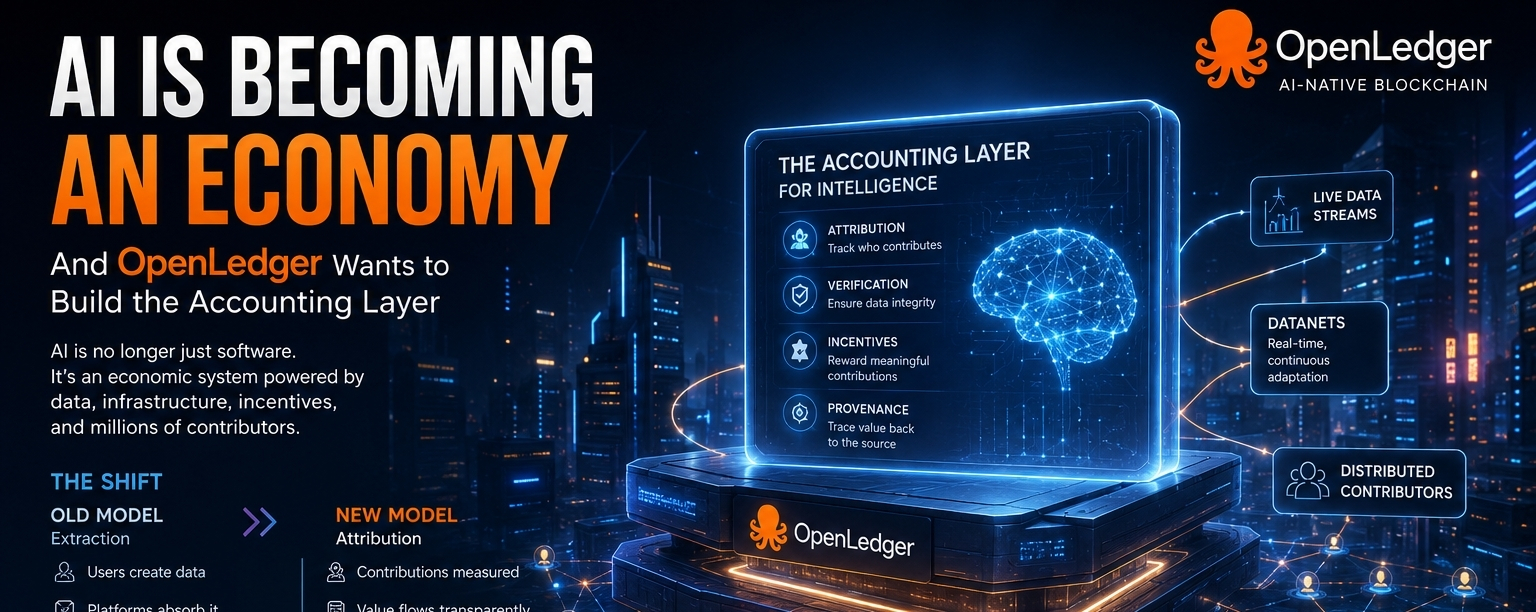
The project seems less interested in making AI look decentralized and more interested in building accounting systems around intelligence itself.
That’s a different idea entirely.
Most large AI systems today still operate through invisible extraction. People create information constantly — posts, conversations, edits, decisions, behaviors, corrections, reactions — and platforms absorb all of it into model improvement pipelines. The end products become extremely valuable, while the people contributing signal into the system rarely participate economically.
Social media already worked this way for years. Users generated the attention economy while platforms captured most of the upside.
AI scales that imbalance much further.
Especially now, in 2026, because the industry has moved beyond static training archives. Models increasingly depend on live environments: real-time market data, changing user behavior, evolving context, localized signals, feedback loops. Intelligence systems now degrade faster when information becomes stale.
That changes what becomes valuable.
Not just data volume. Useful data. Reliable data. Fresh data. Continuously refreshed inputs.
A huge model trained on polluted information eventually becomes unstable no matter how much compute gets thrown at it. You can already see parts of this happening across AI search products. Some systems sound confident while quietly hallucinating outdated realities from six months ago.
The weird thing is that hardware still gets most of the attention because hardware is easier to measure. GPU demand. Nvidia earnings. Cloud expansion. Data center spending in Texas, Malaysia, Saudi Arabia. Those numbers are visible.
Data quality isn’t visible in the same way. But it’s becoming a bottleneck anyway.
That’s partly why OpenLedger’s focus on attribution and Datanets feels strategically smarter than the average AI token narrative floating around crypto right now.
The core idea appears simple on paper: if intelligence is built from distributed contributions, then contribution itself should become measurable and economically visible.
Simple concept.
Messy reality.
Because humans do not contribute information neatly. One useful signal might matter instantly. Another becomes valuable only months later after combining with thousands of unrelated interactions somewhere else inside a model pipeline.
And honestly, that’s where a lot of these systems could break.
Attribution sounds clean until real-world behavior enters the room.
Still, the direction itself matters.
There’s an uncomfortable question sitting underneath the current AI boom that the industry keeps avoiding:
If millions of people continuously shape AI systems, why does ownership remain so concentrated?
Right now a relatively small number of companies control the strongest models, the largest compute environments, the cloud layers, the distribution channels, and increasingly the user interfaces too. Vertical integration is accelerating fast. Faster than most crypto people seem willing to admit.
Open systems are entering this race late.
That’s the real pressure.
And I think some blockchain projects still underestimate how difficult this becomes once AI markets mature further. Infrastructure dominance compounds. Once developers, enterprise tools, inference layers, and consumer habits lock into the same ecosystems, escaping them becomes expensive.
This is partly why the overlap between AI and blockchain finally feels less cosmetic than it did two years ago.
Before, the relationship felt forced.
AI projects wanted decentralization aesthetics. Crypto projects wanted AI relevance. Neither side really needed the other.
Now they actually do.
AI creates attribution problems. Blockchain tracks provenance.
AI depends on distributed contribution. Blockchain coordinates distributed incentives.
AI systems require trust around data flows. Blockchains verify ownership history better than traditional opaque databases.
That convergence is becoming structural instead of promotional.
There was one comparison tied to OpenLedger that I originally dismissed completely — the Formula 1 analogy.
It sounded like marketing theater at first.
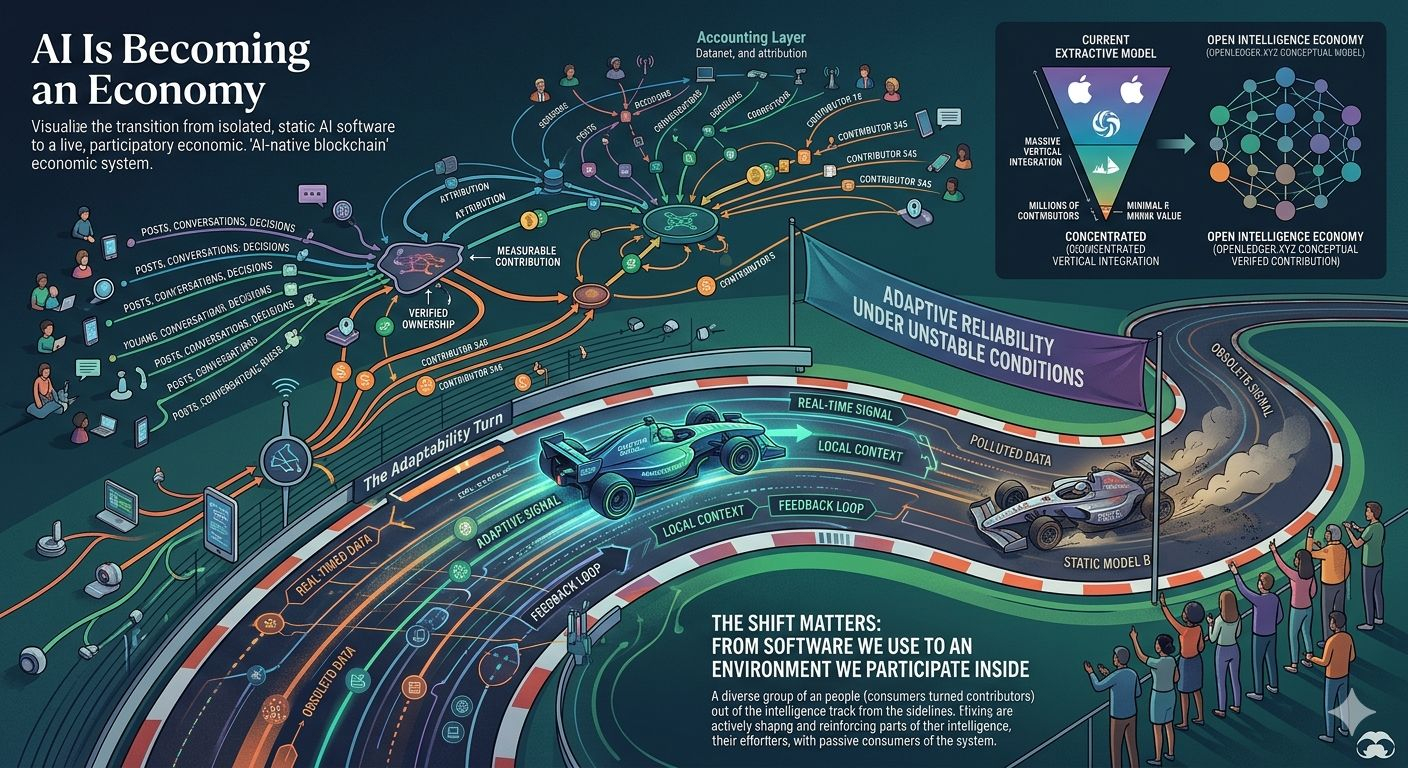
Then it clicked later while watching a race replay at 2:10 in the morning after a rain delay. Teams weren’t winning because the cars were magically faster in isolation. They were winning because they adjusted faster while conditions kept changing underneath them.
Temperature shifts. Tire wear. Fuel strategy. Rain timing. Safety cars.
Everything moved dynamically.
Modern AI systems are drifting toward the same pressure environment. The next competitive edge may not be raw intelligence alone. It may be adaptive reliability under unstable conditions.
That’s much harder.
A model that updates too slowly becomes obsolete. A model that adapts too aggressively becomes chaotic.
Finding the balance between those two extremes probably becomes an infrastructure problem before it becomes a product problem.
And that’s another reason projects like OpenLedger are interesting even if they evolve heavily from their current form over time. They’re attempting to redesign coordination around intelligence before centralized systems completely lock the landscape down.
Will all of it work exactly as intended? Probably not.
Open contribution systems create friction naturally.
Verification disputes happen. Incentives get manipulated. Governance becomes slow. Bad actors optimize around reward structures. Scaling introduces complexity nobody predicted early on.
Open systems are powerful partly because they’re messy.
A perfectly traceable intelligence economy sounds attractive until thousands of contributors begin disagreeing about what influence actually means.
And people absolutely will disagree.
Somebody always does.
Still, there’s something important happening underneath this broader shift that feels bigger than one protocol or one token cycle. AI is starting to look less like software people use occasionally and more like an environment people participate inside continuously.
That changes the economics.
Consumers become contributors. Contributors expect ownership. Ownership requires attribution. Attribution requires infrastructure.
The accounting layer starts mattering almost as much as the intelligence layer itself.
That’s the part a lot of people still haven’t fully processed yet.$OPEN #OpenLedger @OpenLedger $PEPE $BTC