
Most people still describe AI like it’s a product category.
A smarter chatbot.
A writing assistant.
A faster search engine.
That framing already feels too small.
After watching how AI systems are evolving over the last year, I think we’re moving into something much bigger than software alone. AI is slowly turning into an economic environment — one powered by data ownership, infrastructure coordination, incentives, and continuous contribution from millions of participants.
And once you start looking at AI through that lens, the conversation changes immediately.
The important question stops being:
“Which model is smartest?”
And becomes:
“Who owns the value generated by intelligence itself?”
That’s the angle that made OpenLedger interesting to me.
At first, I dismissed the phrase “AI-native blockchain” almost automatically. Crypto has trained people to become suspicious of fashionable labels because every cycle introduces new narratives that usually lead back to the same infrastructure underneath.
But after digging deeper into OpenLedger’s structure, the project started feeling less like another AI narrative and more like an attempt to redesign the economic rails behind AI systems.
That distinction matters.
Most AI ecosystems today still operate through extraction.
Users create data.
Platforms absorb it.
Models improve.
Companies monetize the outcome.
But the contributors generating the raw intelligence usually remain invisible from the economic side of the system.
That imbalance existed throughout the social media era too. Platforms became enormously valuable partly because users continuously produced behavior patterns, preferences, interactions, and content. Yet ownership stayed concentrated at the platform layer.
AI is accelerating the same structure at a much larger scale.
The stronger AI becomes, the more valuable high-quality data becomes. And once systems start depending on live contextual information instead of static training archives, attribution suddenly becomes critical.
That’s where OpenLedger appears to be approaching things differently.
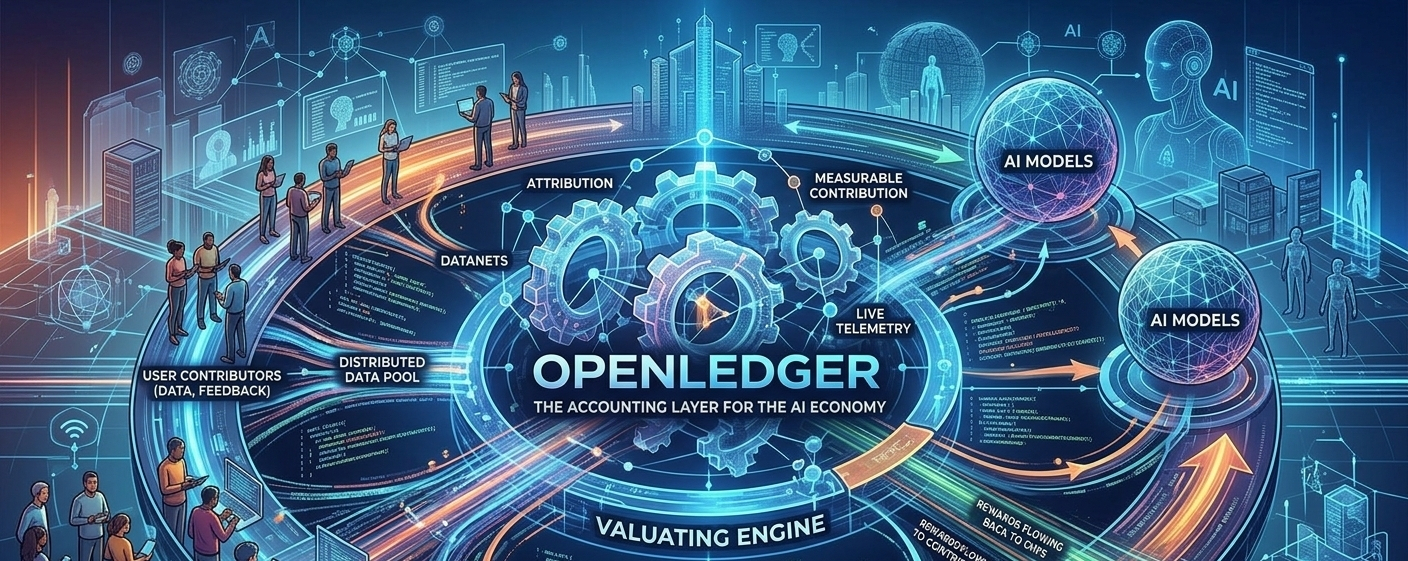
The project’s framework revolves around measurable contribution. Instead of treating data like invisible fuel, the system attempts to track who contributes value, how that value influences models, and how economic rewards could potentially flow back through the network.
In simple terms, the idea is that intelligence should not operate like a black box where only the final product matters.
Contribution itself becomes part of the economy.
That’s a meaningful shift because AI infrastructure is increasingly dependent on distributed participation.
People spend enormous amounts of time talking about GPUs because hardware is easy to quantify. Nvidia revenue, compute shortages, cloud demand — all of it is measurable.
But there’s another bottleneck forming underneath the market.
Reliable data.
Not just massive quantities of information.
Useful information.
Fresh information.
Continuously updated information.
A powerful model trained on poor-quality inputs eventually becomes less effective regardless of compute scale.
That’s why OpenLedger’s focus on Datanets and live telemetry is strategically interesting.
The system is designed around continuous adaptation rather than occasional updates. Instead of behaving like static software waiting for prompts, the framework pushes toward AI environments that constantly recalculate based on changing conditions.
The Formula 1 comparison sounded dramatic to me the first time I heard it. Honestly, I thought it was one of those analogies crypto projects use because they sound futuristic.$BNB $USDC
