

The older I get in crypto, the less impressed I become by high APY screenshots.
I still remember the period when everyone chased yield like it was free money. Capital jumped from protocol to protocol every week, bridges were constantly congested, and entire ecosystems were built around temporary incentives that disappeared the moment emissions slowed down. For a while, it worked. Until it didn’t.
What stayed with me from that era wasn’t the profits or losses. It was the realization that most of DeFi’s biggest problems were never really about yield. They were coordination problems disguised as financial products.
Liquidity was fragmented.
Information was fragmented.
Execution was fragmented.
And lately, when I look at what @OpenLedger is building around ERC 4626 vaults and AI powered infrastructure, it feels less like another DeFi product and more like an attempt to solve that fragmentation at the infrastructure layer itself.
That’s the part I think the market is still underestimating.
At first glance, ERC 4626 doesn’t sound exciting. It’s simply a standard for tokenized vaults. But crypto history has a strange pattern where the least glamorous standards quietly end up shaping entire market structures. ERC 20 standardized token behavior and unlocked fungible asset ecosystems. ERC 721 standardized ownership for digital assets. ERC 4626 is beginning to standardize how yield bearing capital moves across DeFi.
And standardization matters because fragmented systems eventually hit efficiency limits.
Before ERC 4626, every vault architecture behaved slightly differently. Developers needed custom integrations. Aggregators faced unnecessary complexity. Liquidity became siloed across ecosystems even when strategies were fundamentally similar. The result was a market where capital moved inefficiently despite crypto supposedly being programmable finance.
ERC 4626 fixes part of that by creating a shared framework for vault interoperability.
But #OpenLedger adds another layer on top of it entirely.
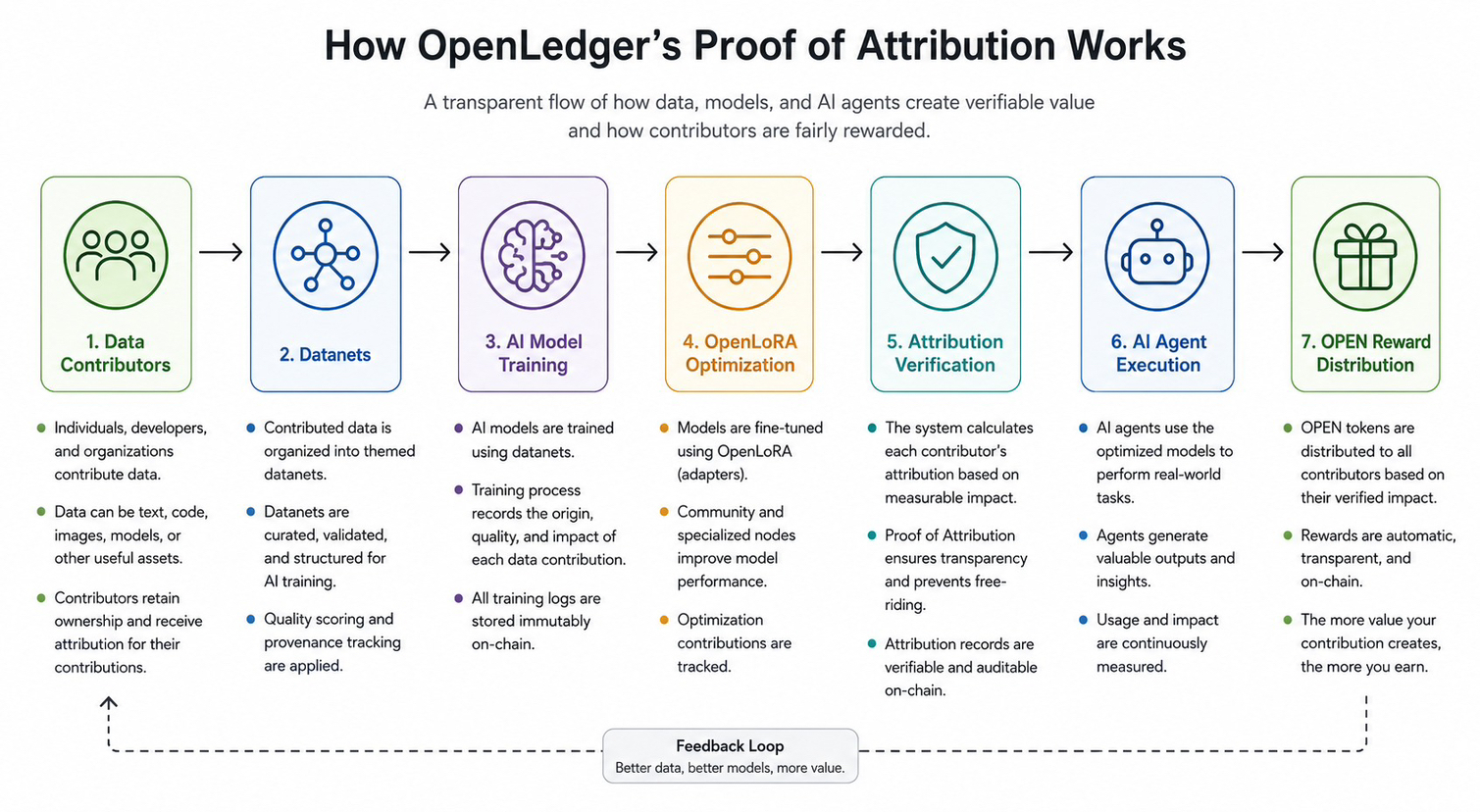
Instead of treating vaults as passive containers for assets, OpenLedger’s broader AI infrastructure suggests a future where vaults become adaptive coordination systems connected to decentralized intelligence networks.
That changes the conversation completely.
Most yield systems today still operate like fixed engines. They follow predefined instructions regardless of whether liquidity conditions, volatility, or cross chain demand changes dramatically. But crypto markets have evolved beyond static environments. Liquidity now behaves almost like migrating weather patterns. Stablecoins rotate between ecosystems overnight. Narratives redirect capital flows within hours. Entire sectors can lose or gain attention in a single trading session.
Human participants struggle to process all of that consistently.
AI systems don’t get tired.
That’s where OpenLedger’s architecture becomes genuinely interesting to me.
The protocol’s ecosystem revolves around decentralized AI coordination through components like Proof of Attribution, Datanets, and OpenLoRA infrastructure. Instead of centralizing intelligence behind closed systems, OpenLedger attempts to create verifiable contribution layers where data providers, model builders, and execution participants are all economically connected through the $OPEN ecosystem.
In simple terms, the intelligence layer itself becomes part of the network economy.
That may sound abstract initially, but inside ERC 4626 vault systems, it creates very practical implications.
The vault standard provides interoperability.
The AI layer provides adaptive execution.
The attribution system provides accountability.
Together, they form a financial structure where capital allocation can theoretically evolve in real time instead of remaining static.
And honestly, I think this reflects where crypto is heading more broadly.
The industry spent years building chains.
Then it spent years building applications.
Now it’s starting to build coordination infrastructure between intelligence, liquidity, and execution.
That’s a much bigger transition than most people realize while watching short term market movements.
What makes OpenLedger particularly aligned with current market evolution is timing. AI is no longer a speculative side narrative in finance. Traditional firms already use machine learning systems for portfolio optimization, execution routing, volatility modeling, and liquidity management. At the same time, crypto has matured into a globally connected liquidity environment operating across Ethereum, Solana, BNB Chain, Base, Arbitrum, and countless modular ecosystems simultaneously.
The problem is that humans cannot efficiently coordinate fragmented liquidity across all those environments continuously.
AI agents potentially can.
And once vault architectures become standardized through ERC 4626, those agents can interact with financial infrastructure much more efficiently across ecosystems without requiring entirely custom integrations every time.
That reduces friction everywhere.
For developers, it lowers integration complexity.
For traders, it improves execution efficiency.
For liquidity providers, it creates more adaptive allocation systems.
For markets overall, it increases capital efficiency across fragmented ecosystems.
But this is also where the risks become impossible to ignore.
AI powered financial coordination introduces entirely new systemic vulnerabilities. A poorly trained model can misinterpret volatility conditions. Over optimized strategies can become fragile during abnormal market stress. Interconnected vault systems improve composability, but they also increase contagion risk if similar AI logic governs too much liquidity simultaneously.
Crypto already learned painful lessons about hidden dependencies during previous DeFi collapses.
There’s also the governance issue.
AI systems evolve dynamically by nature, while financial infrastructure requires transparency and predictability. Balancing those two forces may become one of the defining challenges of decentralized finance over the next decade. OpenLedger’s Proof of Attribution framework may help solve part of this by creating verifiable accountability around model contributions and execution quality, but the broader industry still remains early in understanding decentralized AI governance properly.
And maybe that’s exactly why this matters long term.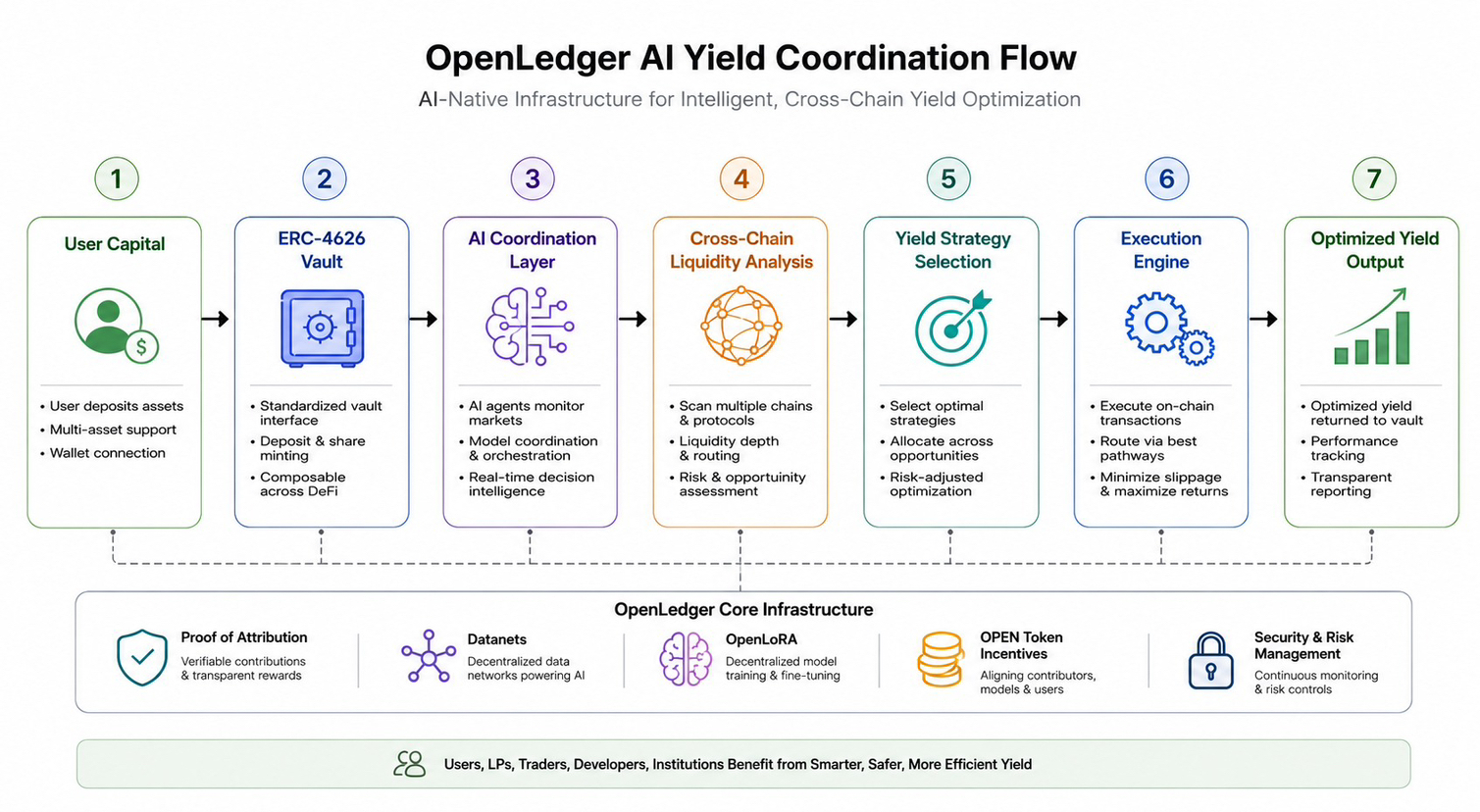
For years, crypto focused heavily on ownership.
Now it’s starting to focus on coordination.
Who coordinates liquidity best?
Who coordinates intelligence best?
Who coordinates execution most efficiently across ecosystems?
Those questions may quietly define the next generation of infrastructure winners far more than short term token narratives.
That’s ultimately why OpenLedger combining ERC 4626 vaults with AI powered yield systems feels important to me. Not because AI magically guarantees better returns. And not because standardized vaults suddenly remove market risk.
But because the architecture points toward something larger:
a financial system where liquidity, intelligence, and execution become interoperable layers operating together instead of fragmented systems competing separately.
Most people still see yield as a percentage number on a dashboard.
What OpenLedger seems to recognize is that future yield may depend less on incentives and more on intelligence infrastructure itself.
And over time, that distinction could reshape how capital moves across the entire digital asset economy.