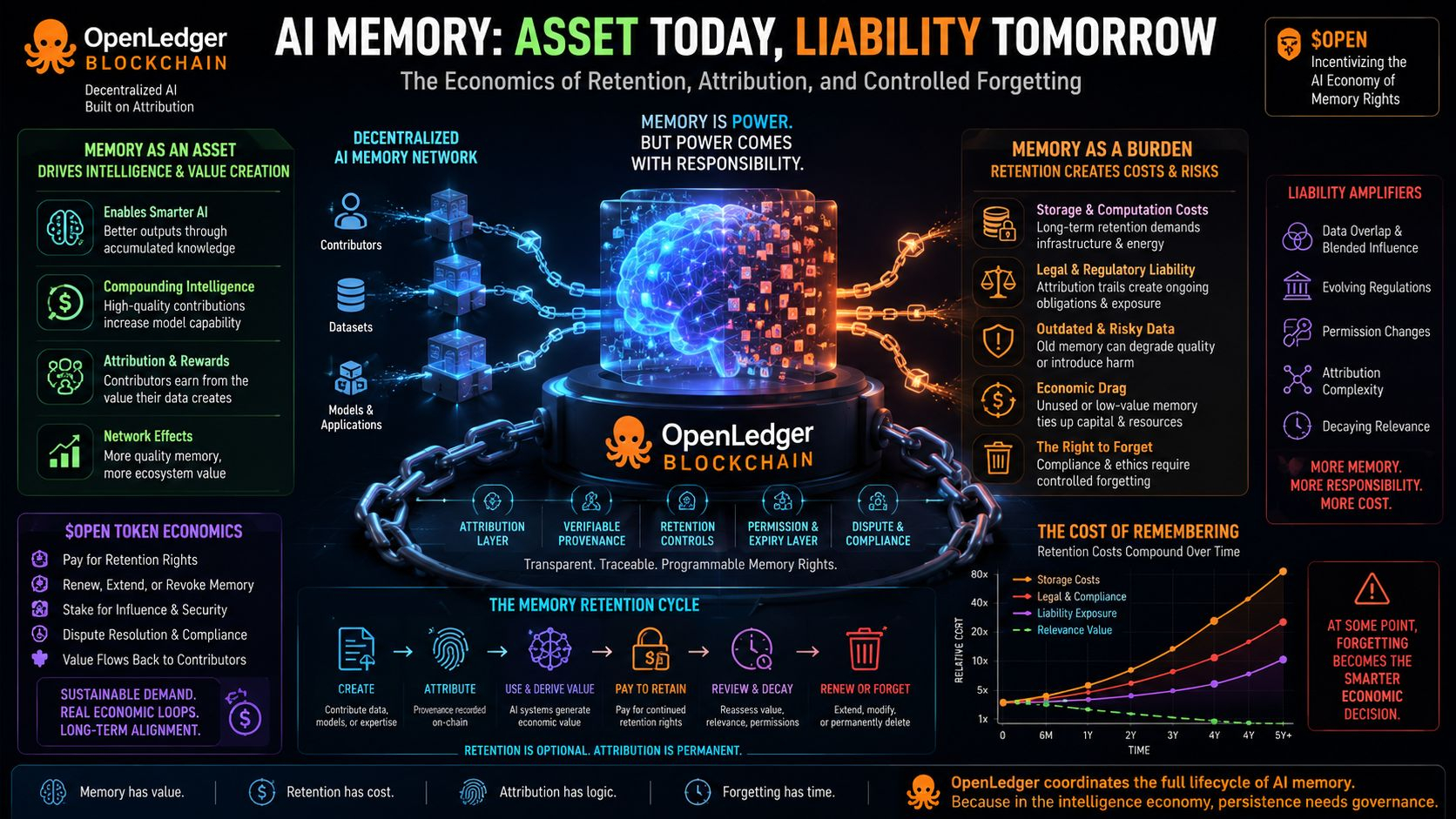
I have been thinking about something lately that honestly feels weirdly ignored in most AI discussions.
Everybody keeps talking about how AI learns.
Bigger models. More context. More datasets. Infinite memory. Smarter outputs.
Cool. But nobody really talks about what happens when these systems remember to much.
That idea hit me again a few nights ago while I was scrolling through another AI token launch. Same familiar setup. Strong branding, polished marketing, big “future of decentralized intelligence” energy all over the timeline. You could literally feel the excitement.
But the chart looked off.
Not terrible. Just… hollow.
Price moved like people were renting attention instead of building conviction. Traders piled in fast, farmed the narrative, then rotated out the second momentum slowed down. I’ve seen that behavior too many times in crypto now lol.
And honestly, that’s when OpenLedger started becoming more interesting to me.
At first I viewed it the same way most people probably do. AI attribution infrastructure. Contributors provide data, systems track usage, rewards get distributed, and $OPEN coordinates the incentives.
Simple enough.
Crypto already understands these models because we’ve seen versions of them before with storage, compute, and marketplace protocols.
But then I started thinking deeper about the economics behind AI memory itself.
Because memory isn’t actually free.
And I don’t just mean storage costs.
The moment AI outputs become commercially valuable, retained memory starts creating baggage.
Old contributor influence may still require compensation months later. Attribution trails can create legal pressure. Permissions change. Data becomes outdated. Regulatory requirements evolve. Suddenly the system isn’t just storing intelligence anymore it’s inheriting obligations.
That changes the entire conversation.
Most people still analyze AI infrastructure like the important thing is access.
I’m starting to think the real issue becomes retention.
Who pays to keep memory active over time?
And honestly… who pays to stop remembering?
That’s the part I think the market still hasn’t fully priced.
Because if AI networks eventually need economically managed memory, then protocols like OpenLedger stop looking like simple attribution systems and start looking more like coordination layers around retention, decay, and controlled expiry.
And that matters a lot for token economics.
Crypto infrastructure survives on recurring behavior, not launch excitement.
Ethereum works because transactions never stop. Cloud businesses survive because usage constantly renews itself. Security systems work because validation keeps happening every single day.
Infrastructure survives through repetition.
Not vibes.
That’s where I think a lot of traders misunderstand AI infrastructure tokens. Initial participation doesn’t mean much long term. What matters is whether the system creates ongoing operational reasons for people to keep coming back.
Otherwise you get the same cycle every time: Users join. Narrative peaks. Emissions drive activity. Speculators rotate. Volume fades.
I’ve watched that movie way too many times already.
But if retaining AI influence itself carries recurring economic cost, then the model changes completely.
Now the network potentially creates continuous demand around:
retention rights
memory renewal
attribution persistence
revocable permissions
compliance verification
influence depreciation
That’s a way stronger loop than one-time onboarding incentives.
Of course, this is also where things get messy fast.
Because attribution sounds way cleaner in diagrams than it does in reality.
AI systems don’t produce outputs in perfectly traceable ways. Influence gets blended across training data, reinforcement tuning, retrieval systems, statistical inference, context injection… everything overlaps.
Trying to measure exact contribution becomes complicated very quickly.
And once token rewards get attached to influence measurement, bad incentives show up immediately.
Low-quality contributors farm emissions. Synthetic data floods systems. Fake attribution loops appear. Networks start rewarding activity instead of actual value.
That’s how infrastructure credibility gets destroyed.
Which is why I think people are still focusing on the wrong metrics.
I care way less about partnership announcements or social engagement numbers.
The stuff I’d actually watch is:
recurring fee generation
real usage growth
contributor retention without heavy emissions
bonded participation
supply absorption
builders returning consistently
Because good architecture trapped inside weak token economics still trades badly. Every single time.
And honestly, I think this connects to something much bigger happening underneath AI itself.
The first phase of AI was about creating intelligence.
The next phase might be about governing persistence.
Because once intelligence becomes commercially embedded into economies, memory stops being purely technical. It becomes financial. Legal. Operational. Political.
Eventually, remembering becomes expensive too.
That is why I think the market may still be looking at OpenLedger from the wrong angle.
Most people keep asking whether AI attribution becomes valuable.
I think the harder question is this:
What happens when retaining intelligence becomes more expensive than forgetting it?
Because if that future actually arrives, then protocols managing memory rights, attribution decay, retention costs, and controlled forgetting could end up becoming way more important than people currently realize.