
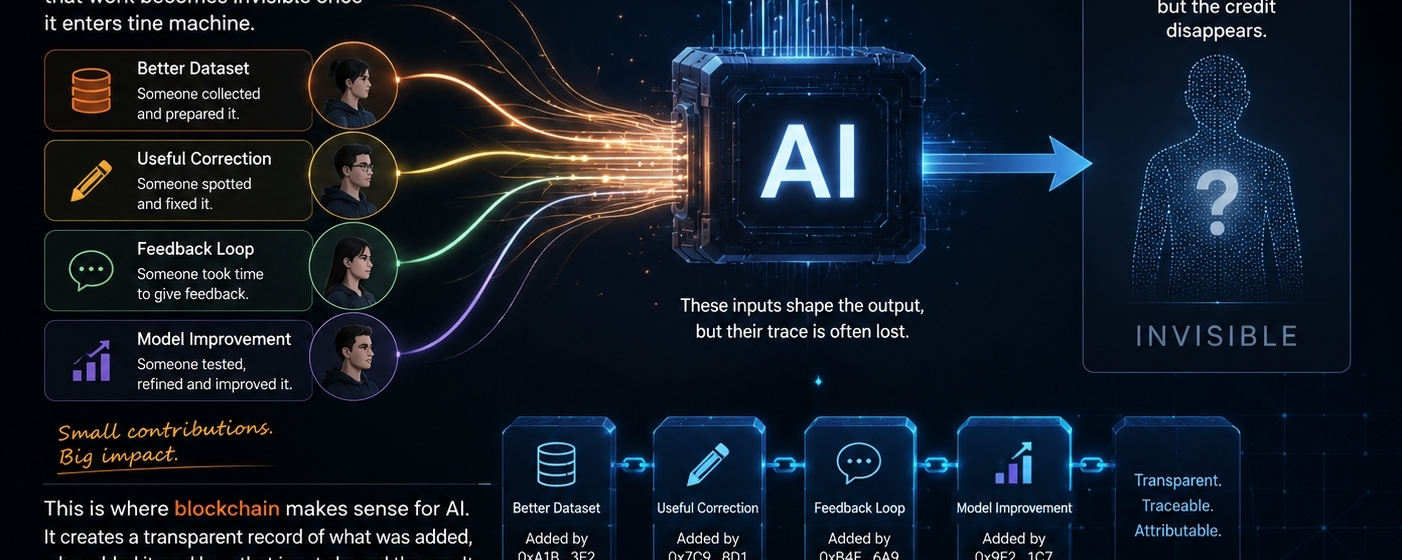
I keep noticing how most AI projects talk about intelligence as something clean, structured, almost artificially simple. Just train bigger models, add more GPUs, throw in more data. But OpenLedger feels slightly different because it pays attention to where the data actually comes from, and honestly, that part is ignored more than people admit.
A few nights ago I was reading about Datanets while only half focused. Coffee already cold beside me. Still, the idea stayed in my head longer than expected. An on-chain system for domain-specific datasets sounds highly technical at first, but the real interesting part is the credibility layer attached to it. Staking weights deciding reputation. Of course, it is not a perfect system. People will always try to game systems. That is just how things work. But at least the problem is being acknowledged instead of being hidden behind polished AI demos.
Most people using AI today probably do not think about dataset quality until the model fails in a very obvious way. Incorrect medical advice. Hallucinated legal references. Financial nonsense delivered with complete confidence. The strange thing is we have normalized a relationship where models appear intelligent long before they are actually reliable.
OpenLedger AI Studio seems more focused on the underlying infrastructure that sits beneath all of this so-called intelligence.
The RLHF side also caught my attention, mainly because human feedback is inherently messy. Different people reward different outputs in different ways. Even ethics are not universally agreed upon, no matter how neatly they are presented in slides. So whenever people talk about “alignment,” I always wonder whose alignment they actually mean. Still, combining supervised fine-tuning with RLHF makes practical sense. Raw intelligence without correction tends to drift into something unusable very quickly.
What I find interesting is that OpenLedger does not pretend the system is magically objective. Credibility scores, staking-based influence, human feedback loops — all of it acknowledges that humans are embedded inside the machine, even if we prefer not to think about it that way.
Maybe that is the uncomfortable reality of AI right now. Models are improving rapidly, but trust is not keeping up.#OpenLedger
And trust always takes time. Sometimes painfully slow.@Pixels $OPEN