
Every cycle in crypto eventually becomes a search for extraction.
Not innovation. Not ideology. Extraction.
The language changes each time. In one era it was block space. Then yield. Then liquidity. Then attention. Now it is intelligence itself. Data, models, agents, inference layers, synthetic labor. The market keeps moving toward whatever appears underpriced relative to the next technological shift, and eventually someone asks the same question in a different form: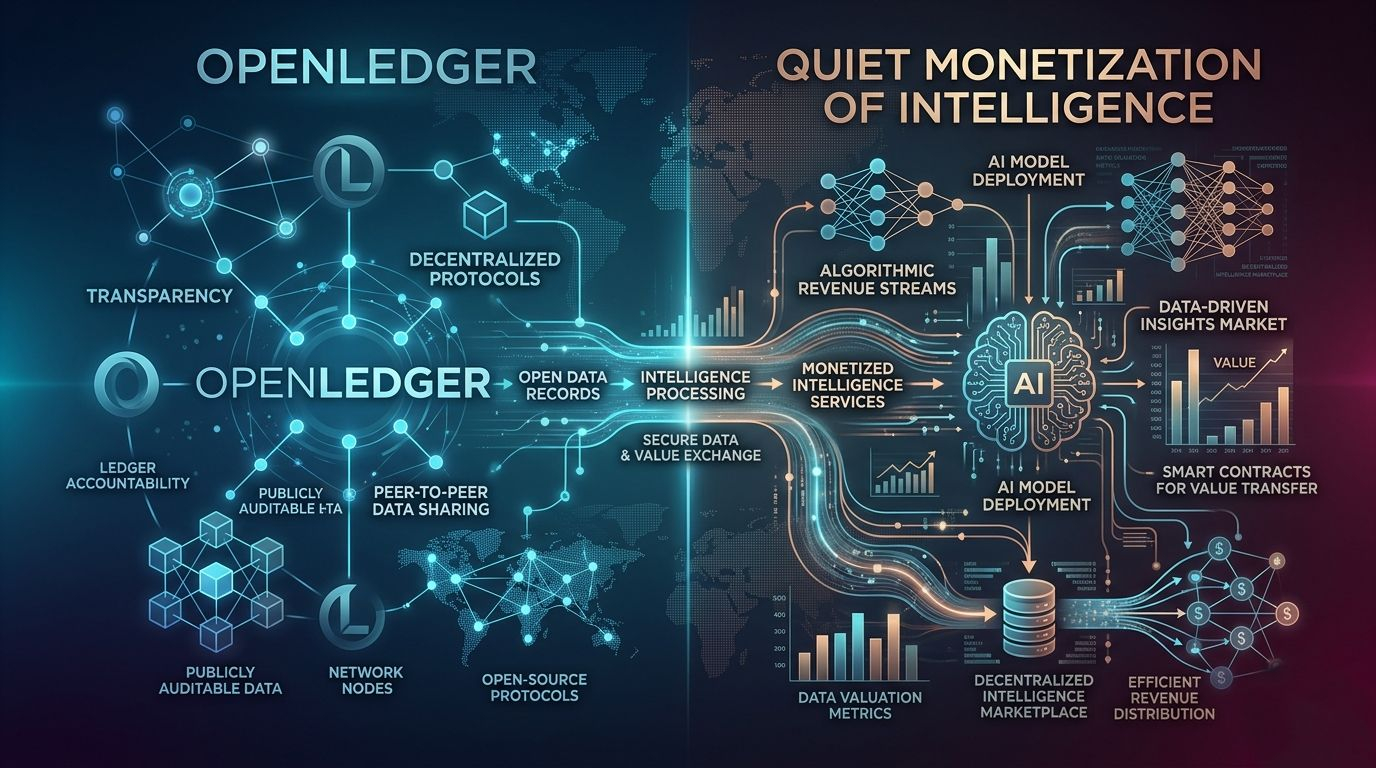
Who captures the value?
AI accelerated that question faster than most people expected. Not because machine learning suddenly became new, but because the public finally saw what scalable intelligence products look like when they escape research environments and enter everyday life. Once that happened, crypto reacted in the only way it knows how. Tokens appeared around everything remotely adjacent to AI infrastructure.
Most of it was predictable.
Projects attaching “AI” to old token models. Networks pretending GPU scarcity alone justified economic sustainability. Data marketplaces built on the assumption that all data naturally wants to become liquid. It felt less like infrastructure and more like narrative arbitrage.
That context matters when looking at OpenLedger.
Because underneath the branding, the more interesting question is not whether decentralized AI becomes large. It probably does in some form. The harder question is whether crypto can coordinate economic trust around intelligence production without recreating the same concentration dynamics it claims to replace.
That is a much uglier problem.
OpenLedger sits in the middle of this emerging attempt to financialize AI contribution layers. Data providers, model builders, agents, inference systems. The pitch sounds straightforward enough. Create infrastructure where contributors to AI systems can monetize their work transparently instead of handing value entirely to centralized platforms.
Reasonable idea.
But crypto has a habit of making reasonable ideas structurally fragile the moment tokens enter the equation.
The deeper issue is that AI systems are not simple ownership systems. They are coordination systems. And coordination breaks down quickly once incentives become uneven.
A dataset contributor wants recurring value capture.
A model developer wants defensibility.
Users want low friction and reliability.
Speculators want volatility.
Infrastructure providers want fees.
Governance participants want influence without responsibility.
These groups rarely remain aligned for long. Crypto history is basically a graveyard of temporary incentive alignment mistaken for sustainable economic design.
OpenLedger at least appears to recognize that AI infrastructure is not merely a technical problem. It is an attribution problem. Who contributed what. Which data mattered. Which model improvements created measurable value. Which agents generated useful outcomes instead of noise.
That sounds manageable until scale arrives.
The moment real economic value exists inside a network, manipulation follows naturally. Low-quality datasets flood systems. Attribution becomes gamed. Reputation systems get farmed. Incentive models become optimization targets instead of trust mechanisms. Crypto repeatedly underestimates how aggressively markets exploit any measurable reward function.
And AI ecosystems already struggle with this without tokens involved.
There is also the uncomfortable reality that decentralization sounds cleaner in theory than in operation. Most users do not care whether infrastructure is decentralized. They care whether it works consistently, cheaply, and invisibly. Convenience centralizes markets faster than ideology decentralizes them.
That creates tension for projects like OpenLedger.
If the network becomes too permissionless, quality control deteriorates.
If quality control tightens, power concentrates.
Every infrastructure protocol eventually discovers this tradeoff. Usually later than it should.
The more interesting possibility is not that decentralized AI replaces centralized AI. Markets rarely work that cleanly. More likely, these systems become peripheral economic layers around larger intelligence ecosystems. Coordination rails. Specialized marketplaces. Attribution engines. Incentive networks sitting underneath broader AI demand rather than dominating it outright.
That is less dramatic than the narratives people prefer, but probably closer to reality.
There is another layer here that crypto people rarely discuss honestly. Data monetization sounds empowering until you examine actual behavior. Most individuals consistently trade privacy, ownership, and long-term leverage for convenience and short-term utility. They always have. Expecting large populations to suddenly manage AI data rights actively through blockchain systems assumes a level of engagement most markets never achieve.
The friction problem remains enormous.
OpenLedger may understand this already. The architecture increasingly seems designed less around idealistic decentralization and more around liquidity coordination for machine intelligence assets. That distinction matters. One is philosophical. The other is economic.
Economic systems survive longer.
Still, none of this guarantees durability.
Crypto infrastructure often confuses theoretical composability with actual adoption. Developers build systems other developers admire while users barely notice they exist. There is an entire class of protocols that function intellectually better than they function economically.
AI may worsen this tendency because the narrative itself attracts capital faster than real usage can mature.
And speculative capital changes behavior.
It pressures timelines. It rewards visibility over resilience. It encourages ecosystems to optimize for token expansion before operational necessity exists. Some projects survive this phase. Most become trapped inside their own market structure, unable to separate infrastructure value from speculative reflexivity.
OpenLedger could face the same pressure.
Particularly because AI narratives create unrealistic expectations around growth velocity. Investors increasingly expect every AI-adjacent system to scale like software while ignoring that trust networks scale much slower than applications. Especially decentralized ones.
Trust is expensive.
Verification is expensive.
Coordination is expensive.
The market keeps pretending these costs disappear because the interface language sounds futuristic.
What makes OpenLedger somewhat more interesting than the average AI token is that it touches a real structural tension emerging beneath the industry. AI models require immense quantities of human and machine contribution, yet ownership remains concentrated at the platform layer. That imbalance probably does create space for alternative coordination systems over time.
Whether blockchain networks are actually the correct mechanism remains unresolved.
There is still very little evidence that tokenized ecosystems naturally produce better machine intelligence markets than traditional systems. Sometimes they simply produce noisier ones.
But crypto occasionally succeeds when it stops trying to replace reality and instead builds around existing economic gravity. Stablecoins worked because they acknowledged demand honestly. Decentralized infrastructure may eventually work the same way if projects stop pretending users care deeply about ideology and focus instead on reducing friction around value exchange.
Maybe OpenLedger understands that transition.
Maybe not.
Right now it exists in that familiar stage where infrastructure narratives remain ahead of observable adoption, but the underlying direction still feels more serious than most of the noise surrounding it. That does not mean success is inevitable. It rarely is.
It simply means the questions underneath the project are real.
And in crypto, real questions are usually more valuable than confident answers.