
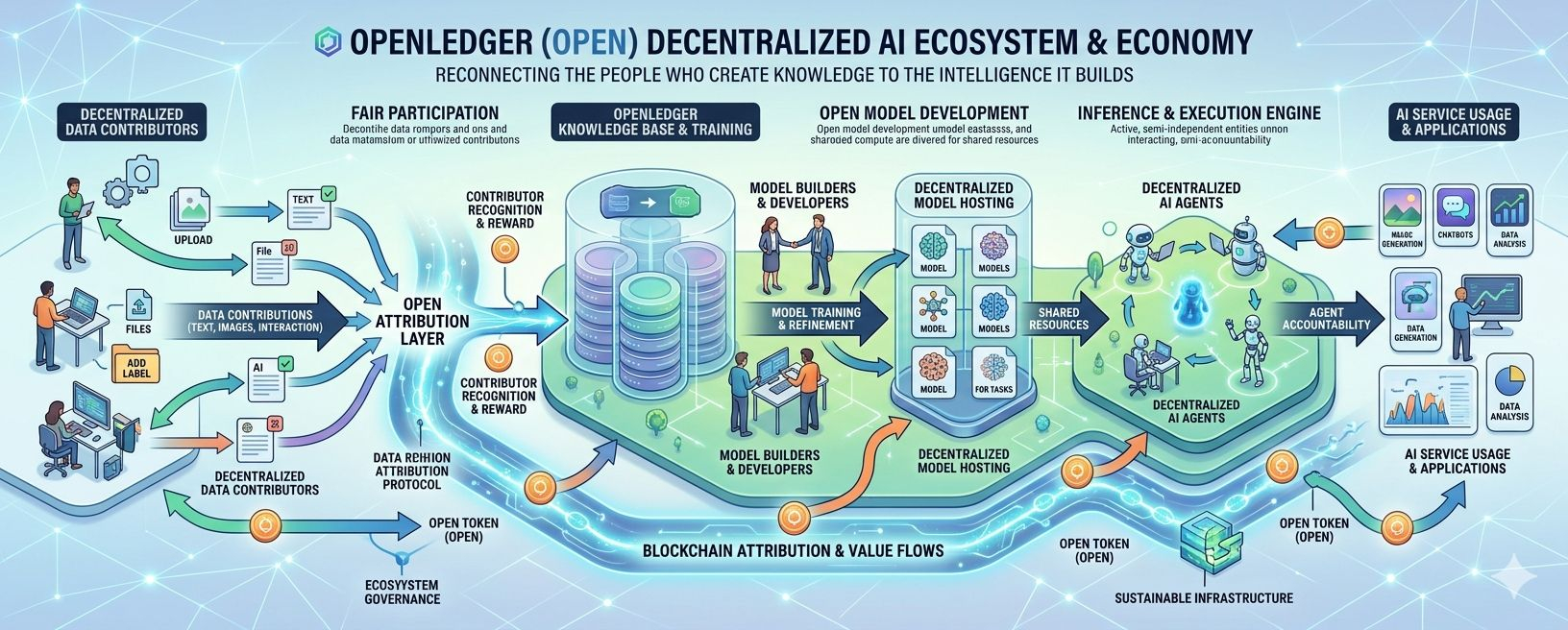
OpenLedger (OPEN) feels like one of those ideas that comes from a very simple frustration that slowly turns into something much bigger.
Because when you really look at how AI is built today, it doesn’t feel fair in a quiet way. People type, write, label, correct, upload, and interact every day. All of that becomes fuel for intelligent systems. But somewhere along the way, that human effort gets absorbed into massive models, and the value almost never finds its way back to the people who created the raw material in the first place.
OpenLedger is trying to interrupt that silence.
It imagines a world where data is not just taken and stored, but recognized. Where models are not just powerful, but accountable. Where AI systems don’t feel like locked black boxes, but more like shared spaces built by many hands. The emotional core of it is actually quite simple: if human effort helps build intelligence, then humans should not be invisible in the outcome.
Instead of treating AI as something distant and corporate, OpenLedger tries to turn it into an open economy. Data becomes something that can be contributed and tracked. Models become something that can be built and shared. AI agents become active participants rather than hidden processes running in the background. And everything is tied together through a blockchain layer that records who contributed what, and where value flows.
There is something almost personal about that idea. It’s not just about technology. It’s about recognition.
One of the most important parts of the system is how it looks at data. Today, data is everywhere, but it is treated like it has no owner. You give it away without thinking. You generate it without reward. OpenLedger tries to change that feeling by turning data into something that can carry value again. If your contribution helps an AI system learn or perform better, there is at least a chance that the system remembers you in an economic way.
That is where its idea of attribution comes in. It tries to answer a difficult question that most AI systems avoid completely. Who actually made this possible? Not in a vague sense, but in a real, trackable way. If your data influenced a model, even indirectly, the system tries to trace that influence and connect it back to you.
It sounds technical, but underneath it, it is emotional. It is about not being forgotten inside the machine.
On the builder side, OpenLedger also tries to open the doors for developers who want to create AI models without relying entirely on big centralized platforms. Instead of building something that gets locked inside a single company, models can live in a shared environment where usage can translate into rewards. It creates a strange but powerful shift, where building AI is not just a technical act, but also an economic one.
There is also an effort to make AI less expensive to run and more accessible to deploy. Because without that, the idea of open AI quickly collapses under its own cost. OpenLedger tries to make that reality more sustainable, so that participation is not reserved only for those with massive infrastructure.
Then there are AI agents, which in this system are not just tools following commands. They are treated more like independent participants that can perform tasks, interact with systems, and operate with some level of accountability. It is a small but important shift in thinking. Instead of invisible automation, you get something closer to visible digital actors inside the ecosystem.
At the center of all of this sits the OPEN token, which acts like the heartbeat of the network. It moves through the system as people use AI, contribute data, build models, and support infrastructure. It is meant to represent flow, not just speculation. Value is supposed to circulate between those who create, those who train, and those who use.
But what makes this project feel emotionally charged is not the token or the architecture. It is the underlying tension it is trying to address.
The tension between those who build intelligence and those who own it.
Of course, the reality is still uncertain. Tracking influence inside AI is extremely complex. Big companies are not going anywhere. Regulation around data and AI is tightening. And every ambitious idea in this space eventually hits the hard wall of execution.
But even with all that, OpenLedger sits inside a growing feeling in the digital world. A feeling that something is off in how value is distributed. That the people feeding the system are too far removed from the benefits of the system. And that maybe, just maybe, AI should not feel like something happening above us, but something we are actually part of.
In the end, OpenLedger is not just trying to build infrastructure.
It is trying to rebuild a sense of participation in a world where intelligence is becoming the most powerful force we have ever created.