
Whenever I think about where AI is actually broken, I keep coming back to the same uncomfortable question.
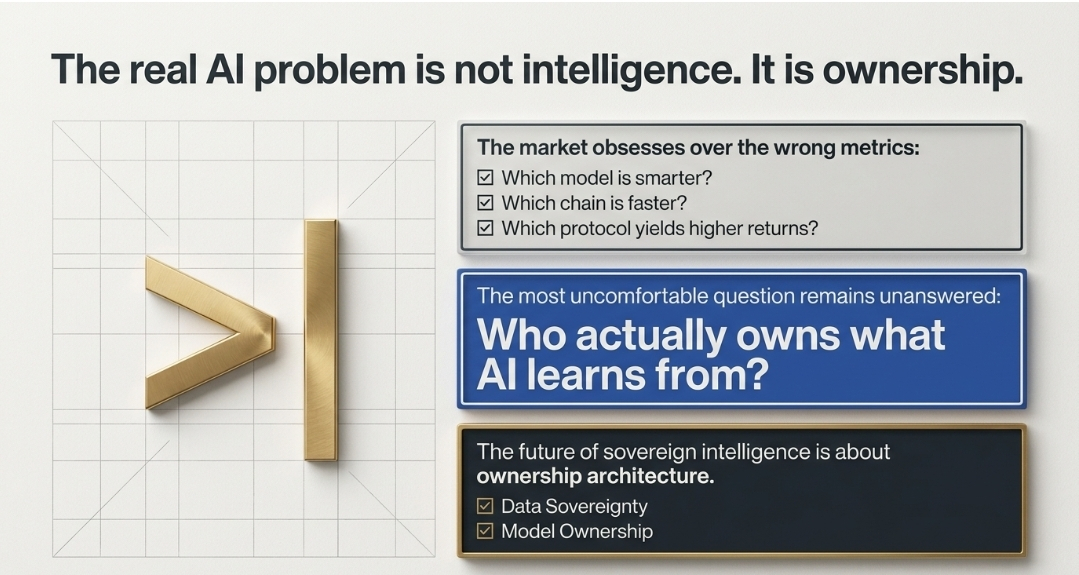
Who actually owns what AI learns from ?
And the more I sit with that question…. the more I realize most people in this space are still looking at the wrong problem.
Everyone is talking about which model is smarter. Which chain is faster. Which protocol gives higher returns. But the thing nobody is asking loudly enough is…. when AI trains on your data, your writing, your creative work…. where does your reward go ?
Practically nowhere.
This is what I call the Attribution Void. And it might be the biggest silent leak in the entire AI economy right now.
Now let me explain why @OpenLedger is making me stop and think seriously here…..
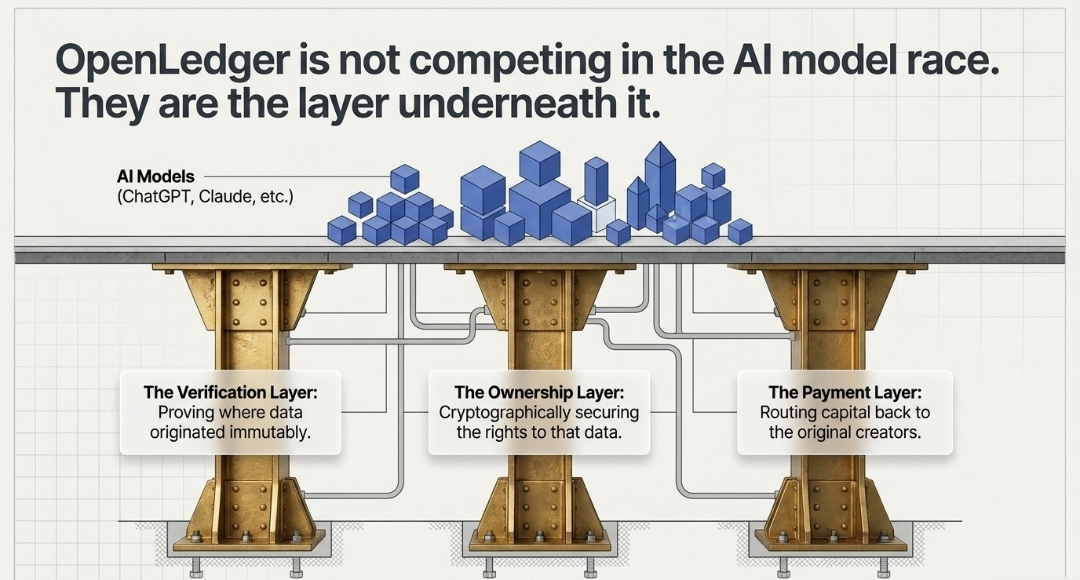
Because they are not chasing the shiny AI model race. They are going one layer deeper. They are building the infrastructure that decides who gets credited, who gets paid, and who gets ignored when artificial intelligence generates value.
Let me break it down in my own way…
First is the Data Ownership Problem.
Global AI spending is already crossing $375 billion and climbing. But the people whose data, creativity, and knowledge actually trained those systems ? They see almost none of it. The pipeline that takes human contribution and converts it into AI capability has no payment rail attached to it. OpenLedger is essentially saying… that pipeline needs to be rebuilt from scratch.
Second is the "Train Now, Litigate Later" Era Ending.
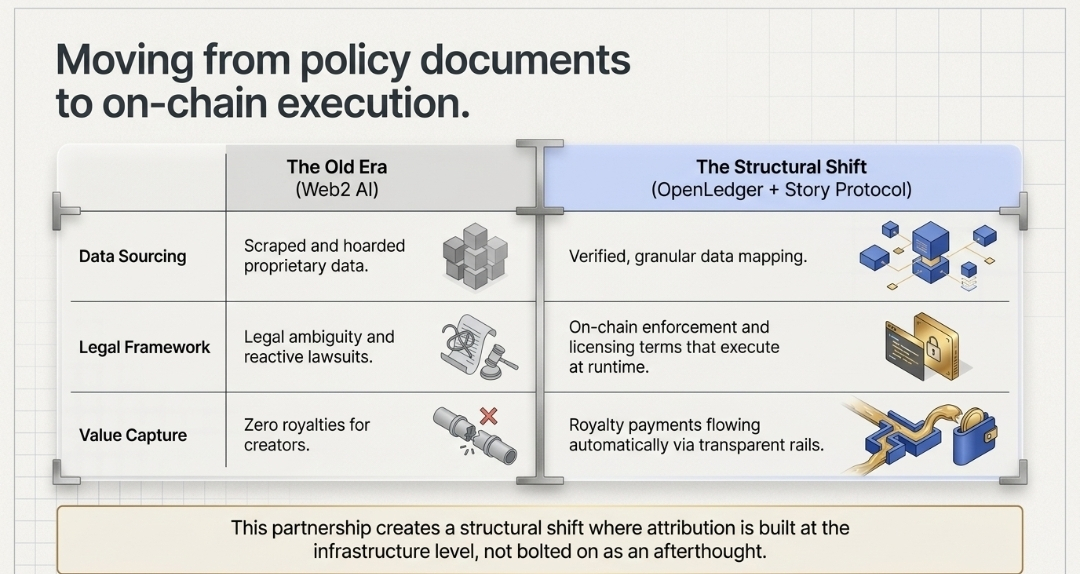
This one hit me hard. AI companies for years operated on scraped data and legal ambiguity. Lawsuits around AI training data exploded through 2025. Courts, regulators, the EU AI Act…. everyone started asking the same question at once. Where did this model learn from ? OpenLedger partnered with Story Protocol to answer that question at infrastructure level. Not with a policy document but with on chain enforcement. Licensing terms that execute at runtime. Royalty payments that flow automatically when your work contributes to an AI output. That is not a feature…. that is a structural shift.
Third is the Infini gram Attribution System.
This is where it gets technically interesting. Most attribution tools are rough approximations. But OpenLedger's Infini gram system tracks data influence at a granular level. Every contribution gets traced, every output gets mapped back to its origins. That is a genuinely hard computer science problem…. and solving it on chain makes it even harder. If they pull this off cleanly, the implications go far beyond crypto.
Fourth is Datanets as Community Intelligence.
The idea here is quiet but powerful. Instead of one company hoarding proprietary training data, communities build domain specific datasets together. Healthcare contributors build health data networks. Legal contributors build legal data networks. Each one is owned by the people who built it, not the platform sitting on top. This is not a small idea. This is a direct challenge to how the entire AI data economy currently works.
Fifth is the OpenFin Direction.
In March 2026, OpenLedger teased something called OpenFin…. described as bringing DeFAI closer. Details are still sparse but the signal is interesting. If they successfully merge decentralized finance infrastructure with their existing AI attribution layer, the token utility picture changes dramatically. It stops being a pure data infrastructure story and starts becoming an execution and capital flow story too.
Now let me come to what is actually going on in my head….
OpenLedger is not competing with ChatGPT or any AI model. They are building the layer underneath all of it. The verification layer. The payment layer. The ownership layer.
And honestly ? That framing is either incredibly early…. or incredibly important. Maybe both.
Because the question of who owns what AI learns from is not going away. Regulators are circling it. Creators are frustrated by it. Investors are starting to price it in. And the $500 billion data infrastructure gap that analysts keep pointing to…. it does not fill itself with hype. It fills with actual infrastructure.
There is something else I keep noticing about how OpenLedger frames their story.
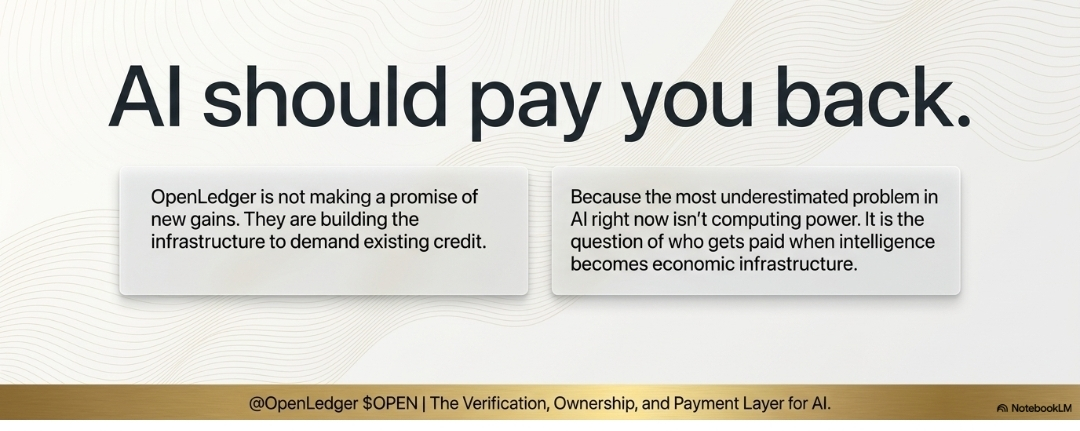
They are not saying "AI will make you rich." They are saying "AI should pay you back." And people connect with that framing very differently. Because it is not a promise of new gains…. it is a demand for existing credit.
In the end, the mixed feeling is still there….
The problem is real. The infrastructure approach is serious. The partnerships are concrete.
But the gap between "this is important" and "this executes perfectly" is still wide open.
And that gap is exactly where every meaningful project either becomes a foundation or becomes a footnote.
I am watching closely. Not fully convinced. Not worth dismissing either.
Because the most underestimated problem in AI right now is not computing power or model size.
It is the question of who gets paid when intelligence becomes economic infrastructure.
