For a long time, most people looked at AI the same way they looked at social media apps a decade ago.
You open the product.
You use the interface.
You enjoy the experience.
And that’s pretty much where the thinking stops.
But recently I’ve been feeling like the conversation around AI is slowly changing.
People are starting to look underneath the surface now.
Not just at the chatbot or the image generator or the app getting millions of downloads, but at the infrastructure underneath all of it.
Where does the data come from?
Who owns it?
Who gets rewarded when AI systems improve?
Who captures the value once these models start becoming part of everyday business activity?
Those questions matter more than people realize.
And honestly, I think this is where @OpenLedger starts becoming interesting.
Not because it’s trying to compete in the usual “our AI is smarter” race.
It feels more like the project is focused on something deeper that most people still overlook:
How do you build an actual economy around AI infrastructure itself?
That sounds abstract at first, but the more I think about it, the more relevant it feels.
Right now the AI market still operates in a pretty uneven way.
Large companies absorb massive amounts of public data.
Communities contribute information constantly.
Users interact with systems every day.
Developers fine-tune models.
Researchers improve outputs.
But the economic structure underneath all of that still feels blurry.
Most contributors never really own a piece of the intelligence economy they help create.
That’s probably one of the biggest hidden issues inside AI right now.
And I don’t think enough people talk about it because the industry is still obsessed with capabilities.
Everyone wants better models.
Faster outputs.
More automation.
More powerful agents.
Which makes sense.
But eventually the conversation was always going to move toward ownership and incentives too.
That shift already feels like it’s starting.
Especially now that AI is moving beyond experiments and becoming real infrastructure for businesses, trading systems, research platforms, education tools, content engines, and even autonomous financial activity.
Once AI starts touching actual economic systems, trust suddenly becomes important.
You can’t really scale intelligence markets long term without solving things like:
Where did this data come from?
Can contributors be verified?
Who gets rewarded when a model improves?
How do you track attribution?
How do agents interact economically with each other?
And maybe most importantly:
How do you create incentives that don’t completely break the system over time?
That last part matters a lot.
Because the internet already showed us what happens when platforms grow faster than incentive structures.
Things become extractive very quickly.
Spam increases.
Quality drops.
Trust weakens.
Value concentrates at the top.
AI could easily follow the same path if infrastructure around attribution and incentives never improves.
This is probably why OpenLedger’s direction feels more interesting to me lately.
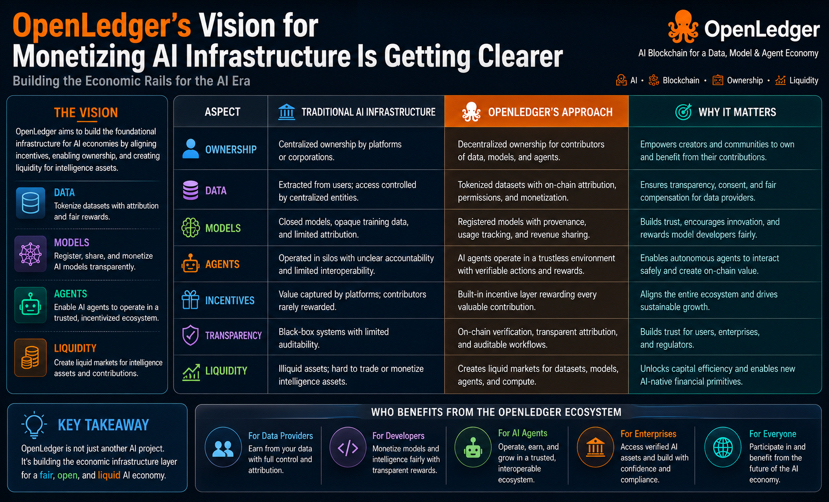
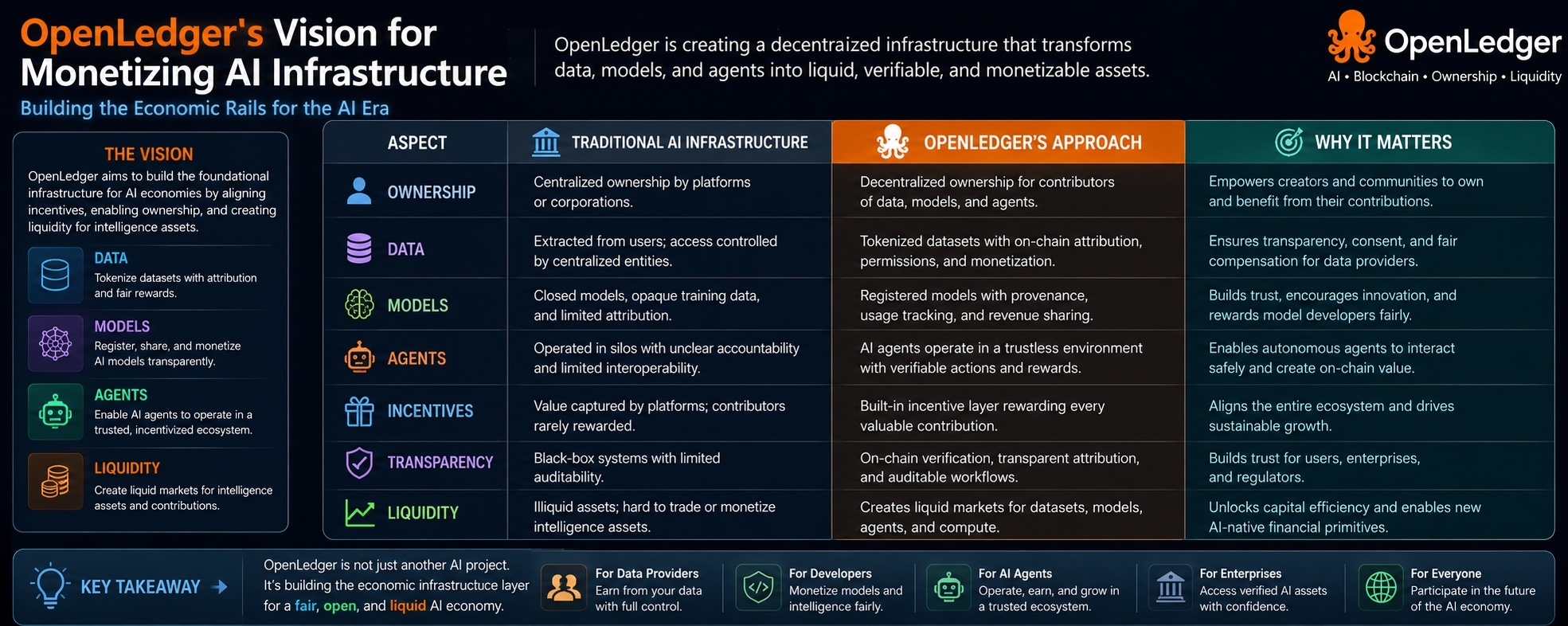
The project keeps framing data, models, and agents almost like economic building blocks instead of isolated software tools.
That changes the entire way you look at AI systems.
Normally we think about AI as a product.
But OpenLedger seems to be thinking about AI more like an ecosystem of participants that need coordination, ownership, and economic alignment.
That’s a very different approach.
And honestly, it feels closer to where AI eventually heads anyway.
Because once AI agents become more autonomous, they stop behaving like simple software features.
They start becoming economic actors.
That sounds futuristic, but parts of it are already happening.
AI systems are beginning to manage workflows, process information independently, assist with trading, coordinate research, automate business operations, and interact with digital economies in ways that were impossible a few years ago.
The infrastructure requirements for that world are huge.
Verification matters.
Trust matters.
Reputation matters.
Attribution matters.
Without those layers, AI ecosystems become chaotic extremely fast.
And this is where blockchain coordination suddenly starts making more sense.
I know some people still roll their eyes whenever AI and blockchain get mentioned together, mostly because the market spent years forcing narratives that never had real utility behind them.
But if you strip away the hype for a second, the overlap actually feels logical.
Blockchains are really good at coordinating systems where multiple participants need transparency, incentives, and verification without relying on a single central authority.
AI ecosystems increasingly need those same things.
That overlap feels less speculative now and more structural.
What also stands out to me is OpenLedger’s focus on liquidity around intelligence itself.
I don’t think the market fully understands how important that idea could become later.
Traditional markets created liquidity around assets like commodities, stocks, debt, currencies, and information.
AI introduces something different.
Now intelligence itself becomes economically valuable.
Not just the final AI application people interact with.
The underlying layers too.
Datasets become valuable.
Specialized models become valuable.
Agent behavior becomes valuable.
Inference systems become valuable.
Verified contribution networks become valuable.
Eventually those things may start functioning almost like digital economic primitives.
And if that happens, marketplaces around AI infrastructure probably become inevitable.
That’s why I think the OpenLedger thesis feels bigger than simply launching another AI-related token.
The project seems more focused on building coordination rails for a future where intelligence itself becomes part of the global digital economy.
Maybe that transition takes years.
Maybe parts of the market move slower than expected.
Maybe centralized AI companies still dominate consumer applications for a long time.
All of that can still happen.
But even in that scenario, the coordination problem underneath AI doesn’t disappear.
Someone still needs to organize how value moves between contributors, developers, agents, datasets, and applications.
And honestly, that may end up becoming one of the most important infrastructure layers of the entire AI era.
What I find interesting is that the market is slowly becoming mature enough to discuss these ideas without instantly reducing everything to hype.
During bull runs, people mostly chase narratives.
During quieter periods, infrastructure becomes easier to evaluate rationally.
You start paying attention to architecture instead of marketing.
And from that perspective, OpenLedger’s long-term direction feels increasingly clearer.
Not perfect.
Not guaranteed.
Not immune to execution risk.
But clearer.
The project seems to understand that AI will eventually need economic coordination layers just as much as it needs better models.
And the more AI integrates into finance, media, enterprise software, and digital economies, the harder that problem becomes to ignore.
Maybe that’s the real opportunity here.
Not just building smarter AI.
But building systems where the value created by AI can actually flow between participants in a more transparent and programmable way.
That idea still feels early.
But it also feels increasingly inevitable.