
I thought the vault was broken. That was my first mistake.
ERC-4626, or whatever you want to call that accounting standard they wrapped the vault in, it was doing exactly what it promised. Shares calculated clean. Deposits tracked. Withdrawals handled without drift. The vault strategy looked healthy on paper. But the market outside the vault had already shifted. Liquidity pools thinned. Yield spreads compressed. Risk bands slid sideways while I watched a single APY figure hold still like it was posing for a photograph.
I blamed the frontend first. Then I blamed caching. Then I thought maybe the Trading Agent, or whatever intelligence layer was supposed to be reading these conditions, had simply decided my vault wasn't worth the compute. None of those stuck long.
The real problem was that the vault wasn't broken. It was obedient.
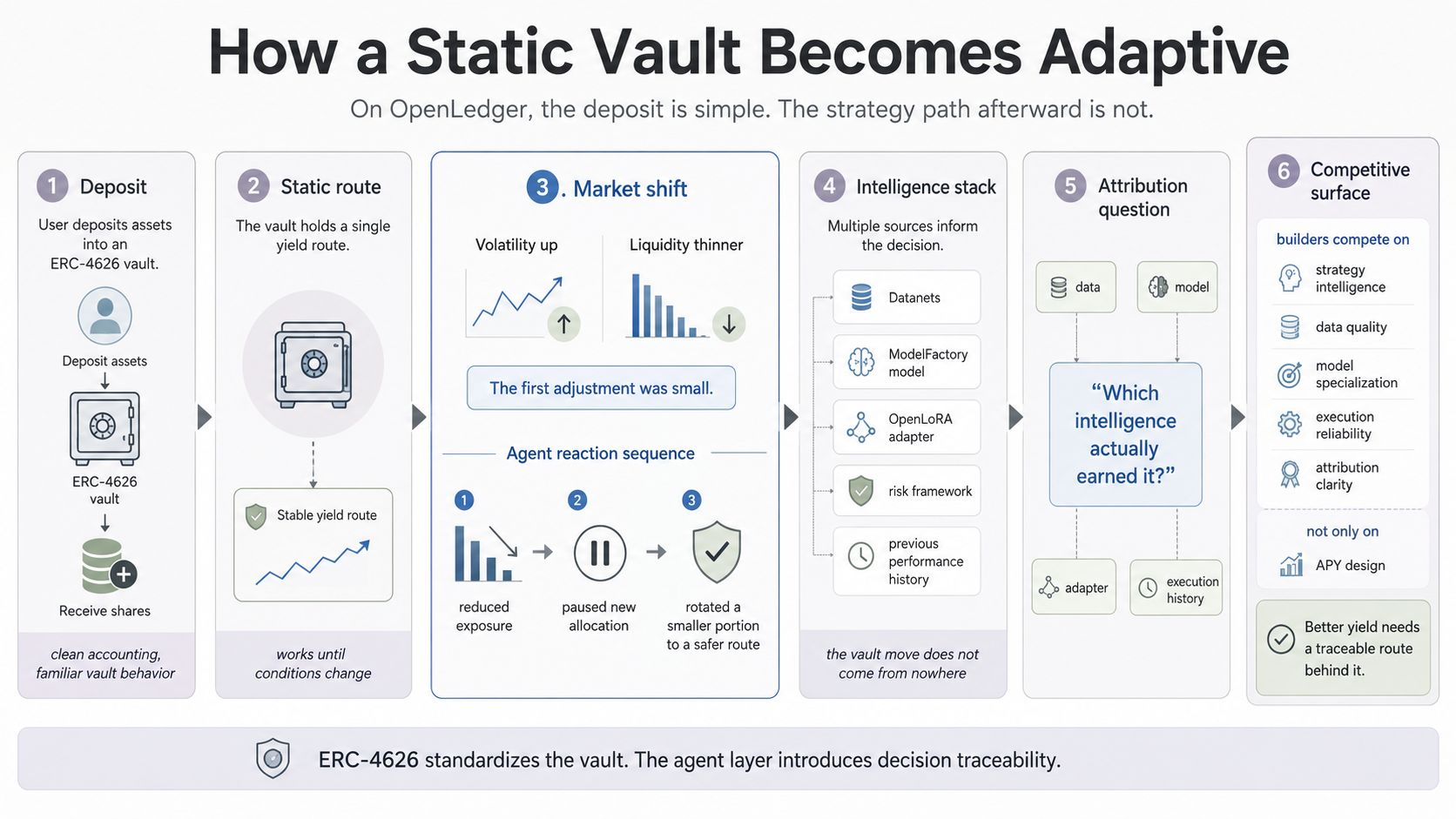
See, ERC-4626 gives you a beautiful container. Deposit in, shares out. Withdrawal in, assets back. The math is standardized, predictable, almost too tidy. But tidy isn't intelligent. The standard tracks what happened. It doesn't flinch at what is happening. And when the Trading Agent starts reading liquidity shifts and yield spreads in real time, when it tries to push adaptive yield into the vault strategy, it hits a wall that isn't technical. It's architectural. The vault can hold value. It can't reconsider value.
I wrote "passive" in my first draft. Didn't like it. Too soft. Left it there anyway for a minute. Then crossed it out.
AI Studio, or whatever workflow builder they use to wire these things together, it lets you assemble the pipeline. Market data feeds in. The Trading Agent interprets. Signals form. But the vault itself, sitting there in its ERC-4626 structure, it doesn't receive signals. It receives transactions. The gap between intelligence and execution isn't a missing API. It's a missing nervous system. The vault strategy is static by design, and the design is the point. Until it isn't.
On OpenLedger, or whatever you want to call that chain where this is supposed to live, the pressure gets economic fast. Because agentic DeFi isn't just a buzzword they throw around in docs. It's the question of whether a vault can become a participant instead of a receptacle. Whether the Trading Agent's read on market conditions can actually reshape where the liquidity sits, how the shares rebalance, when the risk bands tighten. And every time that agent nudges the vault strategy, something has to settle. OPEN settlement, or whatever that reward rail is called, it doesn't just pay for the transaction. It pays for the decision. The intelligence. The moment where model output became liquid.
I kept thinking the problem was that the agent wasn't fast enough. It's not. The agent is fast. The vault is deaf.
The economic consequence lands when you realize adaptive yield isn't free. Every shift the Trading Agent recommends, every time the AI Studio workflow triggers a reallocation because yield spreads changed, that intelligence has a cost. And on OpenLedger, the cost has to settle somewhere. The vault strategy can't just absorb smart decisions like weather. Someone built the model. Someone staked the compute. Someone fed the market data through the layer underneath. And if the vault stays static, if ERC-4626 remains a perfect accounting standard that refuses to become a DeFi surface, then all that intelligence has nowhere to go. It dissipates. The OPEN settlement rail pays for motion, and the vault isn't moving.
"Predictable" was the first word I wrote about ERC-4626. Didn't like it. Too comfortable. Left it there anyway for a minute.
What the Trading Agent actually offers isn't strategy. It's disturbance. It reads the market and introduces doubt into a system that was built for certainty. The vault strategy, however elegant, was designed to be known. Deposits equal shares. Shares equal claims. But adaptive yield breaks that equation. It says your claim might need to move. Your shares might need to rebalance. Your deposit might need to breathe in a different pool tomorrow because the risk bands shifted today. And ERC-4626, for all its cleanliness, wasn't built to breathe. It was built to count.
My second mistake was thinking AI Studio would fix the gap. It doesn't. It just makes the gap visible.
The workflow builder assembles the parts. Feeds the Trading Agent. Triggers the signals. But the vault itself still has to decide whether to listen. And on OpenLedger, that decision isn't automatic. It's agentic. Which means someone, or something, has to choose. And choice introduces a cost that static vaults never had to carry. The OPEN settlement layer settles that cost. It makes the intelligence expensive in a good way. Or whatever. It forces the system to ask whether an adaptive shift was worth more than the stability it broke.
And here's the part that sits wrong. In a good way. Or whatever.
The ERC-4626 standard doesn't need to change. It needs to become something it never claimed to be. A surface. A place where model intelligence can become liquid. Where the Trading Agent doesn't just advise from outside but actually touches the vault strategy from within. Where AI Studio isn't a dashboard but a nervous system. And where agentic DeFi stops being a category and starts being a behavior. The vault that waits. The vault that hesitates. The vault that finally moves because the market demanded it, not because a human clicked.
The neck tightens when you watch the yield spread collapse and the vault do nothing. Every time. Because you know the structure is sound. You know the accounting is perfect. You know the shares and deposits balance to the last wei. But you also know that perfection is a kind of paralysis. And on OpenLedger, the question isn't whether ERC-4626 can handle more complexity. It's whether complexity can find a home inside something that clean.
when vaults become part of AI-guided workflows, when they stop being passive containers and start becoming execution surfaces, the standard has to hold without becoming rigid. The Trading Agent can read the market. AI Studio can wire the flow. OPEN can settle the rewards. But if the vault strategy itself can't carry intelligence, if adaptive yield remains a layer above instead of a function within, then agentic DeFi is just a smart person shouting advice at a locked safe.
And still. And still.
I keep depositing. Because there's something about that gap, between perfect accounting and missing response, that feels like where the real yield lives. Not in the number that holds still. In the number that finally moves because something thought. The OPEN settlement layer doesn't make vaults smarter. It makes their silence expensive. Like resistance to drift. Yeah, that.
The jaw clenches when you realize the vault was never broken. It was just waiting for permission to become uncertain. And OpenLedger keeps that promise, even when the market falls half a spread behind.
