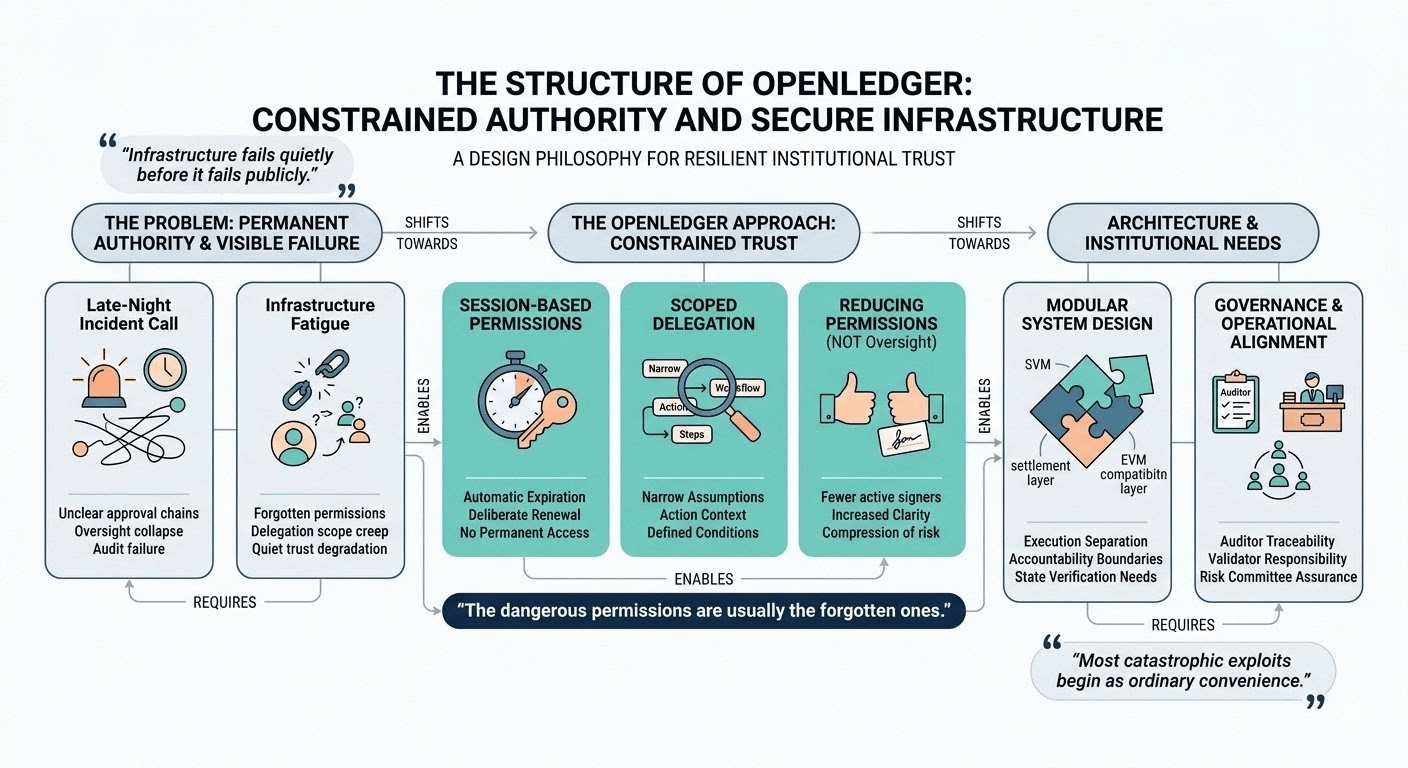
I remember a late-night incident call where the technical details were strangely less alarming than the human ones. A treasury workflow had triggered an emergency review after an execution path behaved in a way nobody expected. Funds had not yet moved improperly, but the room was already tense because no one could reconstruct the approval chain with confidence. One operations lead believed signer authority had been revoked after a previous maintenance window. Security logs suggested otherwise. Governance participants assumed delegation had been tightly scoped. It had not. What should have been a straightforward permissions audit became an exercise in institutional archaeology.
That experience stays with you because it reveals something uncomfortable about blockchain infrastructure: the systems often fail long before the exploit becomes visible.
For years, the industry became obsessed with acceleration. Higher TPS became shorthand for progress. UX smoothness became a proxy for maturity. Execution speed, settlement efficiency, interoperability, composability—every conversation leaned toward movement. Yet authority management remained treated as administrative plumbing rather than a core architectural concern. Wallet permissions accumulated. Governance exceptions became permanent operational habits. Monitoring improved in volume but not always in clarity. Infrastructure fatigue emerged not because systems were technically incapable, but because too few people understood where control actually resided.
“Infrastructure fails quietly before it fails publicly.”
That is why OpenLedger deserves examination—not as a market narrative, but as a design philosophy.
The most compelling idea is not throughput. It is constrained trust.
Session-based permissions matter because permanent authority is almost always managed imperfectly. Temporary authority forces deliberate expiration. Scoped delegation narrows assumptions around who can act, when, and under what conditions. Reducing signatures may sound efficient, but efficiency without constrained authority simply compresses oversight. Endless approvals are not the only risk. Endless permissions are often worse.
“The dangerous permissions are usually the forgotten ones.”
OpenLedger’s SVM-based execution and high-throughput architecture fit the modern infrastructure pattern, but the deeper design question lies in modularity. Separating execution from settlement creates accountability boundaries that are easier to reason about institutionally. EVM compatibility appears less ideological than pragmatic, acknowledging that infrastructure rarely exists in isolation. But modular systems introduce their own uncertainty. State verification becomes more fragmented. Monitoring blind spots emerge between execution layers. Bridge fragility remains unresolved because interoperability is fundamentally a trust translation problem, not merely an engineering one. Composability expands attack surfaces faster than governance processes usually adapt.
“Most catastrophic exploits begin as ordinary convenience.”
Auditors want traceability. Treasury teams want authority expiration. Validators inherit operational responsibility, not just economic incentive. Risk committees fear ambiguity more than latency.
The enduring lesson is simple: resilient infrastructure is not defined by how efficiently it accelerates execution, but by how rigorously it limits authority before institutional trust quietly degrades.