
I will treat OpenLedger as a lens I am thinking through, not as a product I am evaluating from the outside. That matters, because most of the noise around AI blockchains begins with external descriptions that already assume what the system is supposed to become. I am more interested in what actually holds when those assumptions are stripped away.
The common surface story I keep encountering is simple. AI needs data. Data is trapped in silos. Blockchain creates coordination. Liquidity follows, and once liquidity exists, inefficiency disappears. OpenLedger is usually placed inside this logic as a kind of missing settlement layer for data, models, and agents. On paper, it feels clean. I have seen versions of this story before, in earlier cycles around decentralized storage, compute markets, and data marketplaces. The structure is always similar: identify a bottleneck, insert a tokenized exchange layer, and assume friction converts into liquidity once pricing exists.
What I have learned over time is that most bottlenecks are not pricing problems. They are constraint problems. Data is not just “unpriced”; it is entangled in consent, regulation, operational dependency, and quality variance. Even when ownership is clear, usability is not. Models are even less cooperative as economic units. Their value depends on context, deployment, and iteration speed, none of which are stable enough to treat as clean commodities. So when I hear “unlocking liquidity,” I do not hear a solved inefficiency. I hear an attempt to compress complexity into exchangeability.
When I look at OpenLedger through a structural lens, I see something more interesting than the narrative suggests. It is not really about turning everything into a market. It is about forcing attribution where attribution has historically been fuzzy. Data contributors, model builders, and agent systems all sit in overlapping chains of causality. Traditional software economics hide this overlap under platform ownership. OpenLedger-style systems try to expose it and attach measurable value flows to it.
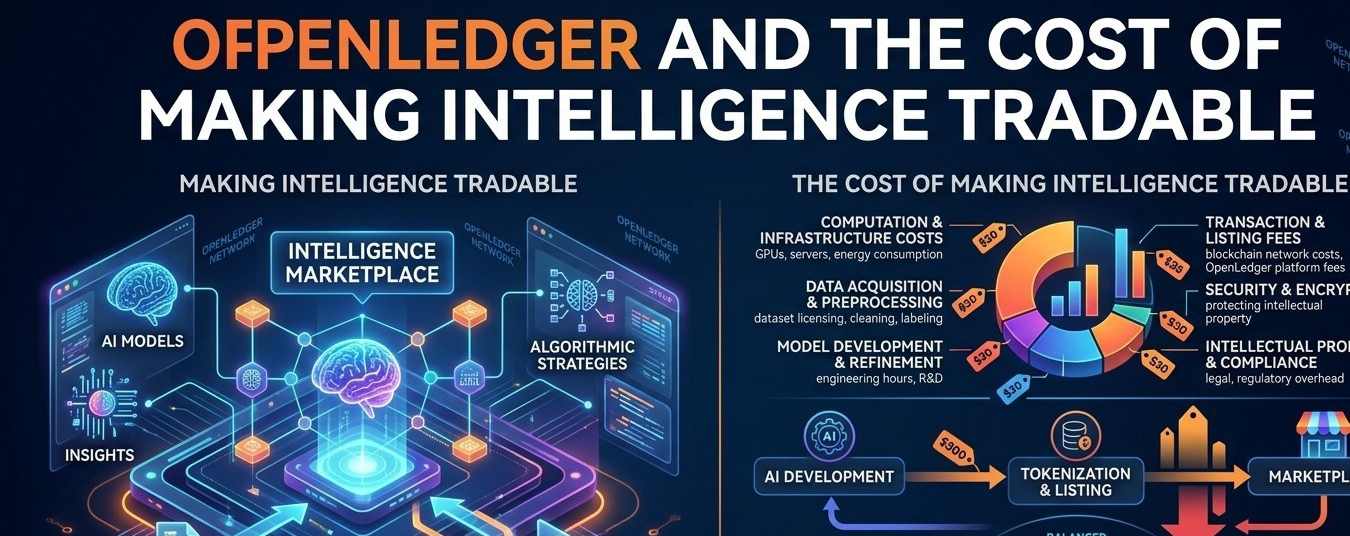
But the moment I think through that, I run into a contradiction I have seen before. The more precise attribution becomes, the more expensive and fragile the system gets. If every dataset, model inference, or agent interaction needs tracking, labeling, and settlement logic, then coordination overhead starts to resemble the very inefficiency the system claims to remove. I have seen similar patterns in earlier attempts to tokenize compute or storage: measurement becomes its own layer of friction.
The idea of “agents as monetizable units” is where this tension becomes most visible to me. In theory, an agent can be treated like an autonomous economic actor producing measurable output. In practice, agents are deeply dependent on orchestration layers, shared memory, and upstream models. When multiple agents contribute to a result, isolating economic causality becomes less like accounting and more like interpretation. Markets can price inputs when boundaries are stable. Intelligence systems rarely respect stable boundaries.
Still, I understand why systems like OpenLedger emerge. There is a persistent intuition in the market that value is leaking somewhere inside AI stacks. Builders suspect they are generating more value than they can capture. Data owners suspect their inputs are undercompensated. Investors suspect a new coordination layer is missing. I recognize this pattern: it appears whenever a technological stack becomes complex enough that contribution and reward drift apart.
Behaviorally, this produces a predictable cycle that I have seen repeat across infrastructure waves. At first, there is abstraction enthusiasm. Everything looks modular, composable, and economically legible. Then early participants begin mapping assets that were previously invisible: datasets become capital, models become revenue streams, agent outputs become billable events. This phase feels expansive because it expands the definition of what can be priced.
But expansion usually gives way to compression. Once systems are exposed to real usage, liquidity thins out. Not everything that can be measured has demand density. Not everything that can be tokenized has buyers or stable pricing behavior. This is where skepticism enters. Builders start to realize integration costs are higher than expected. Investors start to distinguish between conceptual infrastructure and actually adopted infrastructure. Users stop caring about tokenized attribution unless it directly improves performance or reduces cost.
In that transition, OpenLedger functions less as a finished marketplace and more as a stress test of assumptions. It tests whether fine-grained attribution actually improves coordination or just redistributes complexity. It tests whether data liquidity is meaningfully different from data access. It tests whether models benefit from being treated as assets rather than services embedded in pipelines.
I find that the most important structural insight is not about whether the system “works,” but about what it reveals. It exposes a gap between economic imagination and technical constraint. Economically, it is tempting to believe that every digital artifact can become a liquid asset. Technically, most artifacts only function within tightly coupled systems where context cannot be stripped away without losing value.
If I extend the current trajectory forward without assuming success or failure, I do not see a single unified liquidity layer emerging for AI resources. I see segmentation. High-value model development remains concentrated in closed systems where iteration speed and proprietary data matter more than attribution transparency. Data markets remain partial and constrained, mostly operating where compliance frameworks already enforce structure. Experimental layers like OpenLedger persist as coordination experiments that may become useful in specific niches but do not fully absorb the broader stack.
What changes over time is not the existence of markets, but their scope. Markets will exist where abstraction does not destroy meaning. Outside of those boundaries, coordination will remain architectural rather than financial. That distinction is important because much of the excitement around AI blockchains assumes that financialization is the final stage of coordination. My experience suggests it is only one mode among several, and not always the dominant one.
There is also a psychological dimension I cannot ignore. When systems promise monetization of previously invisible assets, participants tend to re-evaluate everything they already have. I have seen this before: data that was once operational noise becomes conceptual capital; internal tools become potential revenue streams; idle outputs become imagined markets. This reclassification phase often inflates perceived value before any real demand structure exists. Eventually, that inflation has to be reconciled with actual usage.
OpenLedger, in this sense, is not just a protocol concept. It is a mirror for how people react when boundaries of ownership and value become negotiable. It reveals how quickly participants shift from building systems to pricing components of systems, even when those components are not independently functional.
If I strip away the narrative entirely, what remains is a familiar tension: coordination versus abstraction. Coordination systems want tight integration and predictable behavior. Abstraction systems want portability, liquidity, and composability. OpenLedger sits directly at that intersection, trying to make intelligence systems economically legible without breaking their internal cohesion. Whether that balance is sustainable is less a question of vision and more a question of how much complexity markets are actually willing to carry before they stop being useful.