
One of the biggest mistakes markets make during new technology cycles is confusing products with ecosystems.
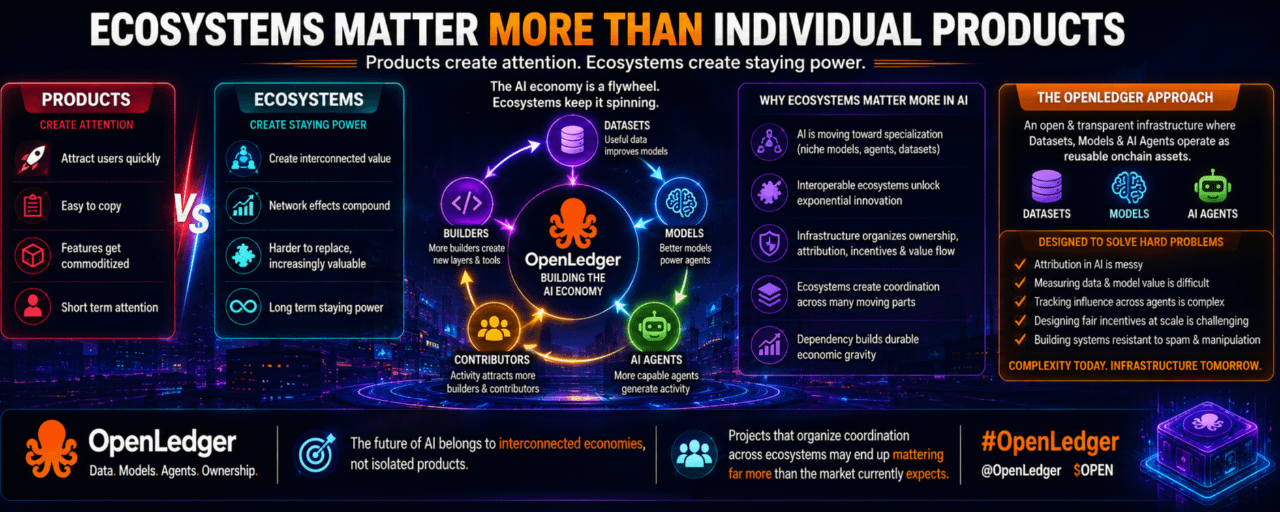
Products create attention.
Ecosystems create staying power.
I think the AI sector is moving toward that realization right now, and that shift is part of why OpenLedger feels increasingly interesting to watch.
Most AI conversations still focus on surface-level competition. Which model is faster. Which interface feels cleaner. Which startup launches the most impressive demo. But those comparisons often miss the deeper layer where long-term value usually accumulates.
Infrastructure.
Coordination.
Networks of contributors interacting through shared incentives.
That is where ecosystems begin to matter more than individual products.
A strong product can attract users quickly. But products are easier to replace than systems. Competitors copy features. Interfaces evolve. Models improve rapidly. What feels differentiated today often becomes commoditized much faster than expected.
Ecosystems behave differently because they create interconnected value rather than isolated functionality.
That distinction becomes extremely important in AI.
AI systems are no longer operating as standalone software tools. Models depend on datasets. Agents depend on models. Contributors improve both through feedback, experimentation, and specialized knowledge. Builders create additional layers on top of existing infrastructure. Value starts moving across multiple participants simultaneously instead of remaining trapped inside one product.
This is where OpenLedger’s direction starts making sense to me.
The project does not appear focused solely on producing one dominant AI product. Instead, it seems more interested in building economic infrastructure where datasets, models, and agents can interact as reusable onchain assets inside a broader ecosystem.
That is a very different approach from simply launching another AI application.
Because once ecosystems begin forming, network effects start compounding in ways standalone products cannot easily replicate.
A useful dataset improves models.
Improved models power more capable agents.
More capable agents generate additional activity.
That activity attracts more builders, contributors, and experimentation.
Then the cycle repeats again.
Over time, the ecosystem itself becomes the moat.
Not necessarily because every individual component is unbeatable, but because the coordination layer connecting those components becomes increasingly valuable.
I think this matters even more as AI moves toward specialization.
The market spent a long time obsessing over giant generalized systems trying to solve everything at once. But the next stage of AI may look much more fragmented. Industry-specific models. Research agents. Trading systems. Workflow automation. Educational intelligence layers. Gaming agents. Community-owned datasets optimized for narrow use cases.
That future does not reward isolated products as much as it rewards interoperable ecosystems.
And interoperable ecosystems need infrastructure capable of organizing ownership, attribution, incentives, and value flow across many moving parts simultaneously.
This is where OpenLedger appears to be positioning itself.
The project’s focus on data, models, and AI agents is important because those are the components likely to generate most of the underlying economic activity inside future AI networks. But activity alone is not enough. The harder challenge is coordinating incentives so contributors continue participating instead of extracting value and leaving.
That coordination problem is one of the least discussed bottlenecks in AI right now.
Most systems still operate through highly centralized structures where data contributors, developers, and smaller builders have limited exposure to the upside generated by the ecosystems they help strengthen. OpenLedger seems to be exploring whether blockchain infrastructure can create a more transparent and reusable economic framework around those relationships.
That idea carries significant complexity.
Attribution in AI is messy. Measuring the value of data contributions is difficult. Tracking model influence across multiple agents introduces additional friction. Designing incentives without creating spam or manipulation problems becomes increasingly challenging as ecosystems scale.
Infrastructure projects rarely get the luxury of simplicity.
But complexity is often where durable systems emerge.
Especially when markets begin shifting from speculation toward actual utility.
This is another reason I think ecosystems matter more than individual products over longer time horizons.
Products can generate temporary attention very quickly.
Ecosystems generate dependency slowly.
And dependency is usually what creates durable economic gravity.
The strongest technology platforms historically were not always the ones with the single best product at every moment. They were often the ones capable of attracting builders, creating reusable infrastructure, and expanding network participation over time.
AI economies may follow a similar path.
If agents become more autonomous, if models become increasingly modular, and if specialized datasets continue growing in importance, then ecosystems coordinating those layers could become more valuable than any standalone AI interface people are currently obsessing over.
That possibility is why I keep watching projects like OpenLedger carefully.
Not because the project already solved every infrastructure problem.
It clearly has not.
Adoption still matters. Builders still matter. Real usage still matters far more than narratives.
But the direction itself feels aligned with where AI systems are naturally heading : toward interconnected economies rather than isolated products.
And once that transition happens, the projects organizing coordination across those ecosystems may end up mattering far more than the market currently expects.
