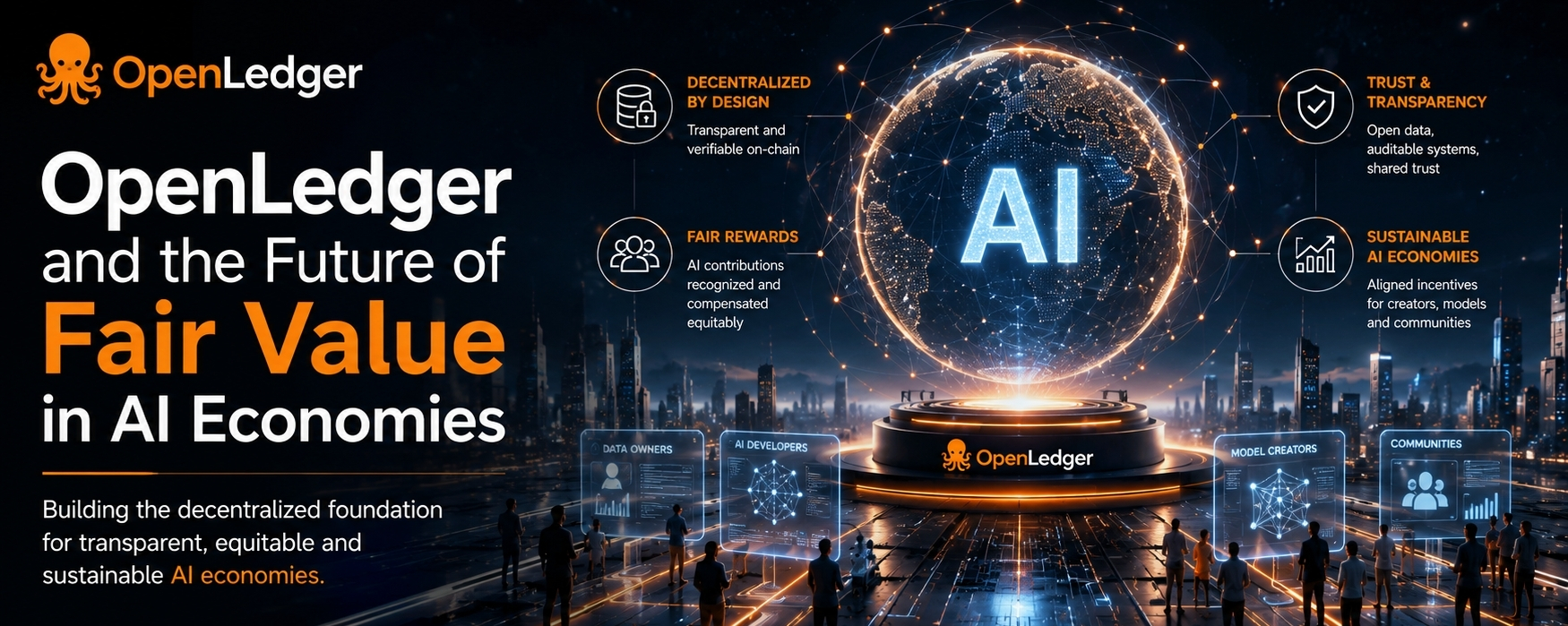
When I think about OpenLedger, I don’t see it as just another “AI + blockchain” idea. I see it more like an attempt to fix something I’ve increasingly noticed across the AI world: the fact that data, models, and AI agents are generating enormous value, but the people and systems behind them rarely have a clean way to capture that value fairly or safely.
My first emotional reaction is honestly split. On one hand, I feel a kind of optimism because the direction makes sense to me. I can easily imagine situations where hospitals, fintech systems, or even small AI developers are contributing intelligence without exposing raw sensitive data, and still getting rewarded every time that intelligence is used. That feels like a more balanced version of the internet economy than what I see today, where data is often extracted once and monetized endlessly by someone else.
But at the same time, I also feel skeptical, because I’ve seen how hard it is to turn “fair value distribution” into something that actually works at scale. It sounds clean in theory, but once real institutions, regulations, and messy data pipelines enter the picture, things tend to break in unexpected ways.
From my perspective, the core problem OpenLedger is trying to solve is that AI value creation is completely fragmented. I see data locked inside hospitals, insurance companies, banks, and SaaS platforms. I see model builders struggling to access high-quality proprietary data. And I see AI systems generating value without any clear way to trace where that value actually came from. So there’s both an economic inefficiency and a trust problem. OpenLedger is trying to turn that into something more structured, where data, models, and AI agents can be tracked and compensated more transparently.
If I translate how I think it would actually work in practice, I imagine a few layers. I imagine controlled access to data where raw information never really leaves its secure environment. Instead, models interact with it through governed interfaces. I imagine some kind of attribution system that tries to measure how much each dataset or model contributed to an outcome. And then I imagine a settlement layer, likely blockchain-based, that distributes rewards based on usage.
What makes this interesting to me is how it could change real workflows. For example, in healthcare, I think about radiology data. Today, sharing CT scans across institutions is heavily restricted, and rightly so. But if a system like this works, I could see hospitals contributing learning signals from their data without exposing patient identities, and still getting rewarded when diagnostic models improve globally. That is a powerful idea because it respects privacy while still allowing collective intelligence.
In finance, I think about fraud detection. Right now, banks don’t really share fraud patterns because of competitive and regulatory concerns. But if there were a privacy-preserving way to contribute signals into a shared intelligence layer, I can see how fraud detection models could become much stronger without exposing sensitive transaction data. That’s another place where I feel the concept makes sense.
I also think about AI agents, which are becoming more common in enterprise systems. If an AI agent uses multiple data sources to make decisions, I find it very compelling in theory to have a system that can track which inputs contributed to which outputs, and then reward those inputs over time. But I also know this is where things get technically very difficult, because attribution in machine learning is not clean or perfectly measurable.
When I look at the broader environment in 2026, I notice that AI infrastructure is becoming more centralized around a few major providers, while at the same time privacy regulations are tightening across healthcare and finance. I also see enterprises increasingly preferring private or hybrid AI deployments instead of fully public APIs. And in blockchain, I see a shift away from pure speculation toward infrastructure narratives like data provenance, verifiable compute, and AI coordination layers. OpenLedger sits right in the middle of all of this, which is why I find it interesting rather than dismissible.
Still, I can’t ignore the risks I see. The biggest one is regulatory reality. Even if a system claims privacy preservation, regulators may still classify derived data or model outputs as sensitive depending on context. Another risk is adoption friction. Large institutions don’t change data infrastructure quickly, especially in healthcare and banking where mistakes are expensive. And then there’s the technical challenge of attribution. If the system gets attribution even slightly wrong, trust can collapse, because people won’t accept payouts they feel are unfair or inaccurate.
I also worry about incentive distortion. If data contribution becomes monetized in a rigid way, I can imagine situations where participants optimize for what gets rewarded rather than what is actually high quality or useful. I’ve seen similar patterns in other digital economies where metrics slowly shape behavior in unintended ways.
Even with all that, I don’t dismiss the idea. I actually think the direction is aligned with where AI is heading. I see a future where intelligence is more distributed, privacy constraints are stricter, and value distribution becomes a central issue rather than a side detail. In that world, something like OpenLedger could become part of the invisible infrastructure that quietly connects data producers, model builders, and AI systems.