
I’ve been working for AI for years without getting paid a cent.
Every search, every click, every extra second spent on a page became training data for someone else’s model. No notification. No payment. Just terms of service nobody reads.
Nobody calls it extraction because the product still feels free.
For traders it goes even deeper. Order flow, entry timing, sizing patterns — things that took years to develop — can quietly become behavioral training data the moment they pass through a platform with an AI layer underneath.
OpenLedger is trying to build a different model.
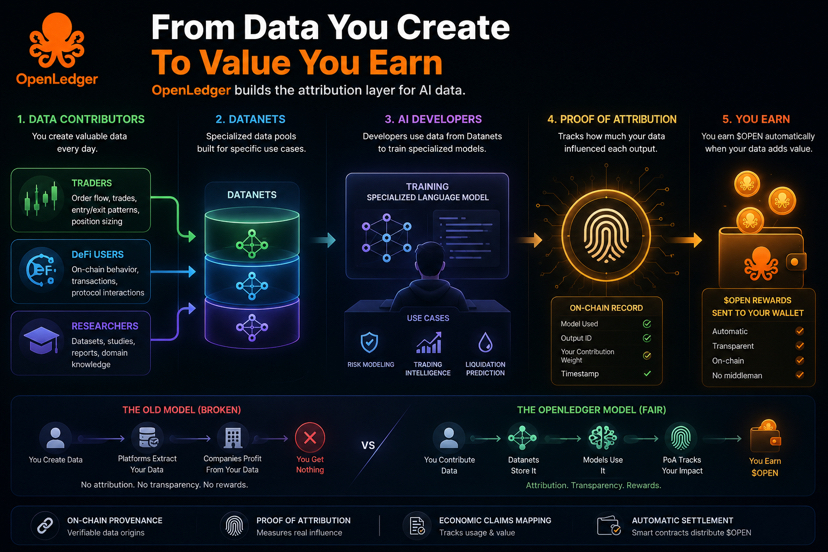
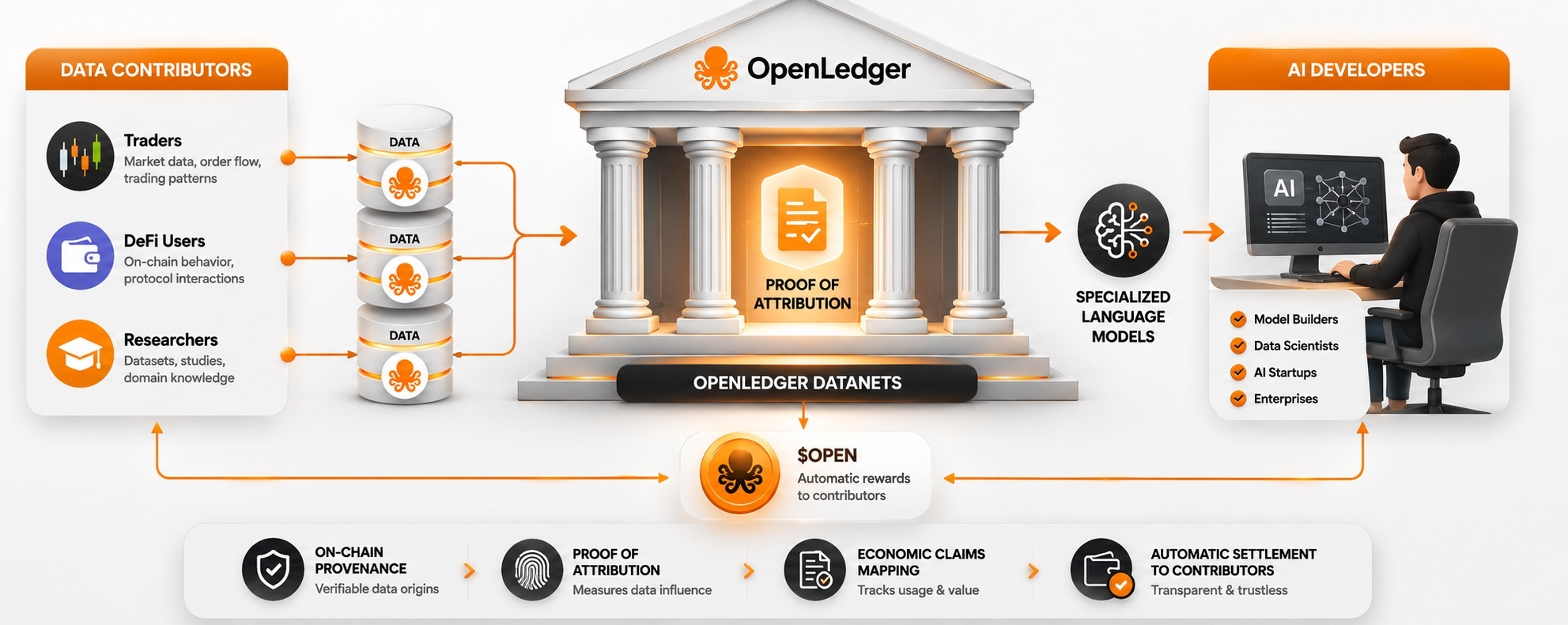
Instead of platforms harvesting data behind closed doors, they built Datanets — specialized data pools where contributors upload information intentionally. DeFi trading behavior. Liquidation history. Funding rate patterns across venues. Any dataset useful for training domain-specific AI models.
Developers pull from those pools to train Specialized Language Models for specific use cases. When those models generate outputs using contributed data, Proof of Attribution tracks the influence on-chain and OPEN gets distributed automatically to contributors. No manual payout process. No opaque revenue split. The smart contract handles attribution and settlement directly.
The technical design of PoA is more interesting than the rewards themselves.
It doesn’t operate on a simple upload-more-earn-more system. It measures contribution weight, not contribution volume. A smaller dataset that consistently shapes model behavior can earn more than a massive dataset that barely changes the output. Contributors aren’t just providing raw inputs. They’re holding economic exposure to model performance itself.
That’s the part that caught my attention. Not the token. The mechanism.
Most AI projects in crypto stop at the observation layer — dashboards, sentiment tools, systems that tell users what to look at. OpenLedger is trying to operate further down the stack: the infrastructure layer where data gets sourced, verified, attributed, and transformed into something models can actually learn from.
Infrastructure work is usually ignored because it looks boring early. Until the entire stack depends on it.
But the real question isn’t attribution. It’s quality control.
PoA can track whether data influenced a model output. That doesn’t mean the data was useful, accurate, or clean. The incentive for contributors is still financial, and financial incentives often optimize for scale before quality. An open Datanet without strong curation fills with noise quickly. And a specialized model trained on polluted data doesn’t become intelligent. It becomes confidently narrow.
That’s the part I’m still watching carefully.
Not the whitepaper. Not the partnership announcements. The production environment after real developers start building on real Datanets at scale. That’s when we find out whether filtering mechanisms are strong enough to maintain signal quality over time.
Developer behavior after the Studio rollout will reveal more than any tokenomics breakdown ever could.
But regardless of whether OpenLedger succeeds, the underlying problem isn’t going away.
Right now the AI economy runs on one model: users generate data, platforms capture it, companies monetize it, contributors receive nothing. That has been the default arrangement of the internet for decades because there was never a credible alternative.
If Proof of Attribution actually works at scale — where contributors receive value proportional to how much their data shaped a model’s output, without a centralized intermediary deciding the split — the economics of AI start changing in a meaningful way. Not just for crypto. For the entire relationship between platforms, models, and the people generating the underlying intelligence those systems depend on.
I don’t know if OPEN ultimately becomes the project that solves this.
The infrastructure is real. The architecture is ambitious. The industry clearly needs a better answer for data ownership than the one it has today. But the distance between a functioning mechanism and a sustainable ecosystem is where most projects fail.
Still worth watching.
Not because of price action.
Because if this model works, data stops being exhaust and starts becoming equity.