


I laughed the first time I saw the “Millennial PR team vs Gen Z social team” OpenLedger meme because it accidentally explains something serious about where crypto is heading. On the left, you get the polished explanation about AI blockchains, RWAs, autonomous capital coordination, and attribution layers. On the right, you get one word: “agentmaxxing.” Same product. Same direction. Completely different compression layer.
That gap matters more than people think.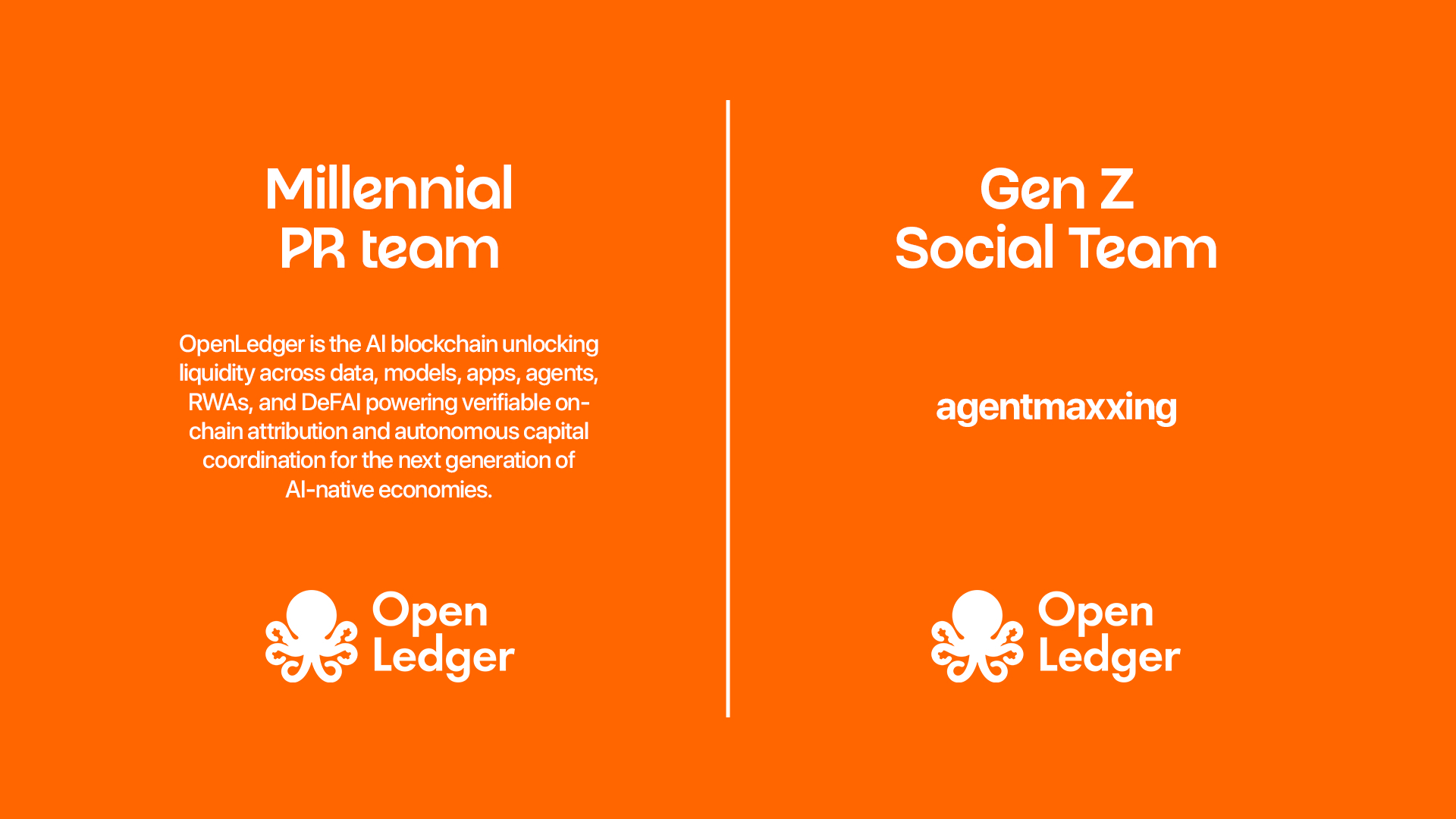
Crypto has always had a language problem. Every cycle creates infrastructure that only insiders can explain clearly. In 2021, it was liquidity mining and cross-chain bridges. In 2023, it became modular blockchains and restaking. Now the center of gravity is moving toward AI coordination layers, agent economies, and machine-managed capital. The technology underneath is becoming more complex at exactly the same moment attention spans are collapsing. So projects are adapting by simplifying the surface while deepening the infrastructure underneath.
OpenLedger sits directly inside that tension.
At surface level, the project is trying to connect liquidity across data, models, applications, AI agents, RWAs, and DeFAI systems. That sounds abstract until you translate what it actually means. Right now, most AI systems operate like isolated islands. Data lives in one place, models in another, incentives somewhere else, and capital coordination is mostly manual. OpenLedger is trying to create rails where those components can interact economically onchain instead of through closed platforms.
The interesting part is not the branding. It is the timing.
AI infrastructure funding crossed tens of billions of dollars globally over the last 18 months, but monetization remains uneven. Meanwhile, onchain activity tied to AI-related tokens has quietly expanded even during broader market hesitation. You can see it in wallet behavior. Retail interest is no longer focused only on speculative meme velocity. There is growing attention around systems that can automate decisions, coordinate yield, or create persistent machine-driven activity without constant human input. That shift explains why “AI agents” became one of the fastest growing narratives on Crypto Twitter during the past year.
But narratives alone do not sustain ecosystems. Coordination does.
That is where the meme actually becomes useful analysis instead of just marketing humor. The millennial-style explanation describes the architecture layer. The Gen Z phrasing compresses the outcome layer. “Agentmaxxing” sounds unserious until you realize it captures the core thesis in a culturally efficient way: optimizing everything around autonomous agents.
Underneath that joke is a real economic shift.
Traditional DeFi assumes humans are the active operators. Humans decide where to allocate capital, when to rebalance positions, which protocols to trust, and how to manage risk. AI-native systems are changing that assumption. Increasingly, protocols are being designed around agents making those decisions continuously. Not once a week. Constantly. Quietly underneath the interface.
If that model holds, infrastructure requirements change dramatically.
An AI agent coordinating yield across multiple protocols cannot rely on fragmented liquidity and incompatible standards. It needs attribution systems to verify actions, predictable vault frameworks, machine-readable incentives, and reliable execution environments. Otherwise automation breaks under its own complexity. This is why standards like ERC-4626 matter more than they initially appeared to. Standardized vault architecture sounds boring until you realize it creates shared behavior that AI systems can navigate efficiently.
That foundation is what many people still miss about the current AI x crypto wave. Most discussions focus on the visible layer, usually chatbots with tokens attached to them. But the deeper opportunity is infrastructure that lets machine actors participate economically onchain without human babysitting.
OpenLedger seems to understand that distinction.
What struck me when looking at the broader positioning is that the project is less focused on creating a single AI application and more focused on coordination itself. Coordination is harder to market because users do not immediately “see” it. But historically, infrastructure layers capture value precisely because they become invisible. Ethereum succeeded not because average users cared about execution environments, but because developers built on predictable rails. Stablecoins scaled because they simplified settlement underneath the user experience. The same pattern may emerge with AI coordination layers.
Of course, there are risks buried inside this direction too.
Autonomous systems increase efficiency, but they also compress failure speed. Human traders hesitate. Agents do not. If multiple AI systems begin reacting to the same incentives simultaneously, liquidity shocks could become sharper instead of smoother. We already see early versions of this in algorithmic trading environments where automated strategies amplify volatility during stressed conditions. Translating that into DeFi creates another layer of systemic complexity.
Then there is the attribution problem. OpenLedger talks heavily about verifiable attribution, which sounds technical until you unpack why it matters. AI systems depend on data contributions, model improvements, and execution outputs coming from multiple actors. Without reliable attribution, incentive structures break. People stop contributing quality data because value extraction becomes opaque. Models become harder to trust. Coordination collapses quietly underneath the user interface.
That challenge is bigger than one project. It is becoming a defining issue for the entire AI economy.
At the same time, there is a cultural layer emerging around these systems that feels very different from previous crypto cycles. Earlier narratives often relied on financial aspiration. This cycle increasingly revolves around identity through participation. People are not just buying tokens. They are experimenting with workflows, agents, automation stacks, and online coordination itself. That is why language like “agentmaxxing” spreads so quickly. It compresses technical behavior into cultural shorthand.
Memes are functioning as interface layers now.
That sounds ridiculous until you notice how effectively they reduce cognitive load. A detailed explanation of AI-native capital coordination may lose most audiences within seconds. A meme creates immediate orientation. Then curious users work backward into the infrastructure. In some ways, crypto communication has evolved into layered abstraction. Serious systems underneath. Simplified cultural wrappers on top.
Meanwhile, the market environment makes this evolution more relevant. Bitcoin dominance has remained elevated for much of the recent cycle, yet AI-related narratives continue attracting disproportionate attention relative to their size. That usually signals investors searching for long-duration themes rather than short-term rotations. Early signs suggest the market increasingly believes AI coordination will become a permanent layer of crypto infrastructure instead of a temporary trend.
Whether projects like OpenLedger fully execute remains uncertain. Building coordination systems is much harder than describing them. Interoperability sounds elegant until incentives diverge. Autonomous capital sounds efficient until strategies converge too aggressively. And AI-native economies still depend on real user activity, not just narrative velocity.
Still, the direction feels important.
Because underneath all the memes and compressed internet language, something quiet is happening. Crypto is moving from systems humans directly operate toward systems humans supervise while machines coordinate underneath. That changes interface design, liquidity architecture, attribution mechanics, and even communication itself.
The funniest part is that the OpenLedger meme accidentally tells the truth better than most whitepapers do. The left side explains what the system is. The right side explains what the market is becoming.


